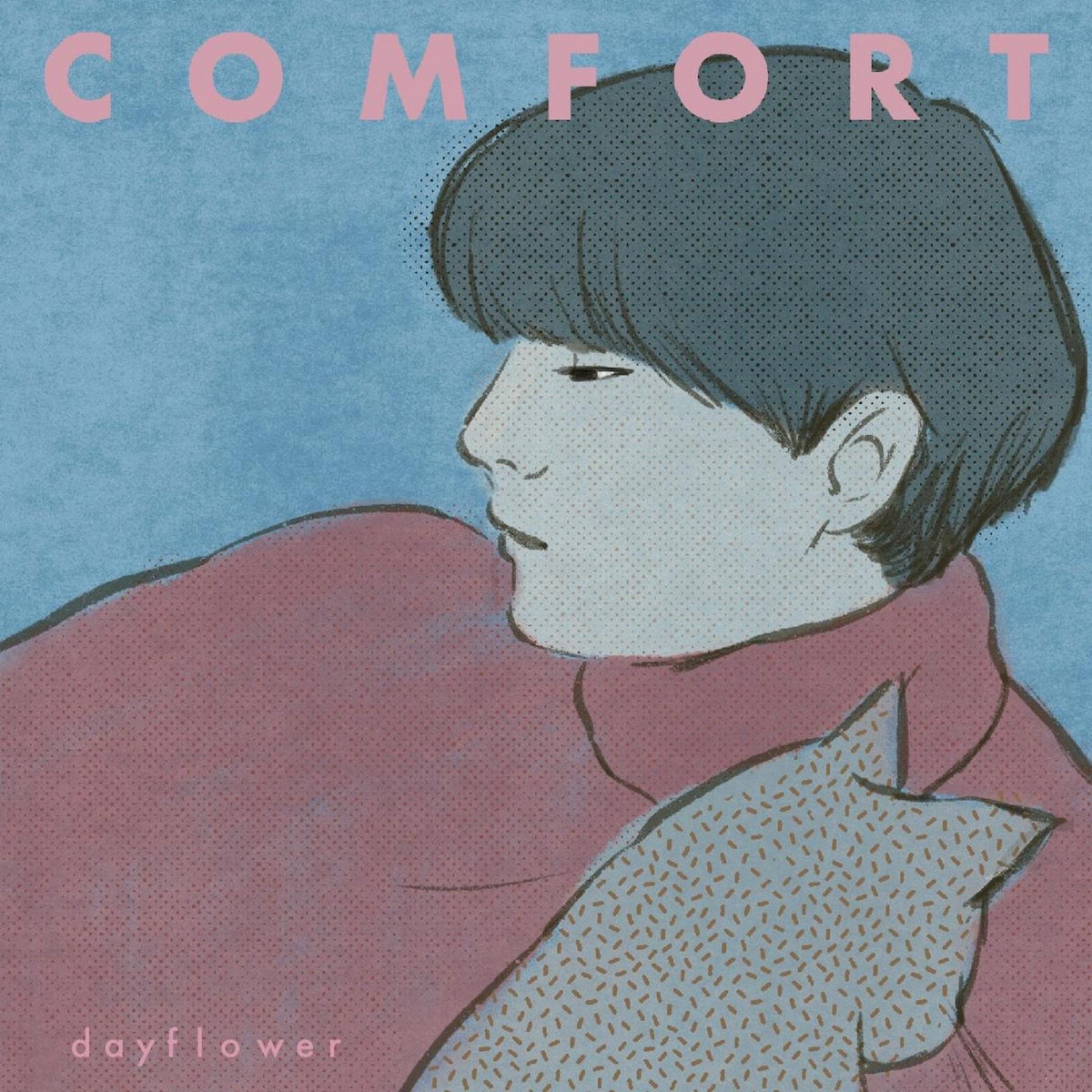
Soft radiance and careful construction define ‘COMFORT,’ the second full-length from Dayflower, yet what lingers most is not its atmosphere alone but the deliberation behind it. Written primarily by Alex Clemence and David Dhonau, with an expanded circle of collaborators shaping its edges, the record unfolds as a study in how intimacy can be composed, arranged, and gently destabilized without ever losing its emotional center.
“Young Sun” introduces that balance with deceptive ease. Clemence’s voice, soft but assured, moves within a lattice of guitar, synth, and beats co-constructed with Tom Young and subtly enhanced through additional production by Lakeem Rose. The track glows without excess brightness, its warmth tempered by a sense of distance, as though the song were being remembered even as it is heard. Johnny McJohnston’s contributions to the low-end and electronic framework deepen that impression, giving the piece a quiet dimensionality.
On “Crush,” the palette narrows but the emotional scope widens. Dhonau’s bass and piano create a grounded undercurrent while Mark Van Hoen’s production and synthesizer work introduce a faintly disorienting shimmer. Clemence’s vocal delivery remains understated, allowing small inflections to carry weight, while the arrangement resists any overt crescendo. The song’s power lies in its refusal to resolve, holding its central feeling in suspension.
“Secret Garden” shifts inward, guided by Euan Rodger’s nuanced percussion and the delicate interplay between guitar lines from Dhonau and Andy Wales. The track feels enclosed yet breathable, its sonic architecture shaped as much by what is withheld as by what is present. This sensitivity to space becomes more pronounced in “Heart Shaped Tambourines (Sunday version),” where Martha Bean’s additional vocals create a subtle dialogue within the song. Matt Flint’s drumming anchors the piece without ever imposing rigidity, allowing its textures to remain fluid.
“Satellite Underground” expands the album’s reach, with Leonie DuBarry-Gurr’s voices adding an almost spectral choral dimension. The production, again touched by Rose, introduces a broader sonic field, yet the track retains the album’s characteristic restraint. Rodger’s percussion moves with a quiet precision, while the interplay of synths and guitars suggests motion without urgency. “Twirlpro (Sunday version)” continues this sense of drift, its structure unfolding in gentle arcs. Contributions from Chris Merriman and Wales on guitar add subtle variations in tone, while Rodger’s drumming provides a soft but persistent pulse. The song feels less like a fixed composition and more like a pattern observed from multiple angles.
“Muji” pares things back, allowing Dhonau’s multi-instrumental presence (bass, synths, and understated rhythmic element), to take on a more central role. The track’s minimalism is not an absence of ideas but a concentration of them, each sound placed with care. This approach opens into “Sunny 19,” where DuBarry-Gurr’s piano, alongside the string textures of Beni Weedon and the unusual timbres of Adam Weikert’s bowed saw and ondes martenot, introduces a fragile luminosity. The arrangement feels almost orchestral in miniature, yet it never loses its intimacy.
“Lazy” leans into a slower, more grounded energy, with Simon Bland’s drumming providing a steady foundation. Guitar contributions from Merriman and Tom Trigg add subtle colorations, while Clemence’s vocal remains at the center, unforced and quietly expressive. The track exemplifies the album’s ability to sustain attention through nuance rather than dramatic shifts. “Mockingbird” closes the record with a sense of quiet openness. Flint’s production and rhythmic framing, combined with McJohnston’s synth and bass work, create a final space that feels both resolved and unresolved. The song does not seek closure in any conventional sense; instead, it allows the album’s themes to settle into a reflective equilibrium.
Across ‘COMFORT’ Clemence and Dhonau function as both architects and participants, their songwriting providing a cohesive thread while their collaborators enrich the surrounding landscape. Each musician (whether contributing a single element or shaping entire sections), feels integrated into the album’s internal logic. The production, distributed among several hands yet unified in intent, reinforces this cohesion, favoring clarity, warmth, and subtle transformation. What emerges is a record that understands softness not as fragility but as a deliberate stance. ‘COMFORT’ does not retreat from complexity; it reframes it, presenting layered emotions and intricate arrangements in forms that feel accessible without being simplistic. The album invites sustained listening, revealing its depth gradually, and in doing so, affirms Dayflower’s capacity to create music that is both immersive and quietly exacting.
Learn more by visiting Sunday Records and Bandcamp.