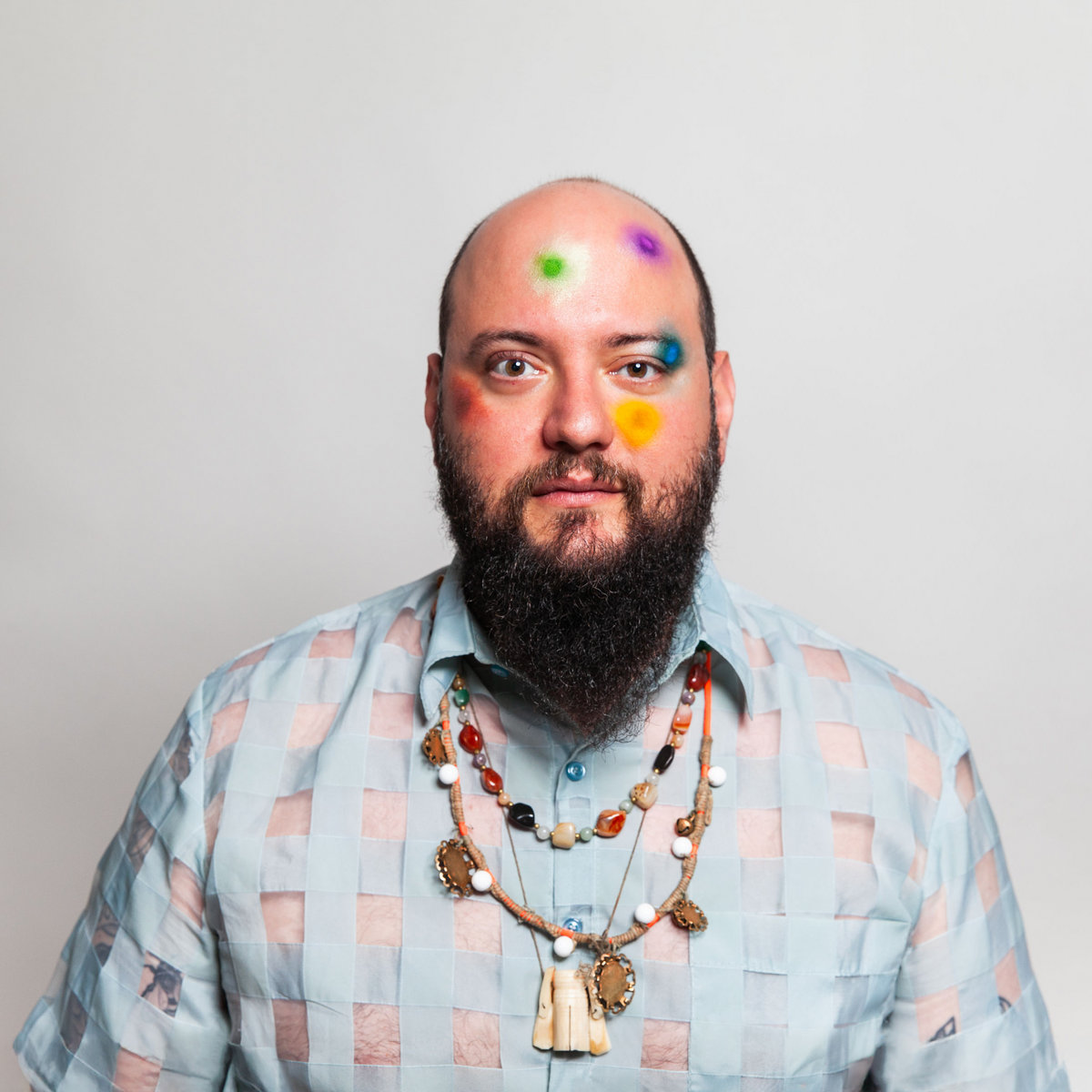
Chad Kouri’s ‘Mixed’ is an album built from contradiction: discipline and spontaneity, inheritance and invention, ritual and experimentation, private reflection and communal exchange. It is also a record about listening as a form of making. Across nine compositions assembled from recordings made between 2021 and 2024, Kouri treats the saxophone, synthesizer, percussion, found objects, room noise, field recordings, and electronically altered sounds not as separate categories but as parts of one expansive vocabulary. The music feels carefully considered without sounding overdetermined, as though every sound has been given permission to exist on its own terms.
That quality is apparent from “How Who Hum Chant,” the opening piece, recorded on a Zoom H6 at a dining room table in an apartment in Lakeside, Michigan. Kouri plays Korg Monologue, voice, and effects, producing a small, intimate composition that seems to hover between incantation and electronic sketch. Its modest circumstances are important. ‘Mixed’ does not depend upon elaborate studio machinery to establish authority. Instead, Kouri demonstrates how a limited environment can become creatively fertile when approached with sufficient attention.
“KHFHH” expands the palette dramatically. Kouri plays tenor saxophone and five-gallon water bottle, joined by Andy Hall on drums, Alex Fuller on guitar, Rod Hunting on bass, and John Hall on handmade chimes. The resulting combination captures one of the album’s defining principles: unconventional sounds need not be presented as curiosities. The water bottle belongs to the same musical world as the guitar and bass because Kouri treats timbre itself as an organizing force. The piece has the energy of a spontaneous ensemble encounter, but there is an unmistakable sense of mutual responsiveness beneath its looseness. “Torus” narrows the focus again. Kouri’s tenor saxophone interacts with brass Torus Rings designed and fabricated by Doug Fogelson, creating a composition in which the distinction between instrument and object becomes pleasantly unstable. The sound has a physical resonance without becoming demonstrative. Kouri’s improvisational language is less concerned with displaying technique than with discovering what a particular combination of materials might reveal. His saxophone can be melodic, breathy, abrasive, or almost architectural, depending upon the surrounding sonic environment.
That curiosity extends into “Drift,” recorded at a lodge on the Brazos Cliffs in New Mexico. Kouri combines Korg Minilogue, tenor saxophone, a hand-carved bone rattle necklace, and effects, with Tom Melk contributing Korg Modwave. The title captures the piece’s sense of suspended movement. Electronic tones and acoustic sounds occupy the same space without being forced into conventional rhythmic alignment. The music seems to float between categories, but its freedom is grounded by Kouri’s unusually strong sense of proportion.
“Little Instruments,” featuring veteran Chicago drummer and mentor Vincent Davis, may provide the clearest expression of Kouri’s belief in sound as a communal practice. Kouri plays hand chimes, bell cords, and assorted little instruments, while Davis contributes little instruments, his vinnyophone, and drum set. Recorded live during an exhibition and community program, the piece carries the atmosphere of people making discoveries together. Davis’s presence is particularly meaningful given his history within Chicago’s creative music tradition. His playing does not overwhelm Kouri’s exploratory approach; instead, the two seem to create a conversation in which percussion becomes a form of language.
The album’s relationship to visual art is central to understanding this sensibility. Kouri spent many years developing a practice focused on color, abstraction, community work, and exhibition-making before devoting himself more intensely to music. On ‘Mixed’, those disciplines do not sit separately. The compositions behave almost like sonic abstractions, with color replaced by timbre and shape translated into duration, repetition, density, and resonance. Kouri appears less interested in illustrating visual ideas than in discovering equivalent methods of perception through sound. “Sound Sketch” reinforces that impression. Recorded during a performance for students of the Siena Jazz – Accademia Nazionale del Jazz in Italy followed by an open jam with students and faculty, it places Kouri’s tenor saxophone and little instruments alongside effects. The piece retains the provisional quality implied by its title, but provisional does not mean unfinished. Kouri has developed a convincing aesthetic around fragments and fleeting observations, recognizing that an improvisation can communicate something complete without pretending to be definitive.
“A Dance for Grounding” brings the record back into a public performance context. Kouri’s tenor saxophone, bell cords, hand chimes, and effects create a piece that suggests ritual without imitating any particular ceremonial tradition. That distinction matters. Kouri’s interest in spirituality and ancestry is not expressed through borrowed symbols or easy exoticism. Instead, he searches for a personal musical language capable of acknowledging those dimensions of identity while remaining open to uncertainty. The music feels devotional without prescribing what devotion should mean. “Rhythm Meditation” takes that premise even further. Made during a public performance at Chicago’s Living Water Tea House, it relies on little instruments, bell cords, hand chimes, and effects rather than a conventional harmonic framework. Rhythm becomes less a means of propulsion than a means of attention. Repetition creates an environment in which the listener can notice minute changes, and the music’s restraint becomes a source of concentration.
The closing “Detroit” adds Matthew Daher on drums to Kouri’s Korg Monologue, tenor saxophone, and effects. Recorded at Spread Art during an impromptu meeting, it provides an apt ending because it combines several of the album’s fundamental characteristics: improvisation, electronic experimentation, percussion, place, and human exchange. The title grounds the music geographically even as the sounds themselves remain open-ended. ‘Mixed’ is continually concerned with where music happens, who participates, and what circumstances can produce an unexpected creative connection. Kouri’s artistic history gives the album an unusual depth. Nearly two decades spent attending performances, participating in non-performing ensembles, experimenting with guitar, bass, homemade instruments and hand percussion, and absorbing Chicago’s extraordinary creative-music culture have clearly shaped his approach. So have his conversations with Douglas R. Ewart and his study of saxophone technique with Isaiah Collier. Yet ‘Mixed’ never feels like an academic summation of those influences. Kouri has absorbed them sufficiently to transform them.
That transformation is perhaps the album’s most compelling achievement. The record does not treat ancestry, mixed identity, improvisation, visual art, spirituality, and community as separate subjects. They become interconnected aspects of a single artistic philosophy: identity is not a fixed object but an accumulation of voices, experiences, materials, places, and relationships. Kouri’s mixed-ness is therefore not merely biographical. It becomes a compositional strategy. The recording’s varied origins are equally important. Some were made with professional engineering, others on an iPhone or portable recorder, and several emerged from public performances or spontaneous encounters. Rather than smoothing those differences into uniformity, Kouri allows the changing circumstances to remain part of the album’s character. The record becomes an archive of attention, documenting not just compositions but situations in which music became possible.
‘Mixed’ is generous music. Its experiments never feel like barriers erected between artist and audience. Kouri invites the listener into a world where a water bottle can become percussion, where a bell cord can carry as much expressive weight as a saxophone, and where a public gathering can become a composition. His work suggests that creative practice does not have to separate the sacred from the ordinary, sophistication from play, or personal history from collective experience. Across “How Who Hum Chant,” “Little Instruments,” “A Dance for Grounding,” “Rhythm Meditation,” and the rest, Kouri offers a vision of music as an abundant, living field in which disparate elements can coexist without surrendering their individuality. ‘Mixed’ is not simply a debut full-length; it is a thoughtful argument for curiosity itself as a way of living.
Learn more links:
Chad Kouri
Bandcamp
Tumblr
Instagram