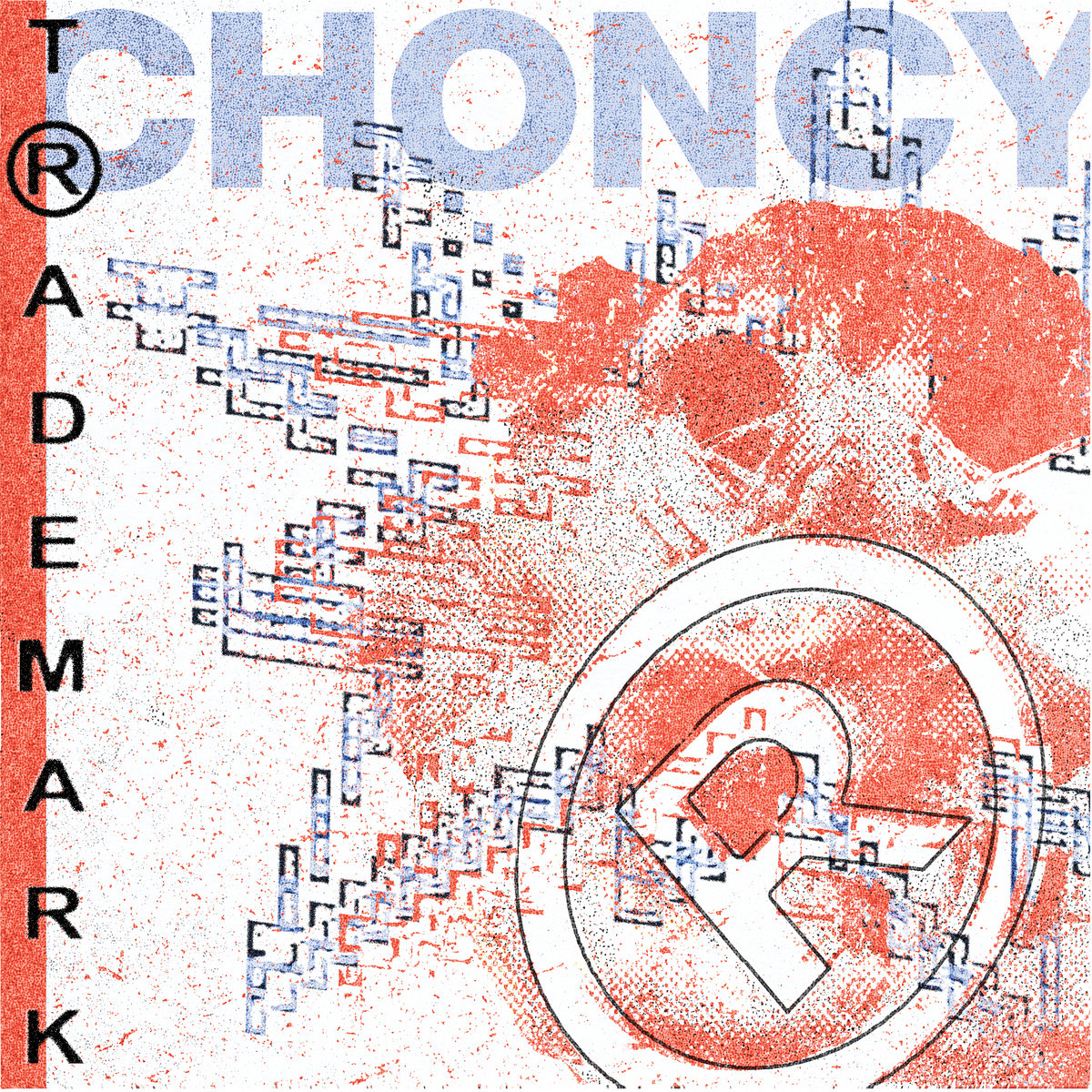
Authorship sits at the core of ‘Trademark,’ not as a legal question but as an artistic provocation. Choncy’s third LP circles the idea of ownership in punk, of sound, gesture, even attitude, and proceeds to dismantle it in real time. Across ten tightly wound tracks, the Cincinnati quartet resists settling into any single lineage, instead pulling fragments from decades of alternative music and forcing them into uneasy coexistence. What emerges is not a pastiche but a deliberate destabilization of familiarity, a record that treats genre less as inheritance and more as material to be bent, warped, and occasionally mocked.
“Scroller” opens with a sense of forward motion that feels deceptively straightforward, Liam Shaw’s rhythm guitar setting a brisk pace while Joe Carpenter’s drumming locks into a pattern that seems almost conventional. That stability quickly gives way to subtle disruptions: Simon Schadler’s lead guitar cuts across the arrangement at oblique angles, while Nathan McVeigh’s bass refuses to sit comfortably in the mix, nudging the song off balance without derailing it. Shaw’s vocal delivery threads through this shifting ground with a detached urgency, framing the track as both entry point and warning. “Dressing the Part” leans further into the band’s fascination with performance as identity. The interplay between Shaw and McVeigh’s vocals introduces a fractured perspective, as if the song itself cannot decide which voice to trust. Carpenter’s drumming becomes more elastic here, stretching and contracting in response to the guitars’ increasingly erratic phrasing. The result is a piece that interrogates its own construction, exposing the seams rather than concealing them.
Brevity sharpens the impact of “Just Like Them,” a track that compresses its ideas into a minute and a half without sacrificing complexity. Schadler’s guitar work is particularly striking, veering between abrasive bursts and fleeting melodic fragments, while McVeigh’s bass provides a counterweight that keeps the song from collapsing under its own volatility. Shaw’s vocal performance adopts a more pointed tone, engaging directly with the anxieties of imitation and assimilation that underpin the record. “A Dogs Best Man” expands the scope, allowing the band to explore a more layered dynamic. Carpenter’s drumming shifts into a more measured approach, creating space for the guitars to interact in less predictable ways. The track’s structure feels deliberately unstable, its sections colliding rather than transitioning smoothly, yet the band’s collective precision ensures that each shift lands with purpose.
“Bypass” introduces a sharper rhythmic focus, its propulsion driven by the tight interplay between McVeigh and Carpenter. The guitars here operate less as competing forces and more as interlocking components, their lines weaving together in patterns that feel both intricate and slightly off-kilter. Shaw’s vocals hover just above the fray, maintaining a sense of control amid the controlled disorder. “Trademark” arrives as a brief but pointed statement, distilling the album’s central concerns into under a minute. Its concision functions as commentary, suggesting that the idea of a fixed signature is inherently unstable, something that can be asserted and dismantled in the same breath.
“Contact” reintroduces a sense of momentum, though it is constantly undercut by abrupt shifts in direction. Schadler’s lead guitar takes on a more prominent role, carving out space within the arrangement while McVeigh’s bass anchors the piece with a steady, insistent presence. The track feels like a negotiation between cohesion and fragmentation, never fully committing to either.“Seatbelt” plays with restraint, its relative simplicity serving as a counterpoint to the surrounding tracks. Carpenter’s drumming is particularly effective here, maintaining a steady pulse that allows the other elements to explore more subtle variations. The song’s economy highlights the band’s ability to achieve impact without excess.
“Version of a Version” turns inward, its title reflecting a recursive approach to composition. The band revisits familiar motifs only to distort them, creating a sense of déjà vu that is both intentional and disorienting. Shaw and McVeigh’s vocal interplay becomes more introspective, suggesting a self-awareness that borders on critique. Closing track “Finance” extends the album’s thematic concerns into a broader context, its longer runtime allowing for a more expansive exploration of structure and tone. The rhythm section remains tightly coordinated, providing a foundation for the guitars to push further into abstraction. The song builds not toward resolution but toward a kind of sustained ambiguity, leaving its central questions deliberately unanswered.
Recorded across disparate spaces in Cincinnati and Brooklyn, then unified through McVeigh’s mix and Collin Weiland’s mastering, ‘Trademark’ carries the imprint of distance without sounding fragmented. Instead, that separation seems to have sharpened the band’s focus, each member contributing with a heightened sense of intent. Shaw’s vocals and rhythm guitar provide a connective thread, while Schadler’s lead work introduces a constant element of unpredictability. McVeigh and Carpenter, meanwhile, form a rhythm section that is both disciplined and adaptable, capable of grounding even the most wayward passages. Choncy approach punk not as a fixed tradition but as an open question, one that ‘Trademark’ refuses to answer definitively. By dismantling the idea of a singular voice or style, the band arrives at something more fluid, more elusive, and ultimately more compelling.
Visit Bandcamp | Feel It Records | YouTube | Instagram.