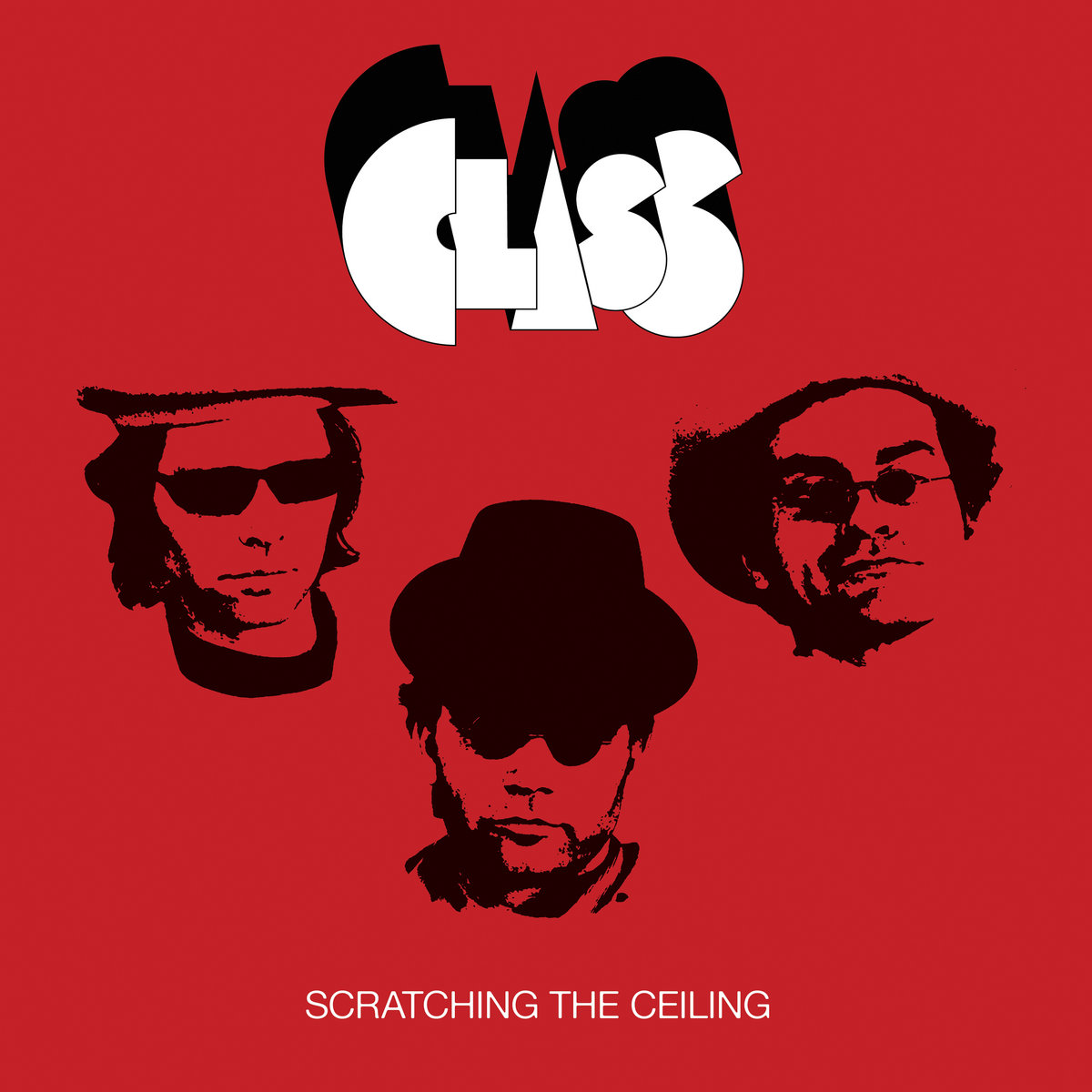
Five days. That is all the time CLASS spent in a Tucson studio to capture ten songs, and the urgency of a compressed schedule is audible in every bar. Nothing on ‘Scratching The Ceiling’ has been fussed over, polished into politeness, or left to marinate. It sounds like a band that booked a room, plugged in, and got on with it.
The trio is Andy Puig, Erik Meyer and Martin Meyer, and the bond between the Meyer brothers sits at the center of the music. Lineup changes and long-distance moves could have scattered a lesser band, but these three got back together at Midtown Island Studios in late January and the first days of February 2026. Matt Rendon engineered and shared the mixing with the band. Mikey Young handled mastering, and anyone who loves lo-fi punk that still hits like a truck will know his touch: everything comes out loud and clear, with the rough edges left on. Puig and Erik Meyer play guitar, Erik takes the bass chair on every song but one, Puig covers bass on “Blister Point,” and Martin plays the drums with the loose-limbed fury of someone who has been waiting years for a reason to hit things.
Two guitars, or a guitar and a bass, set against a single drummer makes for a lean, forward sound. There’s nowhere to hide. Every riff must justify itself, every fill must land, and the Meyers’ sibling telepathy turns that exposure into an advantage. Martin’s drumming does not simply keep time. It chases the guitars, trips over them, scrambles back up and keeps going, like a younger brother who won’t be left behind.
“Distort the Truth” opens the record, and the title doubles as a mission statement. The song acts accordingly, lurching into view on fuzzed-out guitars and a snarl it doesn’t apologize for. Puig’s voice, shouted more than sung, sits right at the edge of control, the sound of someone who has swallowed the evening news and decided to spit it back. “Are You Feeling Okay?” follows with a question that sounds tender until the music turns it into something closer to an accusation. The song’s lyric imagery, as the band presents it, points toward people standing close together on the street, a picture of solidarity edged with real fear, and the playing carries that mixed charge: warm in its melody, jittery in its pulse.
“Animal” strips the sound down further, and the title suggests exactly what it delivers, instinct without apology. “Coward Age” is the sort of name that stings, and the track delivers on the insult, a quick, bitter swipe at a generation that has learned to hedge every statement and apologize for every opinion. The riffs have a nervy, circling quality, like someone pacing a small room. “Blister Point,” where Puig moves to bass, is a knockout, the one track where the band’s low end shifts perspective, and the change in feel is subtle but distinct. Everything tightens, everything sharpens, and the song seems to be the record’s finest balance of melody and menace.
Then comes the shortest stretch of the album, and its most direct. “Take Me With You” runs under three minutes, and the title sounds like a plea thrown over the shoulder at a departing friend. The brevity makes it hit harder. No bridge, no wandering, just a clean burst of feeling and out. “Every Day NME” plays with spelling in a way that suggests a pun on enemy, and the music matches that sideways humor, a skittering, caffeinated rhythm that never quite settles. “Evacuation Zone” feels like the sound of a siren heard from the wrong side of a barricade, urgent and a little breathless, a clear highlight in a record full of them.
“Trouble in the Neighborhood” is where the record’s concerns come home. The previous songs shout at the abstract, society, culture, the machine, but this one narrows the lens to a street, a block, a set of people living side by side with problems they cannot ignore. It makes the album’s political anger feel less like a slogan and more like a neighbor knocking on the door. The finale, “Into the Night,” slows a little and sinks into a darker mood, a fitting way to end a record that spends most of its length running as fast as its legs will go. It doesn’t resolve anything, and that’s exactly right. A band documenting unrest has no business pretending the unrest is over.
For fans of fast, scrappy, riff-driven punk, there’s plenty here to love, especially the way these players keep melody alive under all the noise. A hook surfaces every few bars, half-buried but unmistakable. That balance is the album’s biggest strength. Fury without craft turns to static, and CLASS never lets the volume swallow the songwriting. ‘Scratching The Ceiling’ sounds like three people in a room refusing to stay polite about the state of things. It’s loud, sweaty and short on patience, and under the snarl it’s oddly hopeful. Anger with a good tune attached can still be a form of care, and this album has plenty of both.
Learn more links:
Feel It Records
Bandcamp
Instagram