
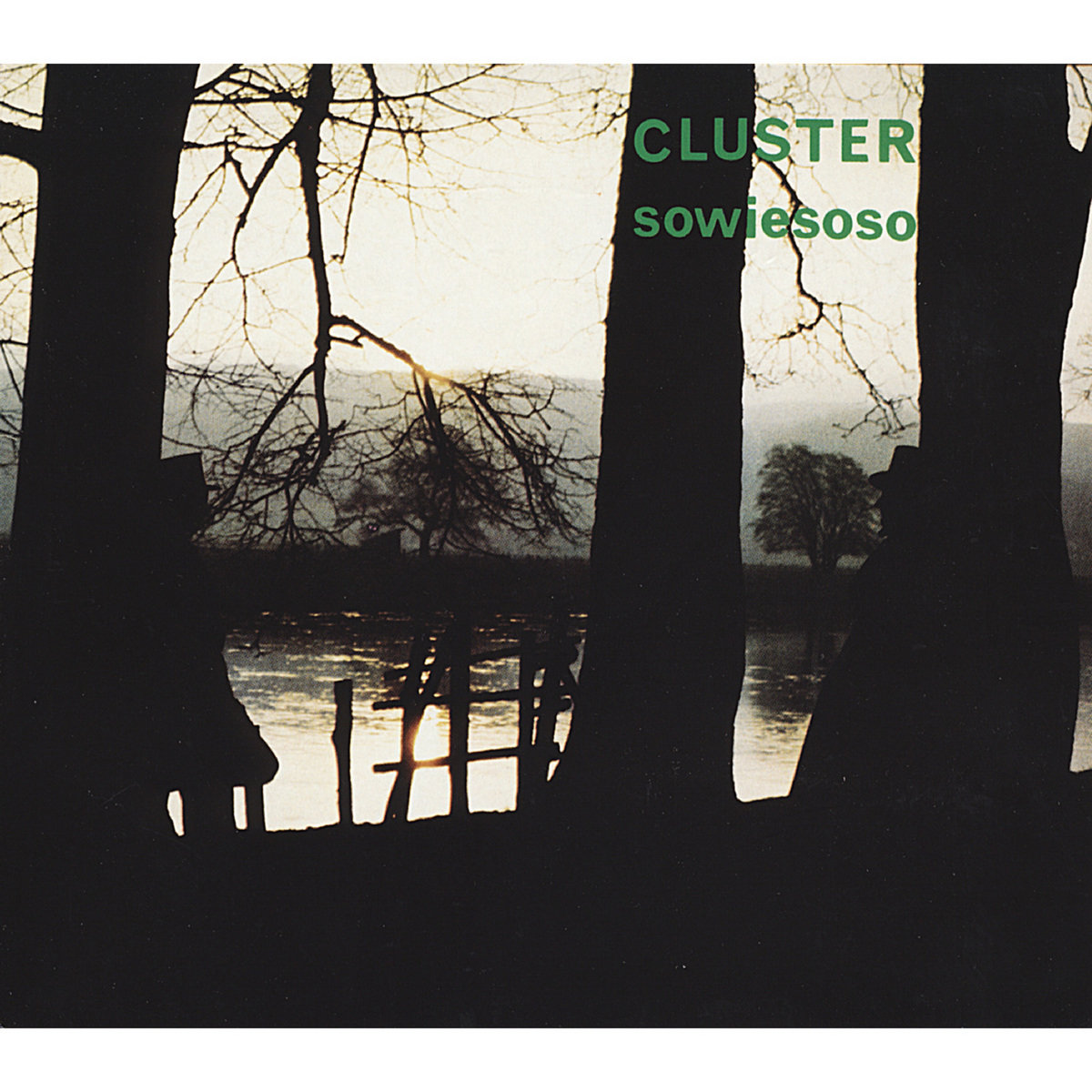
Half a century after its original release, Cluster’s ’Sowiesoso (50th Anniversary Edition)’ still sounds uncannily detached from linear time. Hans-Joachim Roedelius and Dieter Moebius created music that refused both the confrontational severity of early industrial electronics and the polished futurism that would soon dominate much European synthesizer music. Instead, ’Sowiesoso’ inhabits a quieter and more elusive space: pastoral but not nostalgic, electronic yet unmistakably human, minimalist without coldness. The album remains one of the clearest demonstrations that repetition can generate emotional complexity rather than mechanical rigidity.
What distinguishes this record from so many experimental electronic works of the 1970s is its extraordinary modesty. Roedelius and Moebius reduce their musical vocabulary to deceptively simple gestures such as looping keyboard phrases, skeletal rhythms, softly mutating harmonies yet each element carries immense emotional precision. Recorded in a rural environment far removed from urban modernist mythology, the album rejects the image of technology as domination. These synthesizers do not conquer nature; they coexist with it. The music seems shaped by weather patterns, changing light, and drifting thought rather than strict compositional architecture.
The title track, “Sowiesoso,” establishes the album’s philosophical temperament immediately. The phrase itself loosely implies inevitability or acceptance, and the music reflects that state of mind beautifully. Roedelius’ melodic instincts give the piece its fragile warmth while Moebius introduces subtle rhythmic instability beneath the surface. The repetition never behaves like a locked sequence. Instead, the composition gently sways, as though reconsidering itself in real time. Listening to it now, one hears the blueprint for entire strains of ambient techno and minimal electronica, yet the piece possesses an emotional openness many later imitators failed to capture.
“Halwa” drifts further into dreamlike territory. The melodic phrasing evokes distant folk traditions without directly quoting any identifiable source, creating a peculiar sensation of cultural memory detached from geography. Moebius and Roedelius treat melody not as narrative but as atmosphere. The tones shimmer with childlike wonder while maintaining an undercurrent of melancholy. Unlike the rigid precision associated with contemporaries such as Kraftwerk, Cluster embrace irregularity. Their electronic textures wobble slightly, revealing human presence inside the circuitry.
“Dem Wanderer” suggests wandering, and the music embodies movement without destination. Roedelius’ keyboard figures circle patiently while Moebius shapes subtle shifts in texture and pulse. What makes the track remarkable is its emotional ambiguity. It sounds serene but never complacent, reflective yet never mournful. The piece captures the psychological state of solitary travel: the strange calm that emerges when one stops expecting arrival. “Umleitung” introduces a playful quality often overlooked in discussions of experimental electronic music. The title translates roughly as detour, and the composition behaves accordingly, darting unexpectedly between rhythmic ideas and melodic fragments. Moebius, especially, demonstrates his gift for disrupting predictability without collapsing coherence. The rhythm carries a whimsical looseness that prevents the music from becoming overly meditative. One can hear echoes of this sensibility decades later in the more playful corners of IDM and ambient house, though few later artists managed Cluster’s balance between spontaneity and restraint.
“Zum Wohl” strips the music down even further. The piece functions almost like environmental architecture rather than conventional composition. Sparse harmonic patterns drift through open sonic space while subtle tonal variations create the sensation of gradual transformation. Roedelius and Moebius understand silence as an active component of composition. Every pause matters. Every sustained tone acquires emotional resonance through placement rather than complexity. “Es War Einmal” carries one of the album’s most evocative titles (“Once Upon A Time”), yet the track resists narrative nostalgia entirely. Instead, it explores memory as atmosphere. The synthesizers glow softly without becoming sentimental, while the pacing suggests contemplation rather than storytelling. Roedelius’ melodic phrasing here is especially striking. His lines seem to emerge instinctively rather than analytically, preserving a fragile immediacy that many electronic musicians lose through over-construction.
Closing piece “In Ewigkeit” expands toward something almost cosmic. The title translates as “for eternity,” and the composition achieves a rare sense of temporal suspension. The melodic cycles move so patiently that conventional notions of progression begin to dissolve. Ambient music would later adopt this strategy frequently, but Cluster approach it with greater emotional nuance than many of their successors. The track neither demands attention nor disappears into background functionality. Instead, it alters the listener’s perception of duration itself. Part of the enduring power of ’Sowiesoso’ lies in how radically it redefined electronic intimacy. During the 1970s, synthesizer music often positioned itself either as avant-garde provocation or futuristic spectacle. Roedelius and Moebius pursued something quieter and far stranger. Their electronics possess vulnerability. The tones flutter imperfectly, rhythms drift slightly off-center, and melodies linger with tentative delicacy. Rather than aspiring toward machine perfection, Cluster emphasize fragility and incompletion.
The 50th anniversary edition highlights just how sophisticated these recordings were despite their apparent simplicity. The remastered sound reveals subtle details in the harmonic layering and spatial placement, allowing listeners to appreciate the duo’s extraordinary sensitivity to texture and pacing. Yet the album’s true achievement remains conceptual rather than technical. Roedelius and Moebius discovered a way to make electronic music feel pastoral without romanticizing nature, experimental without alienating the listener, repetitive without monotony. Many foundational electronic records now sound historically significant more than emotionally immediate. ’Sowiesoso’ avoids that fate because its central concerns remain timeless: solitude, reflection, movement, impermanence. The album does not announce itself with grandeur. It speaks quietly, patiently, almost modestly. Fifty years later, that restraint continues to feel radical.
Releases June 12, 2026
Find out more by visiting Tapete Records | Bandcamp | Facebook