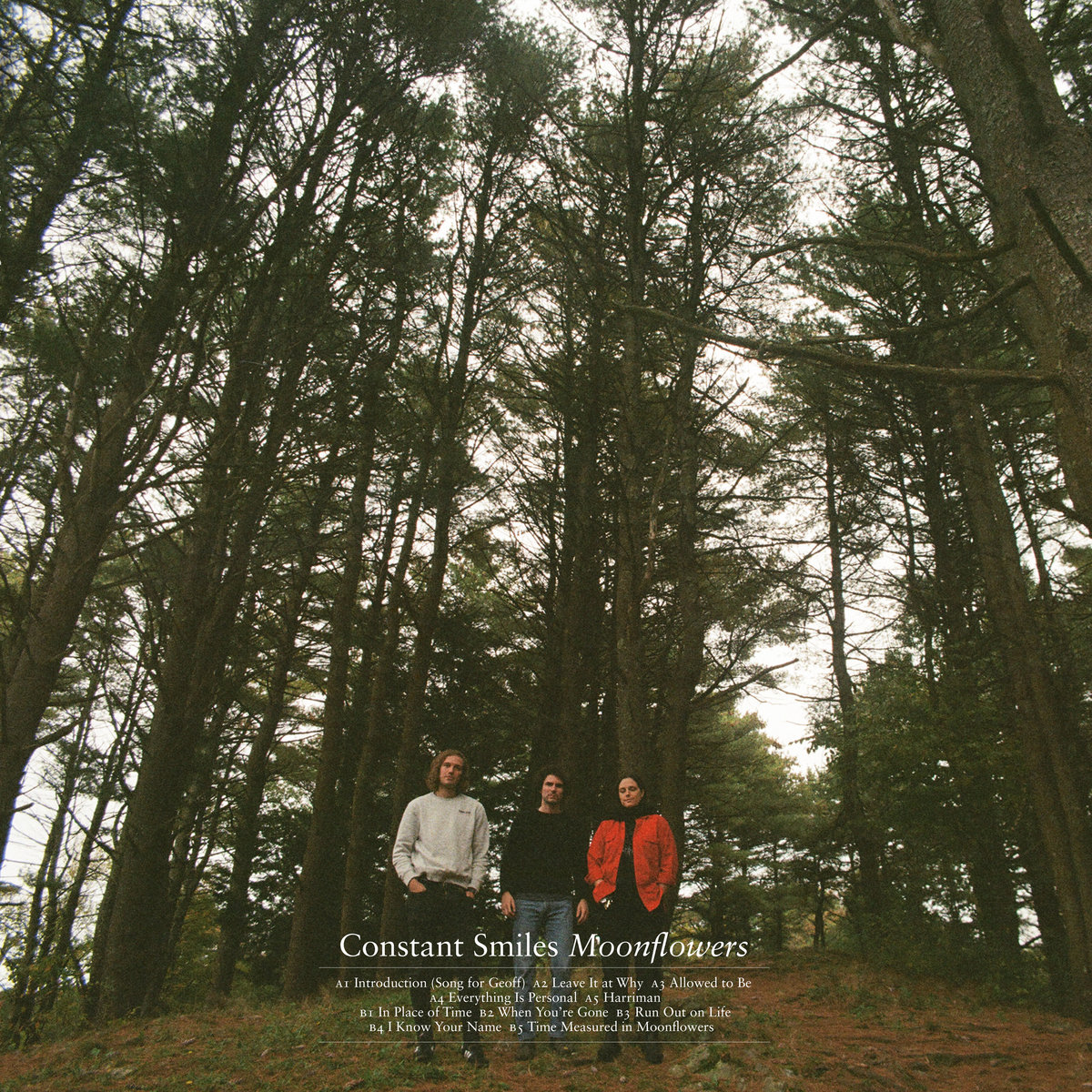
There is a particular hush that falls just after dusk, when color drains from the sky but detail sharpens in unexpected ways. ‘Moonflowers,’ the Felte debut from Constant Smiles, occupies that liminal register. It is an album that feels less like a statement than a slow unfurling, the culmination of years spent shapeshifting in the margins. What once registered as volatility in the band’s catalog now resolves into intention. The restless experimentation that defined their early years has not been abandoned; it has been distilled.
“Introduction (Song For Geoff)” leads the way as a brief instrumental invocation that sets the tone with a kind of suspended tenderness. Noa Maxner’s cello draws a low horizon line beneath gently diffused textures, suggesting both grounding and drift. It feels like stepping into a room where the lights have already been dimmed, where something intimate is about to be shared. “Leave It at Why” follows with a patient pulse, Eri King’s synth threading through the arrangement like a question that never quite demands an answer. Ben Jones’ songwriting has often circled uncertainty, but here the ambiguity feels less anxious than accepting. The trio’s chemistry with Jones alongside drummer/vocalist Nora Knight and bassist Spike Currier, anchors the song in restraint. Currier’s basslines do not so much drive as breathe, while Knight’s drumming favors soft insistence over propulsion.
On “Allowed to Be,” one of the album’s emotional centers, the band achieves a delicate architecture of release. Emma Conley and Jen Ho’s violins hover at the edges before folding into the song’s widening chorus. Leon Johnson’s piano adds a faint gleam, and Shahzad Ismaily’s textural synth and guitar work subtly blur the boundaries between organic and electronic sound. The track’s gradual bloom mirrors its theme of self-permission; it does not erupt so much as exhale. The Atmos mix by Jonathan Low heightens this sense of dimensionality, allowing the song’s soft-touch cymbals and layered harmonies to feel almost tactile. “Everything Is Personal” introduces a more direct lyrical candor, bolstered by Adam Lipsky’s piano and synth and the spectral guitar and synth contributions of Fred Thomas. Frances Rae-Christine’s backing vocals ghost around Knight’s delivery, turning the song into a communal confession. There is a quiet bravery in the way the band allows space to do the emotional heavy lifting.
Knight steps fully into authorship on “Harriman,” the only track here she wrote alone. It begins as a pastoral meditation with an acoustic guitar and spare piano figures before gradually accumulating orchestral detail. Ismaily’s guitar textures and Wednesday Knudsen’s saxophone deepen the palette, while the rhythm section maintains an almost devotional steadiness. The transformation is so subtle that by the time the song crests, it feels as though you have been lifted without noticing the ascent. “In Place of Time” and “When You’re Gone” continue the album’s exploration of absence and presence as intertwined states. On “In Place of Time,” Lipsky’s keys shimmer against Currier’s grounded bass, while “When You’re Gone” leans into negative space, letting the silence between notes articulate longing more eloquently than any crescendo could. The production preserves an intimacy that never collapses into fragility; each instrument feels placed by hand, yet nothing sounds labored.
“Run Out on Life” carries a faint undercurrent of unease, its melodic sweetness offset by harmonic shadows. “I Know Your Name” introduces Adam Howell’s acoustic guitar alongside Jen Ho’s violin, weaving a fragile lattice around Jones’ vocal. Ismaily’s contributions here, as throughout the album, are less about flourish than atmosphere; his synths and guitars act like weather systems passing through the songs.
The closing track, “Time Measured in Moonflowers,” gathers the album’s motifs into a final, luminous meditation. Cassandra Jenkins’ duet vocal adds a new hue to the band’s sound, her voice intertwining with Knight’s in a way that suggests shared memory rather than simple harmony. P.G. Six’s harp glints softly in the background, while Steven R. Smith’s guitar and hurdy gurdy lend an archaic texture that stretches the song beyond the present tense. The result is not a grand finale but a gentle illumination, as though the night-blooming flower of the album’s title has finally opened.
Throughout ‘Moonflowers,’ the expanded cast (Mike Mackey’s live guitar presence, Emma Young’s lyrical collaboration, producers Chris Liberato and Gloria de Oliveira, and Weinrobe’s own synth contributions), serves the core trio’s vision without obscuring it. The record was written on the move, shaped by tours and in-between spaces, and that sense of transit lingers. These songs feel like they are always arriving somewhere just as they are leaving.
What distinguishes this album from the band’s earlier, more mercurial releases is not merely cohesion but clarity. The emotions that once flickered behind gauze now stand in soft focus, neither overstated nor withheld. ‘Moonflowers’ suggests that growth does not always announce itself with spectacle. Sometimes it happens in the dark, quietly and persistently, until one evening you look out and see that something has opened that was not there before.
Find out more by visiting Bandcamp | Constant Smiles | Felte.