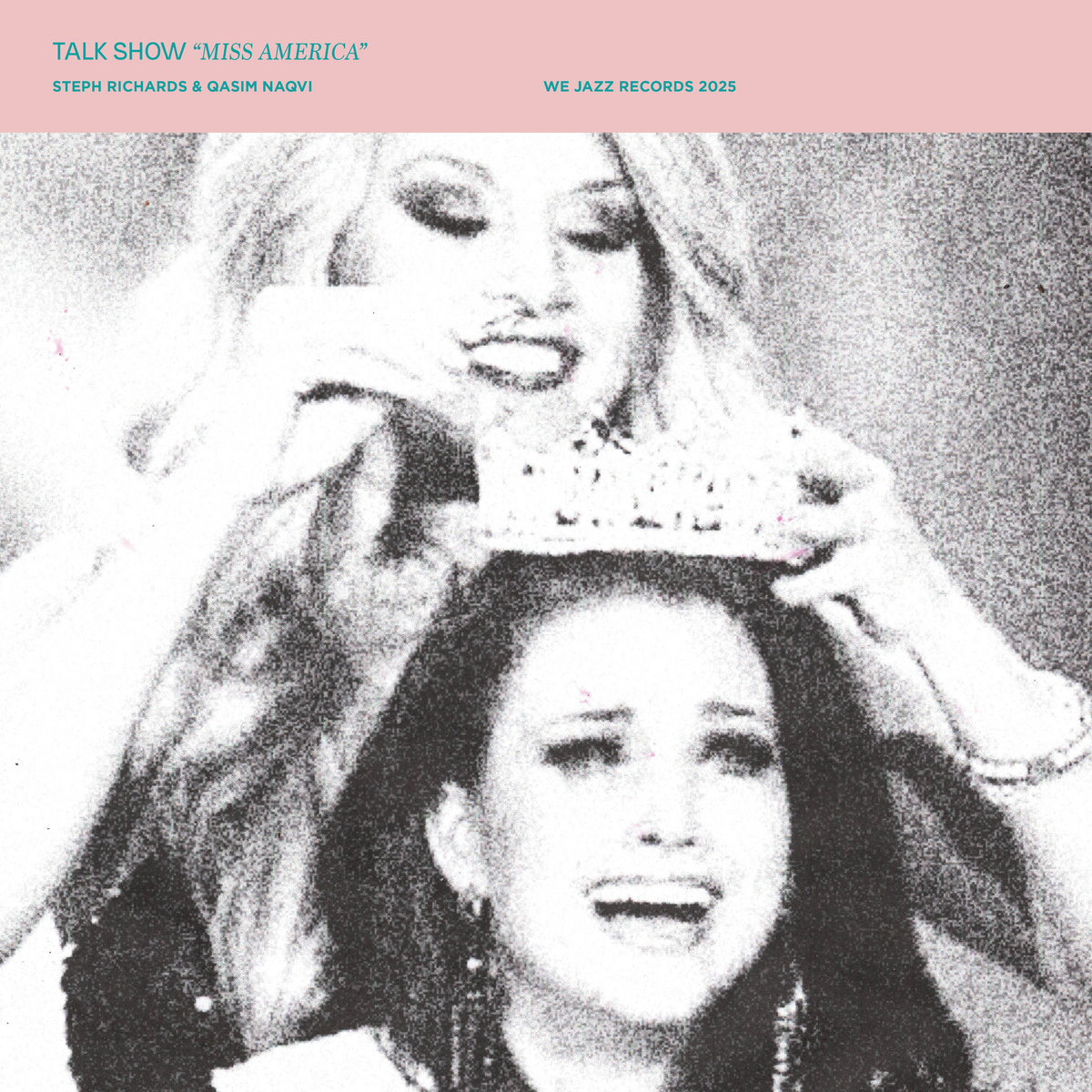
There is a peculiar kind of intimacy that emerges when two musicians strip away mediation and commit fully to the volatility of real-time creation. On ‘Miss America,’ Steph Richards and Qasim Naqvi (working together as Talk Show), construct a sonic environment that feels at once confrontational and strangely seductive, a space where acoustic sound behaves as though it were electronically conjured, and where performance carries the heightened logic of theater without ever abandoning its musical core.
The opening piece, “Royalties,” wastes no time in destabilizing expectation. Richards’ trumpet does not announce itself in any traditional sense; instead, it flickers into being through sympathetic vibrations and resonant surfaces, sounding less like a brass instrument and more like an event unfolding within a chamber of echoes. Naqvi, moving between drum kit, almglocken, and modular synthesizer, creates a shifting architecture that resists fixed hierarchy. His electronics do not sit atop the acoustic field but seem to grow out of it, as though the physical gestures of percussion were being translated into electrical impulses in real time. The result is a music that feels simultaneously grounded and dislocated, its logic unfolding in layers that never fully settle.
“Mom’s Night Out” introduces a different kind of volatility, one that leans into the duo’s shared history in performance art. There is an undercurrent of theatrical exaggeration here, but it is rendered through sound alone. Richards manipulates air, metal, and water to produce tones that hover between the familiar and the unplaceable, while Naqvi’s rhythmic interventions suggest patterns that almost cohere before dissolving again. The piece carries a subtle sense of narrative without ever committing to one, as if hinting at a scenario that remains just out of reach.
The title track, “Miss America,” stands as the album’s conceptual and emotional center. Here, the duo’s fascination with the grotesque and the performative comes into sharper focus. Richards’ flugelhorn lines, warped through resonant surfaces, take on a vocal quality that feels both intimate and estranged, while Naqvi’s modular synthesis introduces a spectral dimension that blurs the boundary between human gesture and machine response. The music seems to interrogate the idea of presentation itself; what it means to be seen, to be staged, to be consumed without resorting to overt symbolism. Instead, these themes are embedded in the very behavior of the sound.
On “Soft As A Rock,” the album reaches a kind of paradoxical stillness. The title suggests contradiction, and the music follows suit: textures that appear delicate reveal an underlying density, while seemingly solid structures dissolve under close listening. Naqvi’s control of dynamics is particularly striking here, allowing silence and near-silence to function as active components rather than absences. Richards, in turn, explores the threshold where tone becomes texture, her playing less about articulation than about the shaping of resonance over time.
The closing piece, “Death Bed,” does not offer resolution so much as a distillation of the album’s central concerns. There is a sense of culmination, but it is achieved through reduction rather than expansion. The duo pares their language down to its essentials, exposing the raw interactions between breath, strike, and signal. The live recording context becomes especially palpable here; one can almost feel the air in the room, the immediacy of decision-making, the irreversibility of each gesture.
What makes ‘Miss America’ so compelling is the way it collapses distinctions that are often treated as foundational: acoustic versus electronic, composition versus improvisation, music versus performance art. Richards and Naqvi do not merely blur these categories; they render them irrelevant, replacing them with a fluid continuum in which sound is both material and metaphor. Their long history of collaboration is evident in the precision of their interplay, but equally in their willingness to leave space for unpredictability, to allow the music to exceed their own intentions.
As individual performers, Richards and Naqvi bring formidable experience to the project; her work spanning experimental composition and multimedia performance, his encompassing decades within improvised music and beyond. Yet ‘Miss America’ does not feel like the sum of two established practices. It feels like a third entity altogether, one that exists only in the charged space between them. In its refusal to conform, its embrace of ambiguity, and its commitment to the immediacy of live creation, ‘Miss America’ stands as a striking statement. It challenges the listener not through opacity, but through the demand for a different kind of attention, one attuned to nuance, to transformation, to the unstable beauty of sound in motion.
Find out more by visiting We Jazz Records.