
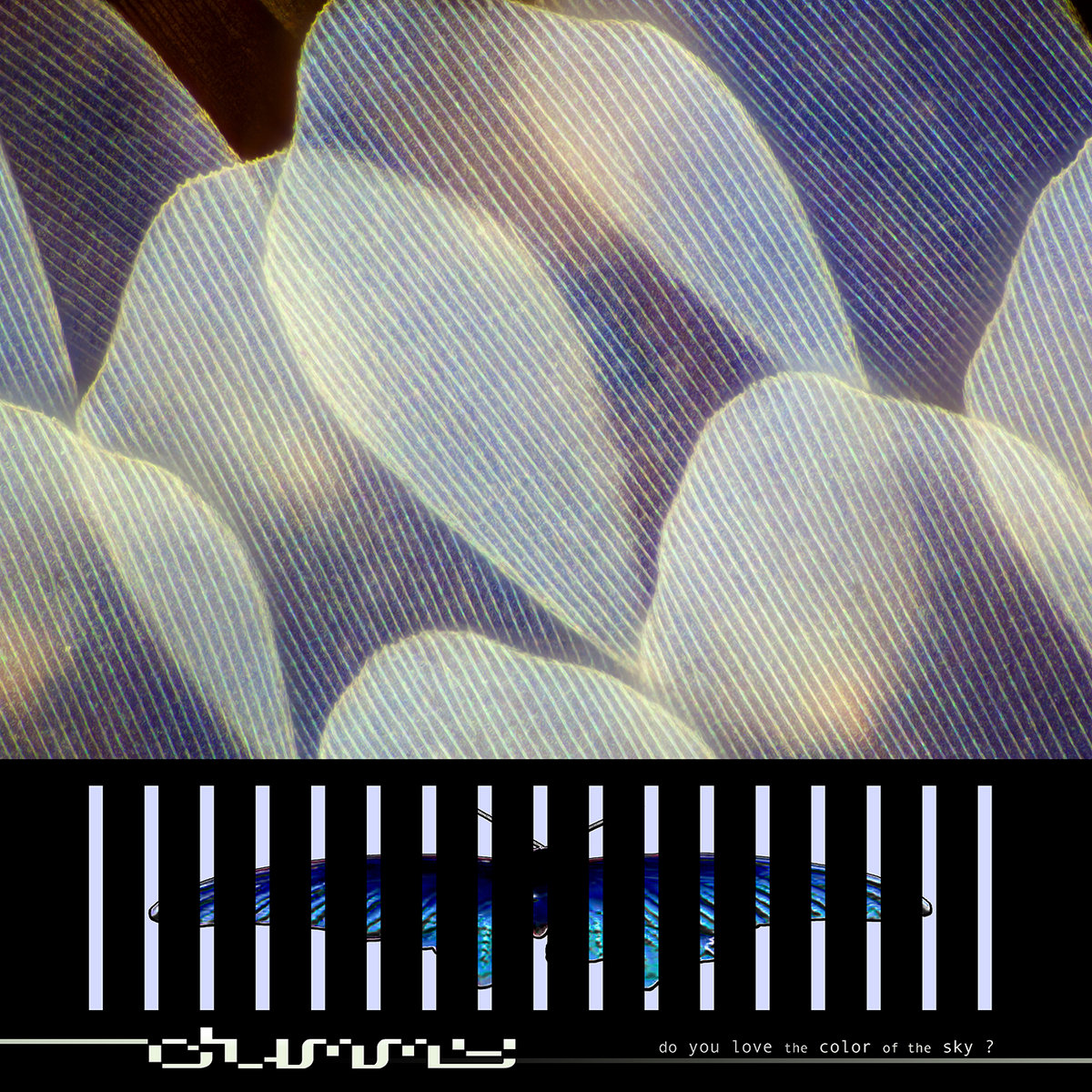
Dummy have an interesting answer to the question contemporary music keeps asking: what comes next? They don’t chase novelty. They’ve made a record so absorbed in its own vocabulary that it ends up sounding a little ahead of everything around it. ‘do you love the color of the sky?’ holds a lot of contradictions in balance. It’s cerebral and euphoric, politically alert and very melodic, steeped in experimental pop history without acting like a revival. Dummy aren’t predicting the future here. They’re building a private present and inviting you in.
The opener, “April Limousine,” shows the ambition right away. The driving rhythm has an uneasy sense of environmental collapse in it, but the song never lectures. Breakbeats, guitars, electronics and Emma Maatman’s voice move together so easily that the heavy subject becomes part of the atmosphere instead of dragging it down. That’s one of the band’s sharpest instincts: a song can make a political point without giving up the fun.
The same idea runs through “Alluvial Fan,” where a stretched chord sets up an airy dream-pop mood before the track slips into a more rhythmic space. Nathan O’Dell’s vocals add a distinct texture, and Allyson Foster and Paul Benson’s extra vocals widen the sense of scale. It recalls the floating elegance of early dream pop and the rhythmic sophistication of British electronic music, but those references are hints, not labels.
“Squeaky Wheel” goes darker. Sampled guitar feedback gives it an abrasive edge, but the arrangement stays tightly controlled. Guitarists Joe Trainor and O’Dell know how to make texture work as rhythm, and drummer Alex Ewell supplies the precision that keeps the band’s more elaborate studio ideas coherent. It never sounds crowded just for density. Each layer has a job, whether melodic, rhythmic, atmospheric or simply psychological.
“Full Spectrum Dominance” brings the album’s concerns about artificial intelligence and the commodification of creative work into sharper focus. Even here, the band steers clear of the dry language that usually comes with talking about technology. Their critique comes through pop music, a form built on human expression, repetition, interpretation and borrowed ideas. There’s a useful irony in a band confronting machine-made culture while making music whose richness depends on human choices. Maatman’s keyboards and vocals are central to that, carrying melodies that are memorable without being predictable.
“Touch the Perfect Speed” continues the fascination with momentum. Dummy have a knack for grooves that are physical and cerebral at once, inviting you to move while giving your mind something to chew on. Ewell’s drumming matters a lot here. It’s loose rather than stiff, giving the electronics and guitars a strong, flexible base. Trainor’s guitar keeps the band tied to rock instrumentation even as the sound drifts toward electronic and ambient.
“Song of Mana” adds vocals from Nina Pitchkites, widening the band’s vocal range and making intimacy feel spacious. It’s almost ethereal, but never empty. Underneath is a real interest in how technology, consumption and political power shape what we perceive, and Dummy make those ideas sit comfortably alongside pleasure. “Omen Globe” does what the name promises: it’s mysterious and a little ominous. Just when the music starts to dissolve into abstraction, a melody or rhythm snaps it back, and that back-and-forth is a big part of what makes the album sound like itself. It’s never filler, and it’s never muddy.
Then there’s “C.B.B.S.I.M.M.P.W.M.,” a wonderfully messy track from a band that clearly isn’t interested in sanding things smooth. Even the title is hard to swallow in one go, the hooks and momentum are all there. Dummy have clearly put time into their chemistry as a live group. Since ‘Free Energy’ (Trouble In Mind, 2024), they’ve reportedly played more than a hundred shows, including extensive U.S. touring and European dates, and you can hear that confidence in the arrangements. The songs may be full of samples, loops, delays, pedals and layers of studio work, but underneath is a band that knows how to play together.
That matters on “N of 1,” where Dummy take on the normalization of surveillance. The subject could easily lead to cold futurism, but the band makes the track inviting enough to pull you in before the implications register. Their political writing works by absorption rather than instruction, so by the time the groove takes hold, the idea has already started to settle. The closer, “Heaven’s What You Make of It,” is warmer. Lance Umble, who went from touring bassist to full-time member, adds bass that strengthens the communal feel. After an album preoccupied with control, technological extraction and ecological decline, the title offers a modest but real counterargument: maybe the future gets shaped through collective action, creativity and the relationships people build around their work.
The band’s chemistry is the album’s biggest strength. Dummy handled production, recording and mixing themselves, with Joo-Joo Ashworth working alongside them, and Mikey Young mastered the record. It sounds carefully assembled without losing room for surprise, and the polish serves the songs instead of hiding them.
Dummy’s real accomplishment isn’t a futuristic record. It’s a record deeply invested in what music itself can do. It draws on dream pop, post-rock, drone, rave, electronic music and shimmering art-pop without settling into homage. History is something to use, and the present is something to question. Under the songs and the big beats is a belief in people making things together, and in the need to get your hands dirty to make art. For all its political unease, it’s an exhilarating album. Dummy understand that radical ideas don’t have to arrive looking austere. Sometimes the best argument for a different future is music this alive.
Learn more links:
Polyvinyl Records
Dummy
Bandcamp
Instagram