
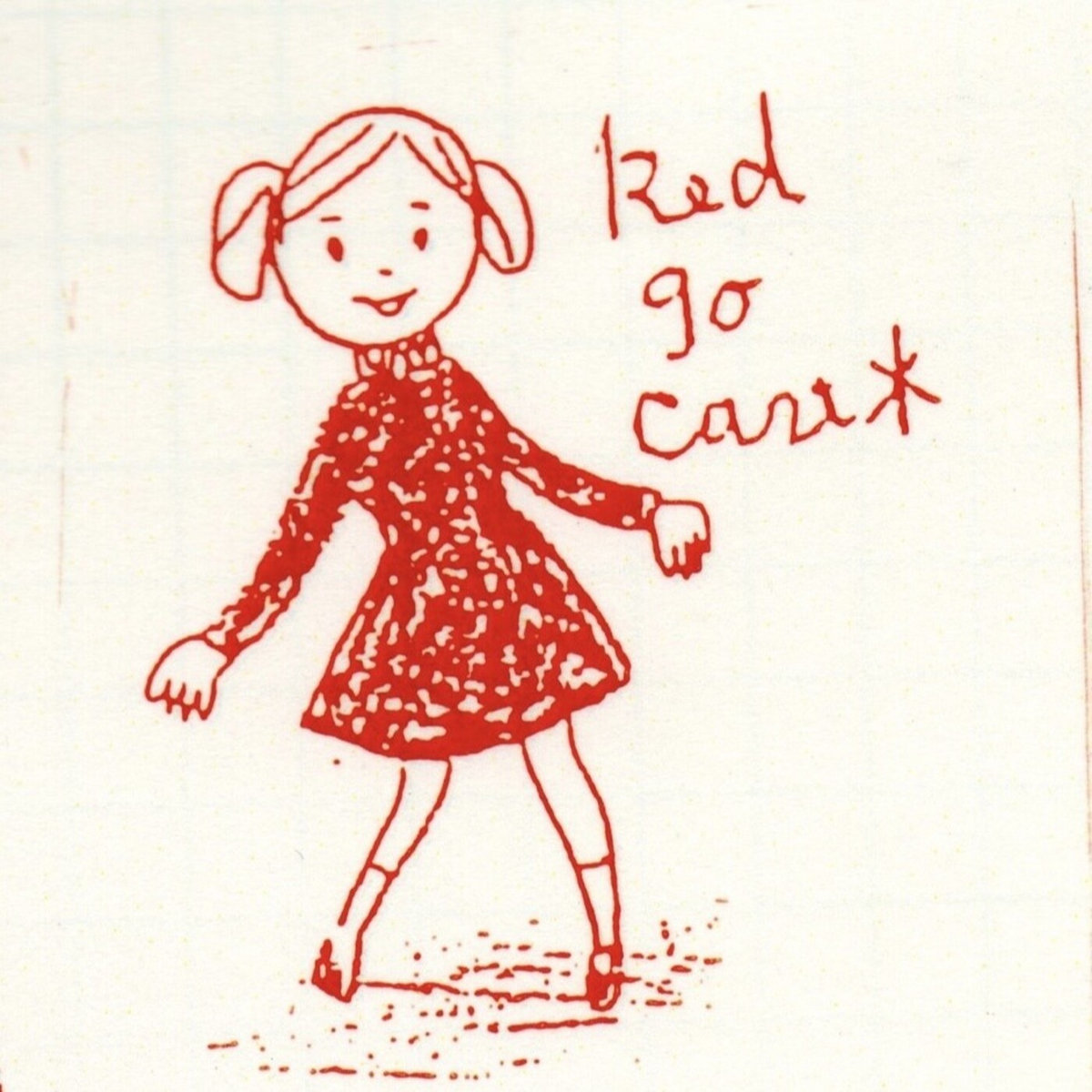
red go-cart’s ‘Very Beginning of Red Go-Cart’ is the kind of archival release that understands an origin story need not be polished into mythology. Compiled to mark the band’s 30th anniversary, this sixteen-track collection gathers the first recordings of a Japanese indie-pop project that began in 1996 as a home-recording unit formed by Tomomi and Yuji, then developed into a live band known for performances with a frantic, almost jungle-like energy. The material has been remastered, but its fundamental appeal lies in how little it has been domesticated. These songs retain the sensation of musicians discovering their vocabulary in real time, chasing melodies, speeding through arrangements, and learning what their own instincts could accomplish.
The first eight tracks draw from the two cassette releases ‘Sweet Consists of Red Go Cart!’ and ‘Something Good Today?,’ originally issued in 1996. The remaining eight collect early covers, demos, and other recordings from the same formative period. Together, they offer something more revealing than a conventional greatest-hits package. This is a document of formation: a band before its identity had hardened, experimenting with speed, melody, structure, and the exuberant collision of amateur immediacy with sharply defined pop instincts. “My Bicycle!” announces the collection with an almost perfect statement of purpose. Its title is childlike, direct, and exuberant, while the music races ahead with bright guitars and a melody that seems determined to become a permanent part of the listener’s memory. The song captures an essential quality of red go-cart’s early work: the ability to make velocity sound joyful rather than aggressive. Their speed is not about intimidation. It is about the sensation of being propelled by an idea before you have had time to question it.
“Little Badge” develops that approach through another tightly constructed rush of guitar pop. The band’s affection for the Japanese indie-pop tradition is clear, but the influences never overwhelm their personality. Their sound carries the melodic sweetness associated with underground pop while maintaining a wonderfully unruly sense of momentum. Tomomi and Yuji’s central role gives the material continuity even as the lineup changed around them, and the performances have the exhilaration of musicians discovering that their songs become something larger when played together. “Last live in the boat house” has an intriguing archival quality even before its sound is considered. The title places the listener inside a particular memory, and the performance feels like a snapshot of a band whose identity was being forged through live experience. The rougher edges are valuable. They remind us that red go-cart’s appeal did not originate in pristine studio construction but in the friction between melody and motion, composition and performance.
“Mail order” is shorter and more economical, demonstrating how much the group could pack into a small amount of time. Their songwriting is concise without feeling underdeveloped. The hooks arrive quickly, but the arrangements have enough detail to avoid becoming disposable. “Very dealy” continues this compact approach, with its playful title and racing instrumental energy reinforcing the sense that red go-cart regarded pop music as something to be grabbed and thrown into motion rather than carefully placed on a pedestal. “Simple question” and “Be like you” reveal another important feature of these early recordings: beneath the frantic guitars is a remarkably strong melodic sensibility. The band’s relationship to pop is not ironic. Even when the performances are scrappy, the songs are built around the belief that a melody should communicate immediately. “Be like you” carries that directness into a slightly more reflective space, while “Early morning play ground” returns to the collection’s sense of youthful discovery. The misspellings and unconventional capitalization across several titles only add to the charm. They feel like artifacts of a private vocabulary rather than attempts at branding.
The second half of ‘Very Beginning of Red Go-Cart’ changes the perspective by introducing the covers that helped define the group’s musical world. “Little Red Go-Cart,” originally by Throw That Beat in The Garbagecan!, is particularly significant because it inspired the band’s name. Hearing red go-cart perform the song turns the collection into a musical family tree: the influence is no longer an abstract reference but a piece of repertoire that the young band physically inhabited. “On The Seventh Day,” a Fat Tulips cover, reinforces red go-cart’s affinity for the kind of fast, melodic guitar pop that flourished around international indie scenes during the era. Their version of “Dear Josie Love Robyn” by SARGE offers another glimpse into the band’s listening habits, while “Pop Song,” borrowed from Red Sleeping Beauty, brings the collection even closer to the pure-pop instincts that run through the entire record. These interpretations matter because they demonstrate that red go-cart were not merely absorbing influences passively. They were testing those influences against their own developing identity.
“Maybe it’s a song” is an especially fitting title for a collection concerned with beginnings. The uncertainty is playful, but it also captures the exploratory nature of the project. “Not Titled” is even more revealing, presenting an unfinished quality that would be easy to dismiss if one were approaching the collection solely as a retrospective. Instead, these fragments allow the listener to hear the process rather than merely its polished destination. “Pippi” and the demo “Merry Go-Round” close the collection with an appealing sense of incompletion. The latter is particularly valuable because demos can expose the moment before a song becomes fixed. Ideas remain visible. Choices have not yet hardened into definitive arrangements. In the context of this album, that openness feels almost philosophical. The band was still becoming itself.
Masato Saito’s 2023 remastering gives these early recordings a clearer presentation without severing them from their period. That balance is important. Over-restoring archival indie recordings can erase precisely the qualities that make them historically and emotionally meaningful. Here, the performances remain energetic and imperfect, with enough sonic character to preserve the sense of a young band working with what it had. Akiko Itoh’s illustrations complement the collection’s handmade, youthful sensibility. ‘Very Beginning of Red Go-Cart’ documents a band learning through imitation, home recording, live performance, experimentation, and sheer enthusiasm. Thirty years later, the songs retain the exhilaration of that discovery because they were made before red go-cart had any obligation to live up to a reputation. As an archival collection, it provides context. As a collection of songs, it provides pleasure.
But its greatest value may be the reminder that artistic identity is rarely born fully formed. It develops through accidents, obsessions, borrowed songs, cheap equipment, uncertain titles, rehearsals, performances, and the sudden realization that a melody has become your own. “Little Red Go-Cart,” “My Bicycle!,” “Simple question,” and “Merry Go-Round” all belong to that formative world, where speed and innocence could coexist with serious musical ambition. ‘Very Beginning of Red Go-Cart’ captures that world without embalming it. The band’s history may now span three decades, but this collection remains what its title promises: not the definitive story, but the thrilling first page.
Learn more links: Clover Records | Instagram