
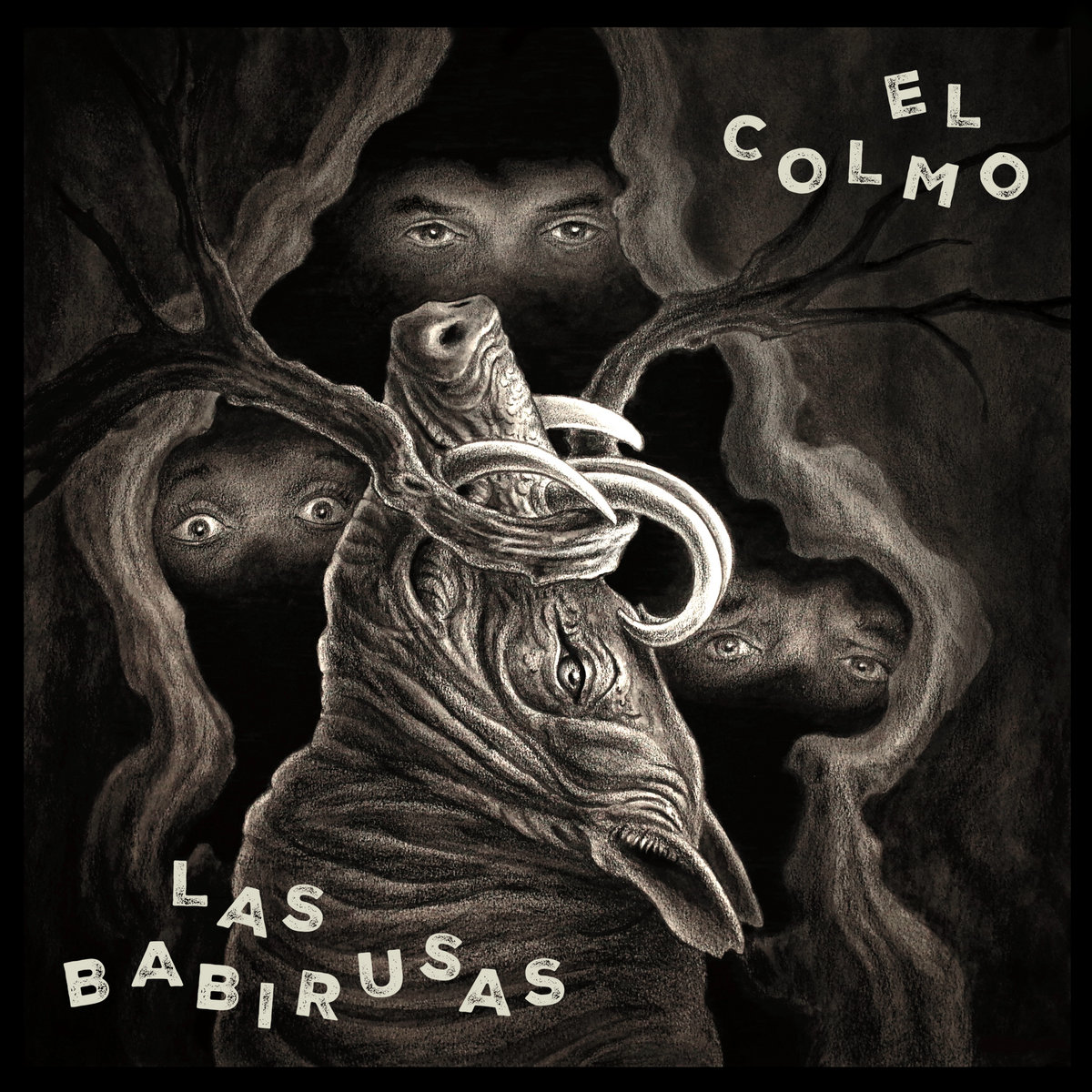
Punk rock often derives its power from immediacy, but the finest records understand that immediacy alone is not enough. Energy without imagination fades quickly. Noise without personality becomes interchangeable. El Colmo’s ‘Las Babirusas’ succeeds because it possesses both urgency and character, delivering a concise yet richly textured collection of songs that transforms garage-punk fundamentals into something stranger, sharper, and more memorable than a simple exercise in revivalism. Created by Los Angeles scene veterans, including former member of the Detroit Cobras, Dante White Aliano, the album carries the confidence of musicians who have spent years immersed in underground music without becoming trapped by its conventions. While the record embraces stripped-down aesthetics and an intentionally rough-hewn presentation, it never feels limited by them. Every song seems animated by curiosity, humor, and a fascination with the peculiar ways language, imagery, and sound can collide.
The opening track, “Leyes y Büeyes,” establishes the album’s distinctive voice immediately. Propelled by driving rhythms and wiry instrumentation, the song introduces a world where wordplay, absurdity, and social observation coexist naturally. The performance possesses the quality of a ritual invocation, setting a tone that remains present throughout the record. Rather than presenting itself as polished or calculated, the music arrives with an infectious sense of spontaneity.
“Montaña Rusa” builds upon that foundation by embracing instability as a creative principle. Much like the roller coaster suggested by its title, the song thrives on sudden shifts and exhilarating momentum. Beneath its energetic surface lies an examination of unpredictability itself, capturing the sensation of navigating a reality that rarely moves in straight lines. “Las Babirusas” serves as the album’s conceptual centerpiece. The babirusa, a curious and visually striking animal, becomes an apt symbol for the record’s broader worldview. El Colmo consistently gravitates toward the unusual, the overlooked, and the delightfully eccentric. The song celebrates otherness without turning it into spectacle, finding beauty in forms that resist easy categorization.
One of the album’s most inventive moments arrives with “Mate-Mática.” The track transforms mathematical language into something playful and unexpectedly expressive. Rather than treating logic and imagination as opposing forces, El Colmo reveals how both emerge from humanity’s desire to impose meaning upon a chaotic world. The song’s compact structure only enhances its effectiveness, communicating complex ideas with remarkable economy. “La Casa Invisible” introduces a more mysterious atmosphere. The concept of an invisible house carries numerous interpretations, and the band wisely avoids settling on any single explanation. Instead, the song occupies a liminal space between reality and metaphor, suggesting themes of absence, memory, and unseen influence. Its brevity leaves lingering questions rather than definitive answers.
That sense of intellectual curiosity continues with “The Looking Class,” one of the album’s most intriguing titles. The phrase evokes questions about observation, privilege, perception, and social identity. El Colmo approaches these themes with wit rather than didacticism, allowing listeners to engage with the song’s implications without feeling directed toward a predetermined conclusion. “The Color of #s” extends the album’s fascination with abstraction. Numbers are typically viewed as neutral symbols, yet the song imagines them as entities capable of possessing character and emotional resonance. Such conceptual playfulness could easily become self-indulgent in less capable hands, but El Colmo maintains a strong connection between idea and execution, ensuring the track remains engaging on both intellectual and visceral levels.
“Palancalandia” introduces one of the record’s most exuberant performances. The song’s invented geography functions as a destination for imagination itself, a place where conventional boundaries lose their authority. The musicians approach the material with palpable enthusiasm, creating a sense of communal celebration that becomes impossible to resist. The album takes a darker turn with “Doom Plume.” Though still driven by the same energetic foundation, the track carries a more ominous undertone. Here, El Colmo explores uncertainty and looming consequences without abandoning the eccentric perspective that defines the record. The result is a song that balances menace with curiosity.
“The Mangle Machine” arrives like a burst of mechanical anxiety. Its compact running time mirrors the relentless efficiency suggested by its title. The song evokes systems that consume, process, and reshape everything in their path, whether those systems are technological, cultural, or psychological. El Colmo captures these ideas through movement rather than exposition, allowing the music itself to embody the concept. Among the album’s most evocative compositions is “Sombra De Monserrate.” The track introduces a stronger sense of place and history, expanding the album’s thematic scope. Shadows, both literal and symbolic, become vehicles for exploring memory and cultural identity. The song possesses a richness that extends beyond its modest length, suggesting narratives that remain partially concealed.
Closing track “No Te Burles De Mi” provides a fitting conclusion. Translating vulnerability into defiance, the song functions as both personal statement and broader declaration of self-respect. After an album filled with surreal imagery, inventive concepts, and playful experimentation, the finale grounds everything in a deeply human sentiment. It reminds listeners that beneath the eccentricity lies a sincere emotional core. A significant part of the album’s appeal comes from the collective performance of the musicians themselves. These are players who understand the value of restraint as much as expression. Every guitar figure, rhythmic accent, and vocal phrase serves the songs rather than competing for attention. Their experience is evident not through technical exhibitionism but through confidence, chemistry, and instinct.
The production enhances this approach beautifully. Rather than smoothing away imperfections, it preserves the immediacy of performance. The sound remains raw without becoming careless, direct without becoming simplistic. This balance allows the album’s personality to emerge fully, emphasizing the human presence behind every note. What makes ‘Las Babirusas’ particularly compelling is its refusal to separate intelligence from fun. Too often, records that aspire toward conceptual depth become overly serious, while albums focused on excitement neglect substance. El Colmo rejects that false choice. These songs are playful yet thoughtful, chaotic yet purposeful, humorous yet emotionally grounded.
Across twelve tracks, ‘Las Babirusas’ constructs a world where strange animals, invisible houses, mathematical puzzles, shadows, machines, and imagined landscapes coexist comfortably. It is a record fueled by curiosity and animated by the belief that even the most unconventional ideas can reveal something meaningful about human experience. El Colmo has crafted an album that celebrates imagination without losing sight of emotion, resulting in a work that is both delightfully eccentric and genuinely affecting.
Learn more links:
Slouch Records
Bandcamp