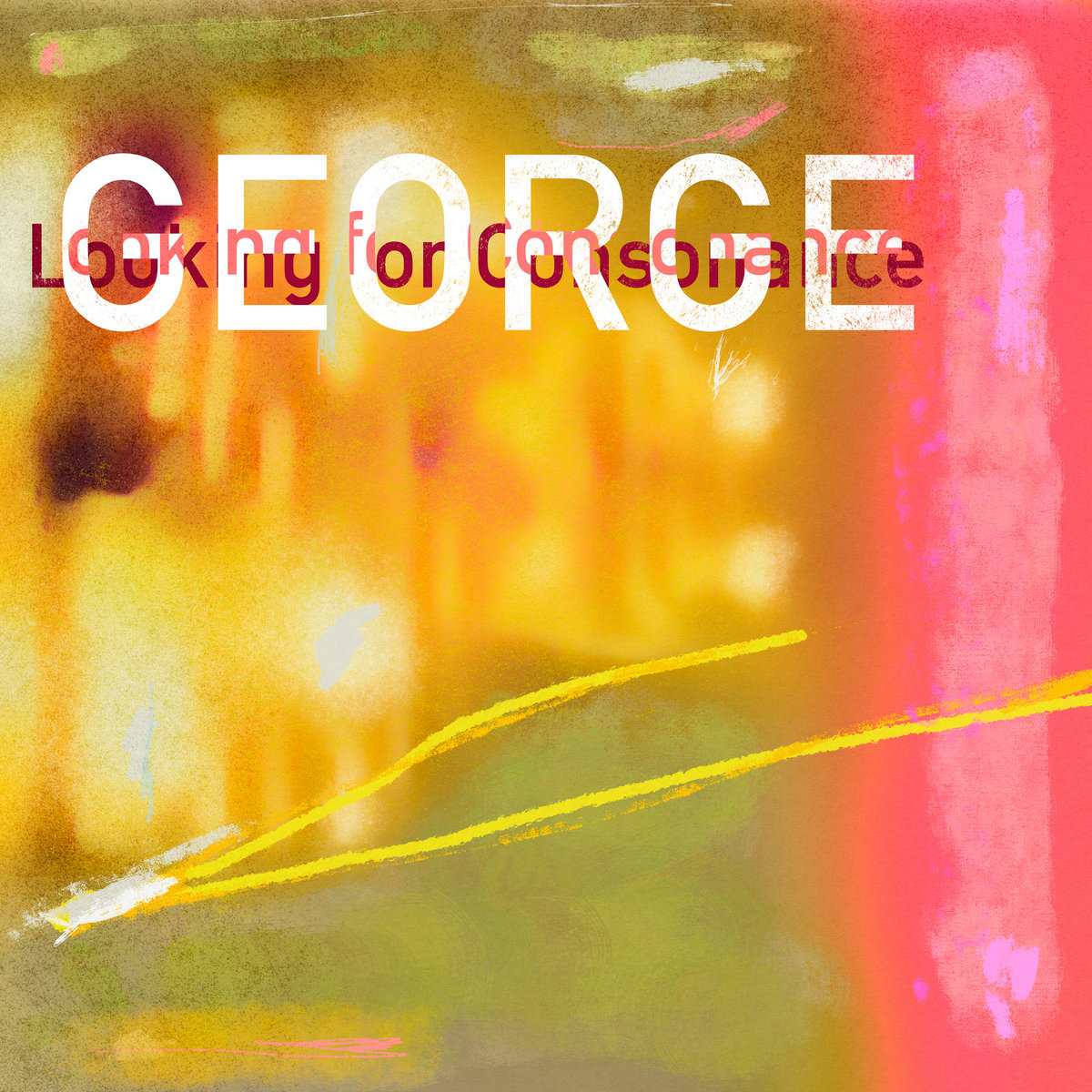
On ‘Looking for Consonance,’ GEORGE refines the radical vocabulary introduced on ‘Letters to George’ (Out Of Your Head Records, 2023), into something more emotionally expansive and philosophically probing. John Hollenbeck’s ensemble has never operated according to the usual expectations of jazz fusion, synth-pop, or avant-garde improvisation, and this second release deepens that refusal to settle into any single idiom. What emerges instead is a body of work preoccupied with instability, community, memory, and the fragile possibility of human accord. The record searches for balance without pretending balance is easily attainable. Its most remarkable achievement lies in how it transforms abstraction into intimacy.
Hollenbeck’s compositions are densely conceptual yet startlingly human in execution. The quartet of Anna Webber on tenor saxophone, flute, and alto flute; Sarah Rossy on voice and synthesizer; Chiquita Magic on synthesizers and voice; and Hollenbeck himself on drums and glockenspiel, functions less as a conventional band than as a living circuitry of impulses and reactions. Every sound appears to provoke another. Rhythms twitch, dissolve, regroup. Melodies arrive in fragments before becoming communal declarations. Electronic textures shimmer beside acoustic gestures without any sense of hierarchy. Rather than smoothing contradictions into coherence, GEORGE allows contradiction to become the organizing principle itself.
“bounce” opens the album with deceptive buoyancy. Hollenbeck’s drumming establishes an elastic pulse that never settles into predictability, while Webber’s tenor lines slice through the arrangement with sharp-edged lyricism. Rossy and Chiquita Magic treat the voice not simply as language but as vaporous architecture, constructing harmonic shapes that hover between devotional chant and corrupted transmission. The piece keeps threatening collapse, only to regenerate momentum through collective intuition. That volatility becomes the album’s governing emotional condition.
“Lewis (dedicated to George Lewis)” carries an especially rich sense of lineage. The composition acknowledges George Lewis not through imitation but through methodology: systems colliding with spontaneity, intellect fused to risk. Webber’s playing here is extraordinary, navigating asymmetrical phrases with a muscularity that recalls post-bop urgency while remaining unmistakably contemporary. Around her, the electronics pulse like unstable weather patterns. Hollenbeck resists the temptation to anchor the ensemble with fixed grooves; instead, he allows rhythm to function as an argument continually revised in real time.
“Nassam Alayna-LHawa (a diasporic offering for peace)” introduces one of the album’s most affecting moments. The arrangement possesses a ceremonial quality without drifting into sentimentality. Rossy’s voice becomes the emotional center, carrying the composition with restrained vulnerability while Chiquita Magic’s synthesizers create radiant harmonic halos that seem to stretch beyond the frame of the recording itself. The track examines peace not as serenity but as longing; something imagined, pursued, and briefly glimpsed before slipping away again. The concise “George and Dee (dedicated to George and Dee Gamble)” demonstrates GEORGE’s remarkable ability to compress emotional information into miniature forms. In just over three minutes, the ensemble constructs a strangely tender environment where glockenspiel accents flicker against softly dissonant harmonies. The piece carries the warmth of personal memory while retaining the ensemble’s appetite for structural surprise.
“Georgist” pivots toward sharper rhythmic experimentation. Hollenbeck’s compositional instincts are particularly vivid here, balancing mechanical repetition against eruptions of improvisational freedom. The ensemble creates a nervous momentum that mirrors contemporary social life: overstimulated, hyperconnected, perpetually accelerating. Yet amid the complexity, small melodic figures recur like attempts to establish common language within chaos. “Porter (10,000 men named George)” arrives with sly wit and compressed force. Its title suggests multiplicity and anonymity, and the music mirrors that idea through overlapping rhythmic cells and fragmented vocal passages. Chiquita Magic’s synthesizer work is especially striking, introducing bursts of color that destabilize the track’s apparent direction. The brevity of the piece gives it the quality of a transmission intercepted mid-sentence.
“Norma (in support of reproductive autonomy)” stands among the album’s moral and artistic high points. Hollenbeck avoids declarative grandstanding, choosing instead to construct a composition rooted in emotional complexity and collective urgency. Rossy’s vocal performance is both restrained and resolute, while Webber’s flute lines drift through the arrangement like unanswered questions. The track refuses simplistic catharsis. Its politics emerge through atmosphere, vulnerability, and the insistence that personal autonomy remains inseparable from dignity itself. “Unicornio (for the Global South, in movement and resilience)” broadens the album’s thematic scope without sacrificing intimacy. Rhythmic motifs circulate restlessly beneath luminous synthesizer textures, suggesting migration, adaptation, and endurance. The ensemble achieves an extraordinary sense of motion here; every player seems to pull the music toward different destinations simultaneously. Rather than fragmenting the piece, that multiplicity becomes its emotional engine.
“Johnson (dedicated to George F. Johnson)” offers one of the album’s quieter revelations. Hollenbeck demonstrates how restraint can produce its own kind of intensity. Sparse percussion, hovering electronics, and carefully spaced melodic gestures create an atmosphere of contemplation tinged with uncertainty. The performance trusts silence as much as sound.
The epic closer, “Wayne Phases (dedicated to Wayne Shorter),” serves as both tribute and philosophical statement. Shorter’s influence appears not through stylistic quotation but through an embrace of mystery, transformation, and narrative ambiguity. Across nearly twelve minutes, GEORGE constructs a shifting landscape where motifs mutate continuously. Webber’s saxophone playing reaches astonishing emotional depth, veering from angular abstraction toward passages of aching clarity. Hollenbeck’s drumming remains in perpetual dialogue with every movement around him, guiding the ensemble through abrupt changes without ever imposing rigid control. By the final moments, the composition seems less resolved than illuminated from within.
Recorded at Hansa Studios and engineered by Nanni Johansson with assistant engineer Frida Claeson Johansson, the album possesses remarkable spatial depth. Every electronic pulse, vocal texture, and percussive detail occupies a carefully sculpted environment. Johansson’s mastering preserves the music’s complexity without sterilizing its volatility. The production allows GEORGE’s intricate arrangements to retain immediacy and physical presence.
GEORGE engages complexity as a means of exploring coexistence itself: how disparate voices can occupy shared space without surrendering individuality. Hollenbeck’s concept of consonance is neither naïve nor utopian. The album recognizes discord as permanent, perhaps even necessary. Yet it also insists that listening (genuine listening), remains capable of generating fleeting forms of solidarity. That aspiration gives the record unusual emotional gravity. GEORGE does not present harmony as a fixed destination. The music searches, doubts, recalibrates, and reaches outward again. In doing so, ‘Looking for Consonance’ becomes far more than an avant synth-pop jazz fusion album. It becomes a meditation on how people endure one another, challenge one another, and occasionally discover moments of shared meaning within instability.
For more information, please visit Out Of Your Head Records | John Hollenbeck | Bandcamp