
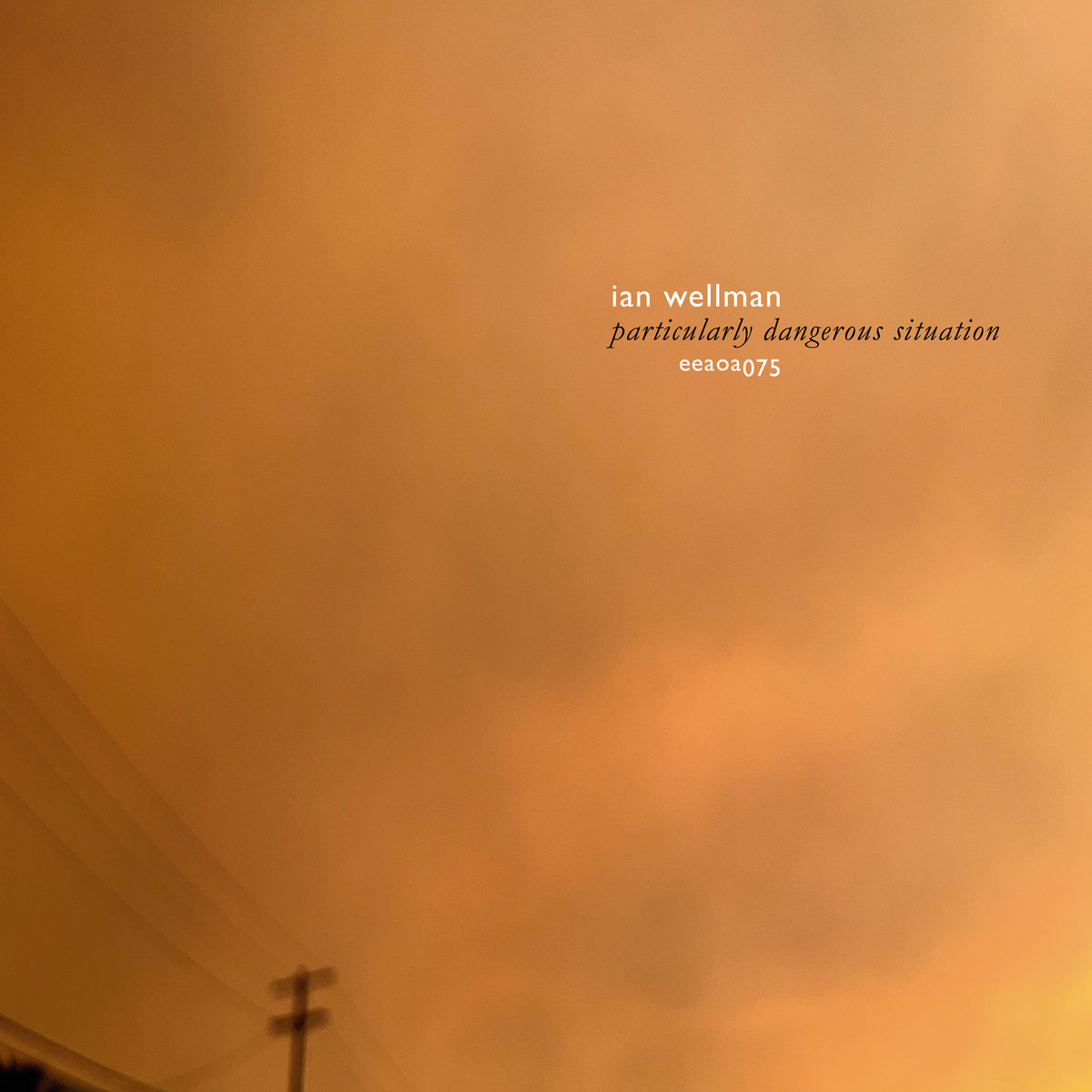
Ian Wellman’s ‘Particularly Dangerous Situation’ functions simultaneously as documentary, lamentation, and environmental requiem, transforming catastrophic climate disaster into a deeply human act of sonic witnessing. Built from field recordings captured during the devastating Southern California wildfires of January 2025, the album avoids sensationalism entirely. Instead, Wellman approaches catastrophe with extraordinary attentiveness, focusing less on spectacle than on atmosphere, psychological destabilization, and the unsettling intimacy of environmental collapse. The result is one of the most emotionally devastating electroacoustic works in recent memory, a record that confronts ecological trauma not through rhetoric but through proximity.
What makes ‘Particularly Dangerous Situation’ so arresting is Wellman’s ability to preserve the physical reality of these moments without reducing them to mere reportage. His compositions possess narrative clarity, yet they resist conventional storytelling. Rather than guiding the listener through a sequence of events with cinematic predictability, Wellman constructs a destabilized acoustic geography in which dread accumulates incrementally through wind resonance, distant mechanical vibrations, destabilized drones, emergency ambience, and the unsettling behavior of ordinary structures subjected to extraordinary force.
The opening “Intro” establishes the album’s emotional vocabulary with remarkable economy. A low-frequency instability hums beneath the surface while faint environmental details emerge like partially obscured memories. Nothing is overstated. Every sound carries the uneasy weight of anticipation, mirroring the psychological condition preceding disaster; the strange suspension between warning and impact. Wellman demonstrates exceptional restraint here, understanding that fear often derives from uncertainty rather than volume. The title composition immediately expands the album’s scale. Wind becomes both subject and instrument. Through geophone recordings attached to poles, fences, shelters, and resonant urban structures, Wellman reveals an acoustic dimension of environmental violence rarely documented with such precision. The city itself appears to groan under atmospheric pressure. Metallic resonances bend and shudder while tape-loop textures drift through the composition like corrupted recollections struggling to stabilize themselves. The piece captures not only the physicality of the storm but the psychological fragmentation accompanying the realization that events are slipping beyond human control.
What separates Wellman from many practitioners of field-recording composition is his instinct for emotional architecture. He does not simply arrange sounds; he organizes perception. “(Afternoon Report)” functions as a transitional psychological corridor in which the listener senses dread hardening into comprehension. The piece’s fragmented textures and distant tonal washes evoke the disorientation of receiving incomplete information during unfolding catastrophe. Communication appears unstable throughout the album, as though language itself becomes insufficient in the face of environmental devastation. “Out of Our Hands” stands among the record’s most powerful statements precisely because of its refusal to dramatize helplessness. Wellman allows environmental sound to communicate scale organically. Gusts slam against resonant surfaces with terrifying force while drones hover beneath the mix like persistent psychological pressure. The composition evokes not only the violence of the fires themselves but the collapse of human certainty before natural systems accelerated by climate imbalance. Few records about ecological disaster manage to sound this personal without collapsing into sentimentality.
The sequencing of the album deserves particular attention. “(Evening Report)” introduces a profound sense of exhaustion and psychic displacement, as though the listener has crossed into a different perceptual state entirely. Small sonic details, distant mechanical hums, trembling frequencies, unstable reverberations, acquire immense emotional significance because of the surrounding sparseness. Wellman understands silence as an active compositional force. The spaces between sounds become charged with anxiety, grief, and disbelief. “The Moon Turned Red” is perhaps the album’s emotional center. Its brevity only intensifies its impact. Here, Wellman transforms a visual image into acoustic sensation with startling effectiveness. The drones darken into suffocating density while high-end frequencies flicker like airborne ash suspended against unnatural light. The composition carries a profound sense of mourning without ever resorting to melodrama. It captures the surreal unreality of witnessing familiar landscapes transformed into scenes of devastation.
“Wind’s Rage” arrives as the album’s most physically overwhelming moment. Structures resonate violently under immense atmospheric force while layers of environmental recordings create a sensation of spatial disorientation bordering on claustrophobia. Yet even here, Wellman resists excess. The composition never collapses into noise for its own sake. Every element remains carefully positioned, preserving the terrifying realism of the documented event. One hears not abstraction but material reality pushed toward collapse. “(Store Sign)” offers one of the album’s most uncanny passages. The resonance of urban infrastructure under pressure becomes strangely musical, though never comforting. Signs, poles, and surfaces transform into involuntary instruments activated by environmental violence. The piece subtly reinforces one of the album’s central ideas: catastrophe reveals hidden acoustic properties of the world, exposing invisible relationships between architecture, atmosphere, and human vulnerability.
By the time “Nothing Will Be the Same” emerges, the album has shifted from immediate documentation toward reflection and aftermath. The title risks obviousness on paper, yet Wellman imbues the composition with devastating emotional complexity. Rather than emphasizing destruction directly, he focuses on absence, instability, and psychic residue. The drones here possess an almost funereal solemnity, while the environmental recordings seem increasingly distant, as though memory itself has begun deteriorating under the weight of trauma. “Outro” does not offer resolution because none is possible. Instead, Wellman leaves the listener suspended in a state of unresolved mourning. The fires may have been extinguished physically, but their emotional and ecological consequences continue reverberating through the album’s final moments.
Although ‘Particularly Dangerous Situation’ is credited solely to Ian Wellman, the record’s emotional force is inseparable from the invisible collective presence surrounding it: firefighters battling impossible conditions, displaced communities, emergency systems, damaged landscapes, and ordinary structures transformed into unwilling collaborators through geophone resonance and environmental pressure. Wellman’s role is not merely that of composer but witness, archivist, and interpreter of forces larger than any individual perspective.
Lawrence English’s mastering work at Negative Space proves indispensable to the album’s immense spatial depth. Every vibration, drone, and environmental fragment occupies the stereo field with startling clarity. The album’s sonic detail remains astonishing throughout, allowing listeners to perceive both macro-scale environmental violence and microscopic acoustic textures simultaneously. What lingers after ‘Particularly Dangerous Situation’ concludes is not simply sorrow but altered perception. Wellman transforms environmental catastrophe into an act of collective listening, forcing confrontation with the acoustic consequences of climate instability and human fragility. The album documents not only a wildfire but a civilization confronting forces it can no longer fully contain or predict. Few records in recent years have communicated ecological grief with such intelligence, discipline, and emotional precision.
For more information, visit Ian Wellman | Bandcamp | SoundCloud Spotify*nd=1&dlsi=dd996cc01c824618/