
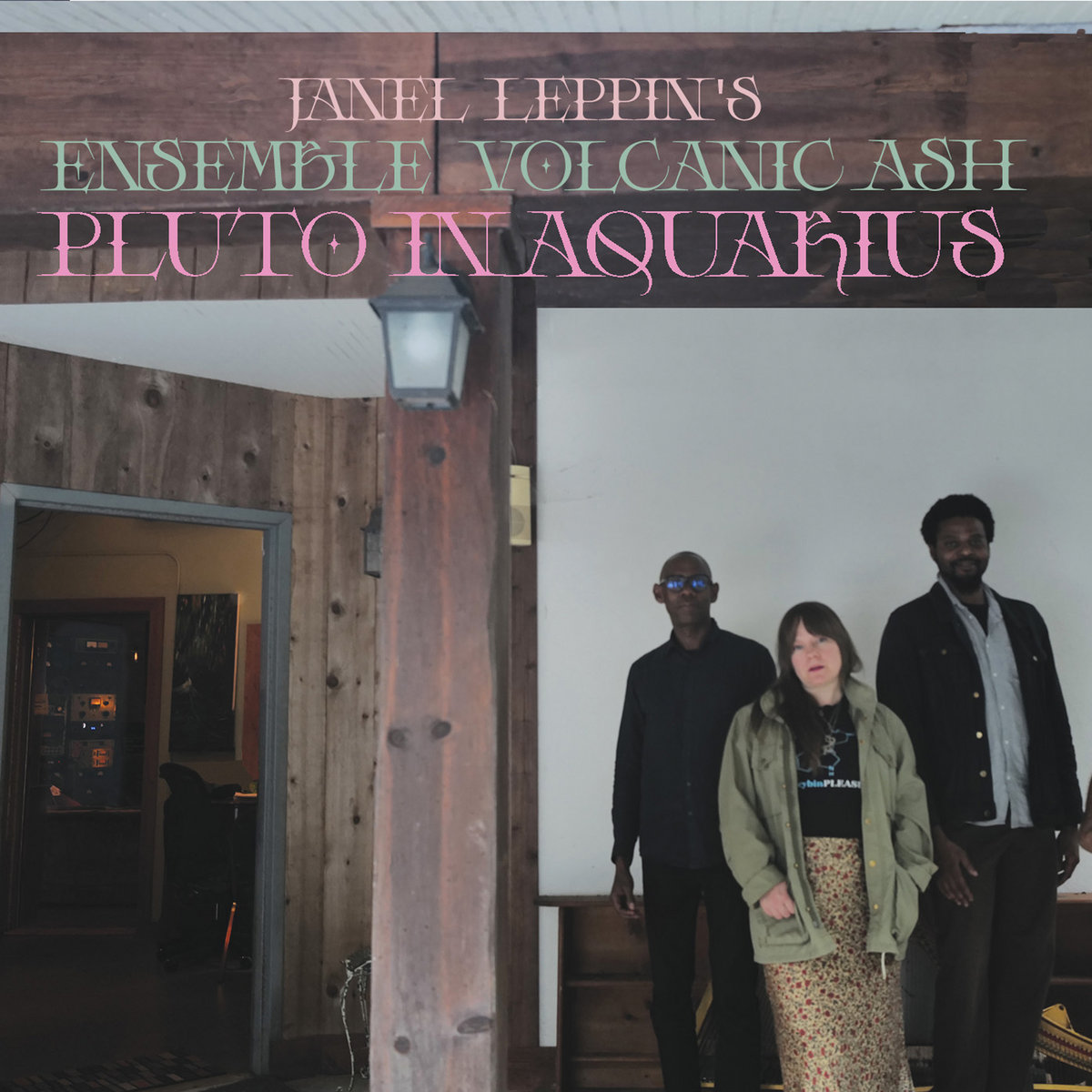
On ‘Pluto In Aquarius,’ Janel Leppin refines Ensemble Volcanic Ash into a sharper, more combustible unit, one that trades ornamental density for immediacy without sacrificing complexity. The record carries the unmistakable imprint of Washington D.C.’s experimental lineage, yet it resists easy geographic or stylistic containment. What emerges instead is a volatile, articulate statement about collective motion (musical, political, and emotional), rendered through a quintet that sounds perpetually on the brink of transformation.
The opening “Mountain Pose” establishes a deceptive calm, its structure poised yet subtly destabilized by the elastic dialogue between Brian Settles on tenor saxophone and Leppin’s cello. Larry Ferguson navigates the piece with a light but deliberate touch, suggesting propulsion without ever settling into predictability. That sense of suspended direction carries into the title track, “Pluto In Aquarius,” where Anthony Pirog introduces fractured harmonic fragments that collide with Luke Stewart’s deeply resonant bass lines. The piece evokes upheaval not through volume but through constant recalibration, as if the ground beneath the ensemble is shifting in real time.
“Hope Marathon” stretches this instability into something more expansive, allowing motifs to recur just long enough to suggest cohesion before they splinter again. Leppin’s compositional voice is particularly striking here; she balances rigor with a willingness to let the ensemble test the limits of form. The brief but incisive “Point Thy Sword” functions almost like a palate cleanser, distilling the group’s intensity into a compact burst that feels both confrontational and precise. Narrative depth surfaces vividly in “Susan Was a Warrior,” a piece that carries an almost cinematic sense of character. Settles’ saxophone becomes a storyteller, weaving lines that suggest resilience without sentimentality, while Pirog’s guitar adds a brittle, angular counterpoint. In contrast, “Our Time” leans toward collective affirmation, its rhythmic undercurrent driven by Ferguson and Stewart forming a foundation that feels grounded yet never static.
The album’s middle stretch pivots into sharper commentary. “Old Guard” and “We See Dark Money” operate as pointed reflections on power and inertia, their structures tighter, their gestures more declarative. The latter, in particular, compresses its message into a concise form that leaves little room for ambiguity, its urgency conveyed through abrupt shifts and stark tonal contrasts. “Jazz is Resistance” stands as a thesis statement, not in a rhetorical sense but in its embodiment of the idea. The ensemble’s interplay here is restless and deliberate, each musician asserting individuality while remaining tethered to the collective pulse. It’s followed by “The Collective,” the album’s most expansive track, where Leppin allows the group to explore a broader dynamic range. The piece moves through phases of near-silence and surging intensity, emphasizing the ensemble’s ability to function as a single, adaptive organism.
The closing sequence of “New Guard,” “Cruel Motherfuckers,” and “Deerhoof is God” leans into brevity and punch. These tracks feel like dispatches rather than full narratives, each one capturing a distinct mood or idea before abruptly giving way to the next. “Cruel Motherfuckers” is particularly striking in its bluntness, while “Deerhoof is God” injects a sly, irreverent energy that prevents the album from settling into solemnity. Throughout ‘Pluto In Aquarius,’ Leppin’s decision to streamline the ensemble’s sound proves decisive. The music gains clarity without losing its edge, and the reduced density allows each player’s voice to register with greater impact. Ferguson’s drumming is both responsive and assertive, Stewart’s bass provides a gravitational center, Pirog’s guitar oscillates between texture and disruption, and Settles’ saxophone offers a melodic thread that ties the shifting pieces together.
What distinguishes this release is not just its compositional ambition but its sense of purpose. The album engages with its moment without resorting to didacticism, channeling urgency through structure and interplay rather than explicit declaration. It captures a group in active dialogue with itself and the world around it, forging a sound that is as intellectually rigorous as it is viscerally compelling.
Learn more by visiting Janel Leppin | Cuneiform Records | Bandcamp | Instagram | Facebook