
Johnny Bell’s ‘Mountain States’ arrives as a deliberate reframing of an instrument too often confined to inherited expectations. The banjo, historically associated with communal tradition, regional folklore, and quicksilver virtuosity, is here treated not as a nostalgic artifact but as a modern compositional engine capable of sustaining longform thought, atmospheric depth, and structural patience. Across seven pieces, Bell reshapes its identity, drawing from the high deserts and volcanic quiet of the American West to construct a sound world defined by weight, resonance, and suspended motion.
This is Bell’s first fully committed solo banjo statement, though his career has long demonstrated a curiosity for textural interplay and instrumental expansion. The shift is therefore not abrupt but inevitable, a culmination of years spent positioning the banjo within larger ensembles before placing it at the center of its own gravitational field. Working alongside producer and collaborator Andrew Weathers, Bell approaches composition less as display and more as excavation, uncovering latent tonal possibilities within an instrument often mischaracterized as limited in expressive range.
The opening piece, “Departure Valley,” functions as both introduction and philosophical declaration. Its title suggests leaving, yet the music resists linear narrative. Instead, Bell establishes a tonal environment where repetition becomes a form of orientation. Notes circle and return with subtle variation, creating a sense of terrain rather than trajectory. Weathers’ production choices are immediately apparent: the instrument feels physically present, as though its wooden body occupies the same air as the listener. The result is not intimacy in the sentimental sense, but proximity in a spatial and sonic one. “Staying Home” shifts perspective inward without reducing scale. The composition explores stasis as an active condition rather than absence of movement. Bell’s phrasing suggests observation rather than progression, each figure returning with altered emphasis. The banjo’s natural brightness is softened, its percussive qualities recontextualized into something more meditative. Within this restraint lies an implicit question about domestic space and interiority, and how repetition can become both comfort and confinement.
The longest piece, “Old Blood,” deepens the record’s engagement with inheritance and continuity. At over six minutes, it stretches the banjo’s traditional vocabulary into broader harmonic territory. There is a sense of ancestral presence here, though not in a literal or celebratory manner. Instead, Bell seems interested in the weight of lineage itself, how musical memory accumulates and presses against the present. The collaboration with Weathers becomes especially significant, as subtle electronic undercurrents and low-frequency reinforcement expand the instrument’s perceived size, giving the piece an almost geological density. “Monsoon Sunset” introduces movement that feels environmental rather than rhythmic. The title evokes atmospheric transition, and the music mirrors that transformation through gradual shifts in tonal emphasis. Bell allows phrases to linger until they dissolve into resonance, creating a sensation of watching light change across distant terrain. The banjo’s plucked articulation begins to resemble wind patterns or water flow, suggesting that the instrument can simulate natural systems when freed from rigid structural expectations.
“Caldera Repose” stands among the album’s most striking achievements. The track’s conceptual foundation is volcanic stillness, the calm that follows eruption, and Bell translates this idea into a carefully controlled sonic landscape. The instrumentation, which includes shruti box and bowed cymbals alongside banjo, creates a layered field of sustained resonance. Rather than resolving into clarity, the piece inhabits a state of suspended aftermath, where sound appears to hover rather than advance. The presence of Weathers’ synth and guitar contributions enhances this sensation of geological scale, as though the composition itself has been shaped by deep time. At the album’s midpoint, “Evening Primrose” extends this sense of temporal elasticity. The banjo here becomes less a melodic instrument than a generator of harmonic weather. Notes recur with patient insistence, forming patterns that suggest both ritual and erosion. Bell’s playing emphasizes decay as much as articulation, allowing tones to blur at their edges. The result is a composition that seems to exist slightly outside conventional tempo, anchored more in duration than rhythm.
“Secret Cities” closes the record with its most expansive vision. The title implies hidden urbanity, structures existing beneath or beyond perception, and the music reflects that idea through layered density and shifting internal architecture. This is the point at which Bell’s broader conceptual aims become clearest. The banjo is no longer simply an instrument associated with tradition or regional identity; it becomes a mapping device for imagined geographies. Weathers’ contributions are particularly effective here, with distorted electric guitar and subtle synthesizer textures expanding the harmonic field into something approaching orchestral scale. Across ‘Mountain States’, the collaboration between Bell and Weathers proves essential. Recorded over a focused three-day session at Wind Tide in Littlefield, Texas, the process prioritized immediacy over perfection. Banjo performances were captured first, establishing the emotional core of each piece, before being augmented with additional instrumentation. This method preserves the sense of first impulse while allowing for later expansion, resulting in music that feels both grounded and architecturally considered.
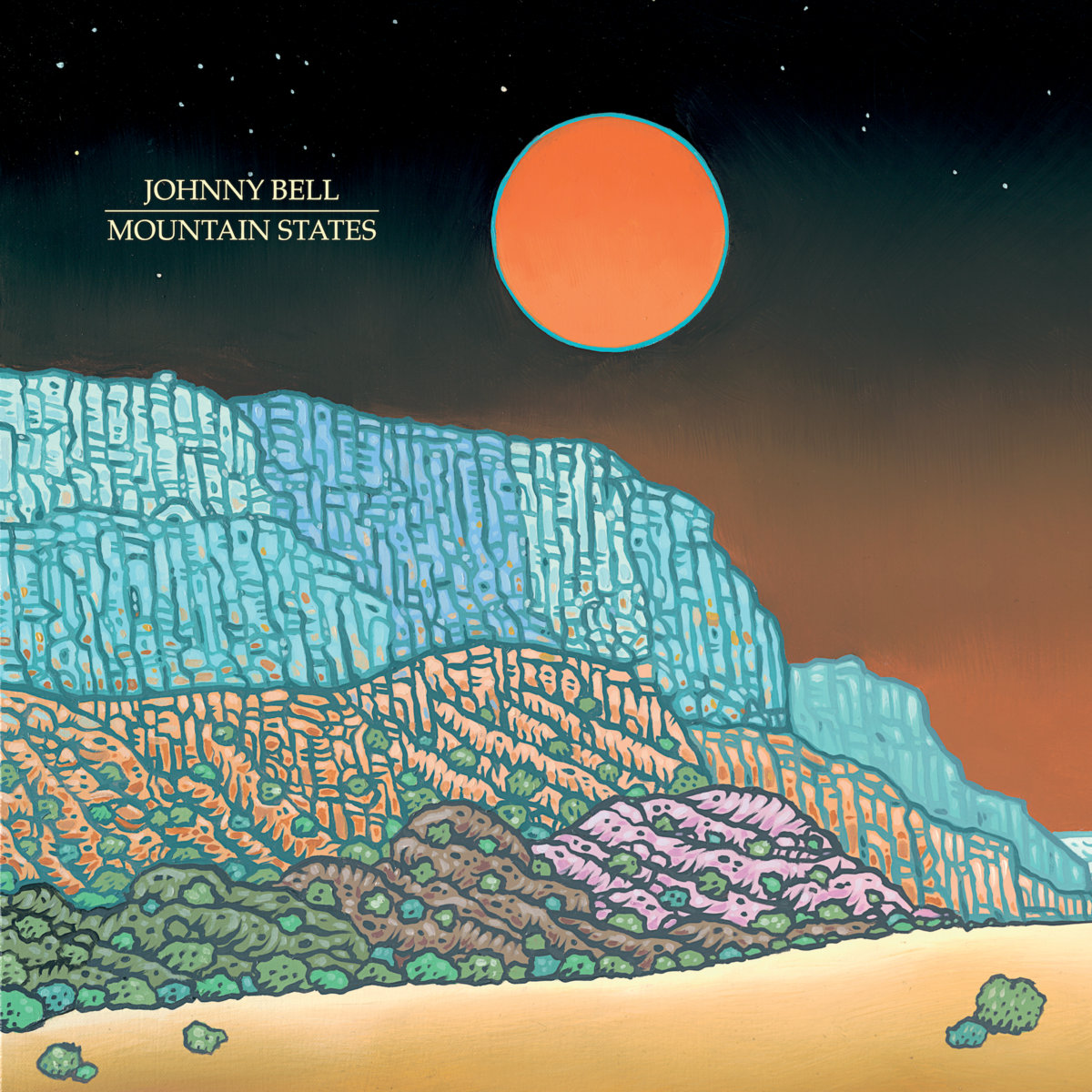
Equally important is Bell’s decision to capture the banjo’s full sonic spectrum. By miking the back of the instrument’s pot, the production reveals frequencies often excluded from traditional recording approaches. The result is a broader, more dimensional sound, where low-end resonance supports the instrument’s characteristic brightness. This technical choice reinforces the album’s central thesis: that the banjo contains far more internal complexity than its conventional presentation suggests. The artwork by Daniel McCoy Jr. complements this sonic philosophy. Depicting New Mexico’s Diablo Canyon in a stylized, surreal palette, it reframes familiar geography as something simultaneously grounded and otherworldly. This duality mirrors Bell’s musical approach, where recognizable instrumental gestures are continually reshaped into unfamiliar forms.
What distinguishes ‘Mountain States’ is its refusal to treat minimalism as limitation. Instead, restraint becomes a tool for expansion. Bell does not overwhelm the listener with technique or density; he invites sustained attention to gradual transformation. The banjo, under his control, becomes capable of carrying harmonic weight, spatial ambiguity, and emotional depth typically reserved for more heavily orchestrated forms. There is a quiet radicalism in this approach. Rather than abandoning tradition, Bell interrogates it from within, extracting from the banjo a vocabulary suited not to preservation but to evolution. The album’s connection to place is equally vital. These compositions are shaped by the landscapes of the Rocky Mountains and the broader American West, not as romanticized backdrops but as active influences: arid, expansive, and resistant to easy resolution.
‘Mountain States’ stands as a significant contribution to contemporary instrumental music, not because it reinvents the banjo in spectacular fashion, but because it reveals how much has always been present within it. Through careful composition, thoughtful collaboration, and an acute sensitivity to resonance and space, Johnny Bell transforms a familiar instrument into a site of exploration, where memory, geography, and sound converge into a single evolving continuum.
To learn more, please visit Johnny Bell | Centripetal Force Records | Ramble Records | Bandcamp