
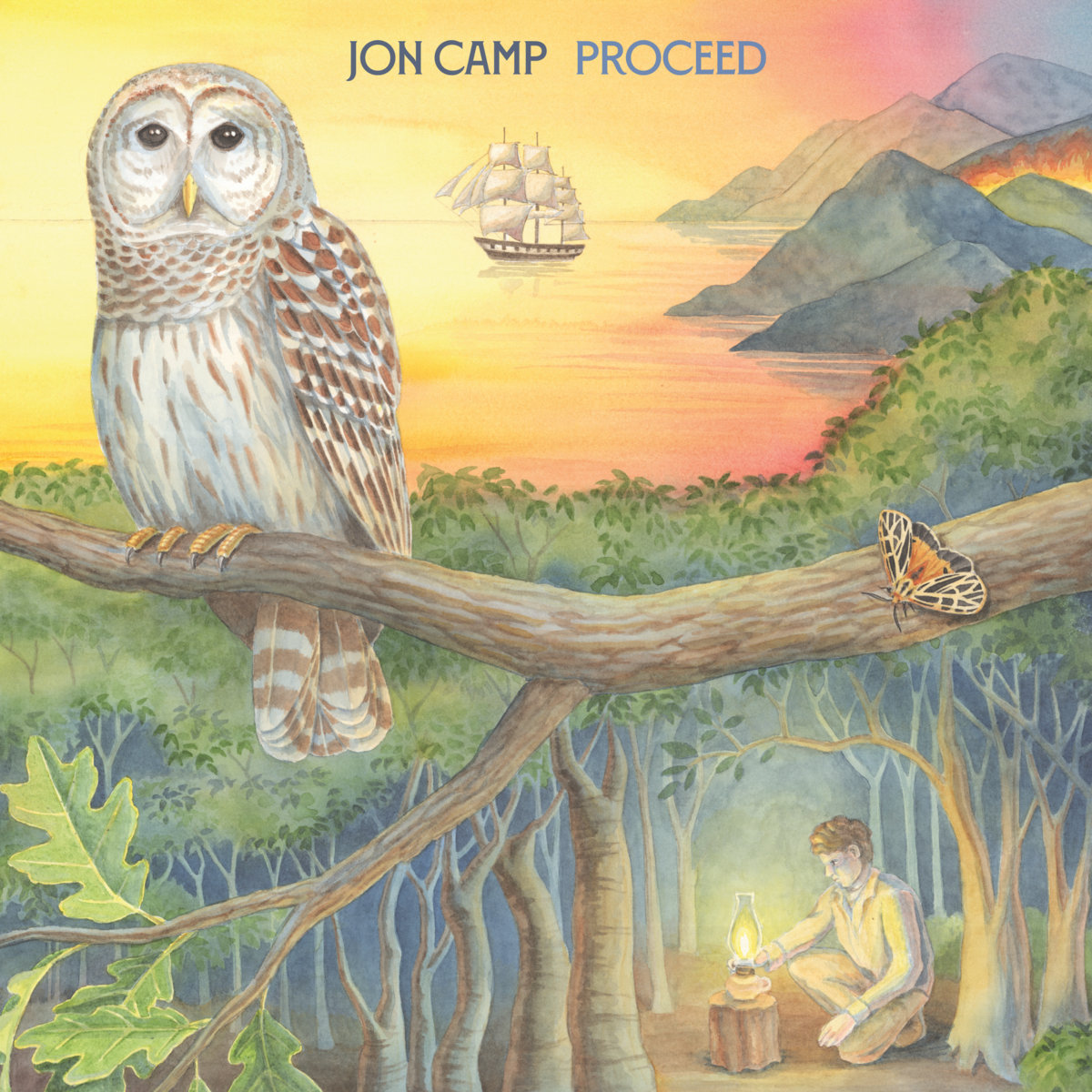
With ‘Proceed,’ Jon Camp makes a decisive turn, not away from intimacy, but toward amplitude. The album finds Camp stepping fully into electric full-band territory, and in doing so, he reveals that collaboration is not a dilution of his voice but its natural extension. If his earlier work often felt like solitary reflection, ‘Proceed’ feels like communal reckoning: a gathering of trusted musicians circling a set of compositions that wrestle with inheritance, ecology, politics, and endurance.
Camp has long been associated with intricate fingerstyle guitar and patient compositional arcs, yet here his Telecaster’s B-bender and the vibrato shimmer of his Creston guitar animate a sound that is more tensile, more forward-leaning. Producer and mixer Kevin Bernsten, now five albums deep into a working relationship with Camp, captures that shift with clarity. The result is neither a departure from the spaciousness of 2019’s ‘Headwinds & Tailwinds’ nor a simple amplification of it. Instead, ‘Proceed’ is defined by propulsion; by the refusal to remain static in the face of personal and cultural gravity.
The album opens with “Mining Twilight,” a title that suggests excavation at the edge of day. Dave Jones’ guitar threads through Camp’s own lines with a conversational elasticity, while Kaitlin Grady’s cello lends a burnished undertow. Drew Gardner’s vibraphone flickers like distant light, and Scott Verrastro’s drumming keeps the piece grounded without hemming it in. The effect is liminal: dusk not as an ending but as a threshold. Camp’s glockenspiel accents feel almost geological, small crystalline details embedded in a larger sonic terrain.
“Bombus Bombus” (named after the bumblebee), moves with a jittery, pollinating energy. Ryan Peterson’s drums give the track a nervous system, and Jones’ synth lines hum and dart in tight formation with Camp’s guitar. There is an ecological subtext here, but it never feels didactic. Instead, the music embodies fragility and resilience in equal measure, suggesting the delicate labor of sustaining a world that seems perpetually on the brink.
“Kerosene Goodbye” is among the album’s emotional centers. Inspired by Camp’s father’s childhood transition from kerosene light to electricity on an Iowa farm, the piece glows with a kind of sepia-toned reverence. Jamie Linder’s pedal steel bends toward memory without collapsing into nostalgia, and Grady’s cello lines deepen the sense of generational continuity. Peterson’s drumming is restrained, allowing Camp’s electric piano to color the margins. The track feels like a farewell not only to a fuel source but to an era; a meditation on progress that neither romanticizes the past nor blindly celebrates modernity.
“Partisan’s Folly” shifts the lens outward. With Joseph Allred contributing Hammond organ, bass clarinet, and even bongos, and David Sexton’s accordion adding a wry, almost Brechtian edge, the composition takes on a theatrical quality. Verrastro’s drums punctuate rather than drive, giving the arrangement room to expand. The title hints at political miscalculation, but Camp avoids caricature. Instead, the music seems to ask how conviction curdles into rigidity, how collective ideals fracture into factional noise.
The title track stands as the record’s thesis statement. Simone Baron’s accordion interlocks with Linder’s pedal steel in a subtle dance, while Matthew Byars joins Peterson behind the kit to create a layered rhythmic foundation. Nick Arrivo’s bass anchors the ensemble with understated authority. Camp’s guitar lines arc upward, bending toward resolution but never quite settling. The track embodies the album’s core ethos: forward motion not as triumphalism, but as necessity. To proceed is not to conquer; it is to endure.
From the “Big Bang” to the Battle of Oriskany” is the record’s most overtly ambitious piece, telescoping cosmic and historical time into a single instrumental narrative. Allred’s harmonium and Hammond organ broaden the harmonic palette, Linder’s Moog synth introduces a faintly sci-fi sheen, and Gardner’s vibraphone returns to add metallic shimmer. Verrastro’s drums and hand percussion give the composition a ceremonial cadence. The track suggests that human conflict is but a brief flare in a vast continuum, yet it does not minimize its cost. Instead, it situates personal and national histories within a larger, almost humbling frame.
“Dropping By” offers a moment of relative intimacy. Allred’s organ playing is warm and unhurried, and Arrivo’s bass feels conversational, as if leaning across a kitchen table. The piece carries the spirit of the nightly talks with Camp’s parents that partly inspired the album. It feels domestic in the best sense; music made not for spectacle but for presence. Closing track “Sixteenth of April” brings the ensemble back into full focus. Verrastro’s drumming propels the piece with a restrained urgency, and Jones’ guitar interlocks with Camp’s in a final affirmation of shared language. The composition feels date-specific yet open-ended, as though marking a personal anniversary that resonates beyond its particulars. There is no grand crescendo, only a steady insistence on continuation.
Throughout ‘Proceed,’ Camp’s playing remains the gravitational center, but the album’s power lies in its collective fluency operates within a framework of deep listening. This is music that trusts space as much as sound. ‘Proceed’ resists confinement. It draws from folk in ethos rather than form, from ambient country without succumbing to drift, from post-rock without bombast. More than anything, it feels lived-in. These compositions carry the weight of years of performance and the quiet discipline of daily practice. They acknowledge heaviness (familial, political, ecological) yet refuse paralysis.
To proceed, in Camp’s framing, is both a personal survival instinct and a cultural imperative. The album does not promise clarity about what lies ahead. Instead, it offers something more durable: a model of how to move forward together, attuned to the past, awake to the present, and unafraid of complexity. In that sense, ‘Proceed’ is less a declaration than an action. An action that continues to unfold long after the final notes fade.
Learn more by visiting: Bandcamp | Instagram | Facebook | X.