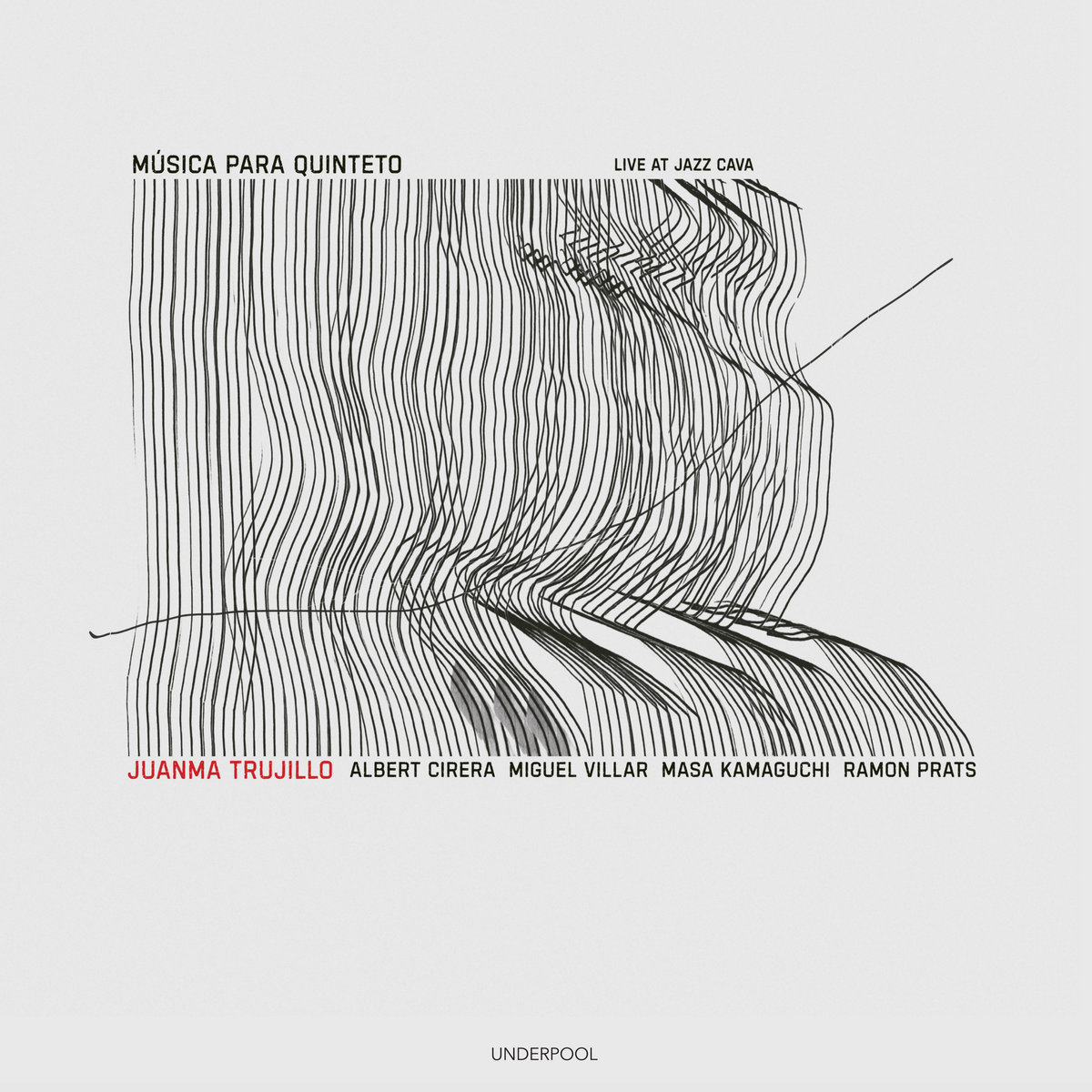
Recorded in the charged acoustics of Vic’s Jazz Cava during the 27th Vic Jazz Festival, ‘Música Para Quinteto (Live at Jazz Cava)’ captures Juanma Trujillo at a pivotal point in his artistic relocation to Barcelona, where displacement becomes less a biographical detail than a compositional force. This is his first outing as a bandleader since that move, and it arrives not as a declaration of arrival but as an assertion of process; music built in real time, exposed to audience, space, and the unpredictability of collective improvisation. Around Trujillo’s guitar and compositional framework, Albert Cirera and Miguel “Pintxo” Villar on tenor saxophones, Masa Kamaguchi on double bass, and Ramon Prats on drums form a quintet that operates less as hierarchy than as responsive organism.
“Howl” opens the set with immediate physicality, Trujillo’s guitar articulating motifs that feel both skeletal and expansive. Cirera and Villar enter not in unison but in overlapping lines, creating a polyphonic surface that resists simplification. Kamaguchi’s bass anchors the harmonic field with understated authority, while Prats shapes the temporal flow with a drumming approach that prioritizes gesture over regularity. The piece establishes a core principle of the performance: structure exists, but it is continuously negotiated.
“Conflagration (For Los Angeles)” extends this language into a broader register of intensity and spatial suggestion. The dedication is not illustrative but atmospheric, its sense of place emerging through accumulation rather than depiction. Trujillo’s phrasing becomes more angular here, his lines intersecting with the saxophones in ways that suggest friction without resolution. Cirera and Villar, both deeply attuned to micro-variation, push the harmonic environment outward, while Kamaguchi and Prats maintain a fluid, responsive undercurrent that prevents the ensemble from settling into fixed roles. At over ten minutes, the piece sustains its own internal logic without relying on repetition as anchor.
“Humo (For Andrew Hill)” shifts the ensemble toward a more reflective mode. The reference to Hill is not ornamental; it informs the piece’s approach to space, fragmentation, and harmonic ambiguity. Trujillo allows phrases to dissipate before fully resolving, while the saxophones respond with lines that feel conversational rather than declarative. Kamaguchi’s bass work is particularly striking here, offering counter-melodies that subtly reorient the harmonic center. Prats, meanwhile, introduces a lighter, almost suspended rhythmic texture that resists forward propulsion in favor of lateral movement.
“Jardín,” the longest composition on the record, functions as both culmination and open field. Its duration allows the quintet to explore a wide range of interactional modes without settling into predictable cycles. Trujillo’s guitar becomes increasingly textural, at times receding into the ensemble fabric rather than standing apart from it. Cirera and Villar engage in extended dialogue, their tenor voices distinct yet interwoven, producing a layered brass presence that feels both architectural and ephemeral. Kamaguchi and Prats provide a foundation that is never static, shifting subtly in response to harmonic and rhythmic cues that arise spontaneously within the group.
What distinguishes this performance is not individual virtuosity, though each musician demonstrates it in abundance, but the quality of listening that governs the ensemble’s behavior. Trujillo’s compositional approach allows for openness without surrendering coherence, creating frameworks that invite divergence while maintaining a shared sense of direction. Cirera and Villar bring contrasting tenor vocabularies that enrich the harmonic field rather than compete within it. Kamaguchi’s bass functions as both grounding force and melodic participant, while Prats’ drumming consistently reframes the temporal experience of each piece.
Recorded live and preserved with clarity by Sergi Felipe at UnderPool Studio, ‘Música Para Quinteto (Live at Jazz Cava)’ retains the immediacy of its setting without romanticizing it. The presence of audience space, room resonance, and unedited interaction becomes part of the compositional fabric rather than external documentation. Trujillo’s work here situates itself within contemporary jazz discourse not by expanding its vocabulary in abstract terms, but by reasserting the importance of collective presence, real-time decision-making, and the porous boundary between composition and improvisation. The result is a record that operates as both document and proposition. It captures a specific ensemble at a specific moment, yet its implications extend beyond that frame, suggesting a mode of practice where authorship is distributed, and musical meaning emerges through sustained, attentive exchange.
Learn more by visiting Bandcamp and UnderPool.