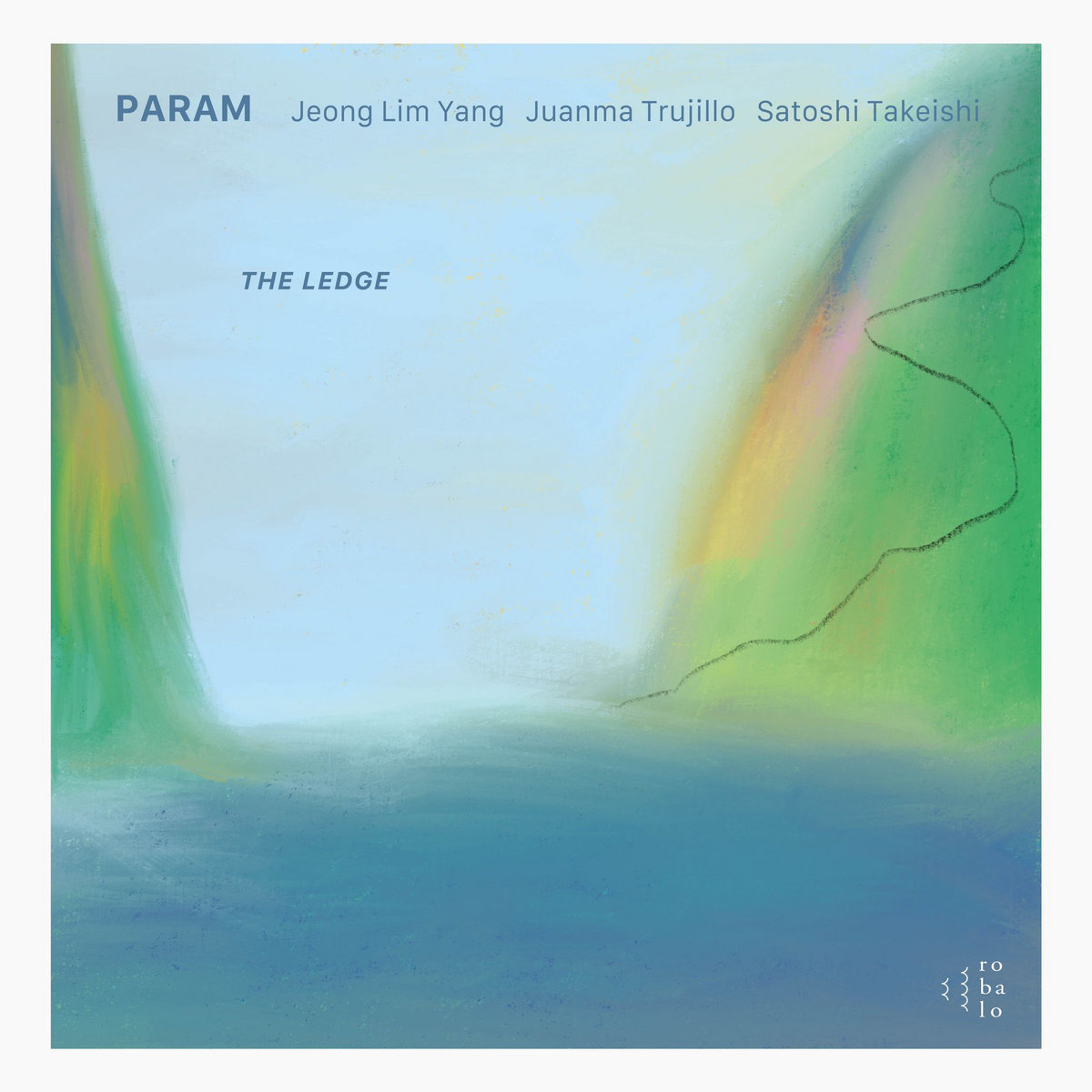
Collaboration becomes the central compositional principle on ‘The Ledge,’ where Jeong Lim Yang, Juanma Trujillo, and Satoshi Takeishi construct a shared language that resists simple division of roles. Rather than presenting a conventional leader-plus-accompanists dynamic, the trio operates as a continuously recalibrating system, each musician shaping the direction of the music as much through restraint as through assertion. Recorded in Brooklyn and mixed by Trujillo himself, the album carries the imprint of collective authorship while maintaining a striking internal coherence.
“Ordinary Waltz,” composed by Yang, opens the record with a measured sense of motion that quietly resists the predictability implied by its title. Yang’s bass work is immediately central, not as accompaniment but as narrative force, outlining harmonic pathways that Trujillo’s guitar responds to with careful, often elliptical phrasing. Takeishi’s drumming avoids conventional metric emphasis, instead introducing subtle shifts in emphasis that keep the piece in constant redefinition. The result is a form of waltz that acknowledges its structure only to gently reposition it.
“Chico,” a Trujillo composition, moves into a more expansive register. Here, guitar and bass engage in a more pronounced dialogue, with Yang’s lines offering both counterpoint and propulsion. Takeishi’s contribution remains fluid, shaping transitions rather than marking them. The piece suggests geographic and emotional displacement without settling into narrative certainty, its forward motion continually refracted through small harmonic deviations.
Title track “The Ledge” introduces synthesizer textures from Trujillo, adding a new dimensional layer to the trio’s established interplay. The synth does not dominate but instead hovers at the edges of the arrangement, subtly altering the perception of space. Yang’s bass becomes more exploratory, moving between grounding figures and more fragmented gestures, while Takeishi’s drumming emphasizes negative space as much as rhythm. The composition’s sense of suspension is carefully managed, never tipping into stasis.
“Morning Glory,” another Yang composition, offers a contrasting clarity. Its melodic contours are more direct, though still subject to subtle distortion through performance nuance. Trujillo’s guitar lines here are more vocal in quality, often mirroring or extending the bass melody rather than countering it. Takeishi’s drumming introduces a gentle propulsion that keeps the piece from settling into simplicity, maintaining a sense of forward inquiry. “Exposure,” by Trujillo, shifts the balance again, introducing a more angular approach to phrasing. The interplay between instruments becomes more fragmented, though never disjointed. Yang’s bass anchors the harmonic field while also introducing unexpected shifts in direction, and Takeishi responds with percussive decisions that prioritize texture over regular pulse. The piece suggests revelation not as climax but as gradual exposure to shifting perspectives.
“Sebastian,” composed by Yang, narrows the focus into a more intimate frame. The trio operates with heightened sensitivity to decay and resonance, allowing notes to linger without extension. Trujillo’s guitar work is particularly restrained here, favoring sparse interventions that leave space for Yang’s melodic intent to remain central. Takeishi’s drumming is understated, functioning almost as environmental suggestion rather than structural component.
“Hope” reintroduces a more open harmonic field, though its emotional register remains carefully modulated. Trujillo’s compositional voice here aligns closely with Yang’s interpretive sensibility, creating a seamless exchange of melodic ideas. The trio’s interaction suggests forward movement without directional certainty, maintaining a delicate equilibrium between expectation and deferral.
“Weeping Dream,” another Trujillo composition, deepens the album’s engagement with abstraction. The harmonic language becomes more fluid, less anchored to stable reference points. Yang’s bass lines take on a more textural role, while Takeishi’s drumming emphasizes continuity through subtle variation rather than repetition. Trujillo’s guitar alternates between clarity and dissolution, shaping the piece’s emotional contour through absence as much as presence. “Sebastian Reprise,” returning to Yang’s thematic material, reframes earlier ideas within a slightly altered context. Rather than functioning as closure, it offers reinterpretation, shifting emphasis across familiar motifs. The trio’s interplay here is particularly refined, each musician responding to memory as compositional material rather than static reference.
Across ‘The Ledge,’ the contributions of Yang, Trujillo, and Takeishi are inseparable from the work’s structural identity. Yang’s bass provides both harmonic foundation and melodic agency, Trujillo’s guitar and synth work expand the trio’s sonic vocabulary without overwhelming its balance, and Takeishi’s drumming operates as a constantly adaptive framework that resists fixed interpretation. Recorded by Chris Gilroy and mastered by Mariano Míguez, the album preserves this interplay with clarity and precision, allowing each decision (whether structural or spontaneous), to remain audible within the ensemble’s collective voice.
What emerges is not a hierarchy of roles but a continually negotiated field of sound, where composition and improvisation coexist without clear boundary. ‘The Ledge’ sustains its focus through interaction rather than assertion, offering a model of trio performance defined by attentiveness, restraint, and shared authorship.
Find out more by visiting Param and Robalo Music.