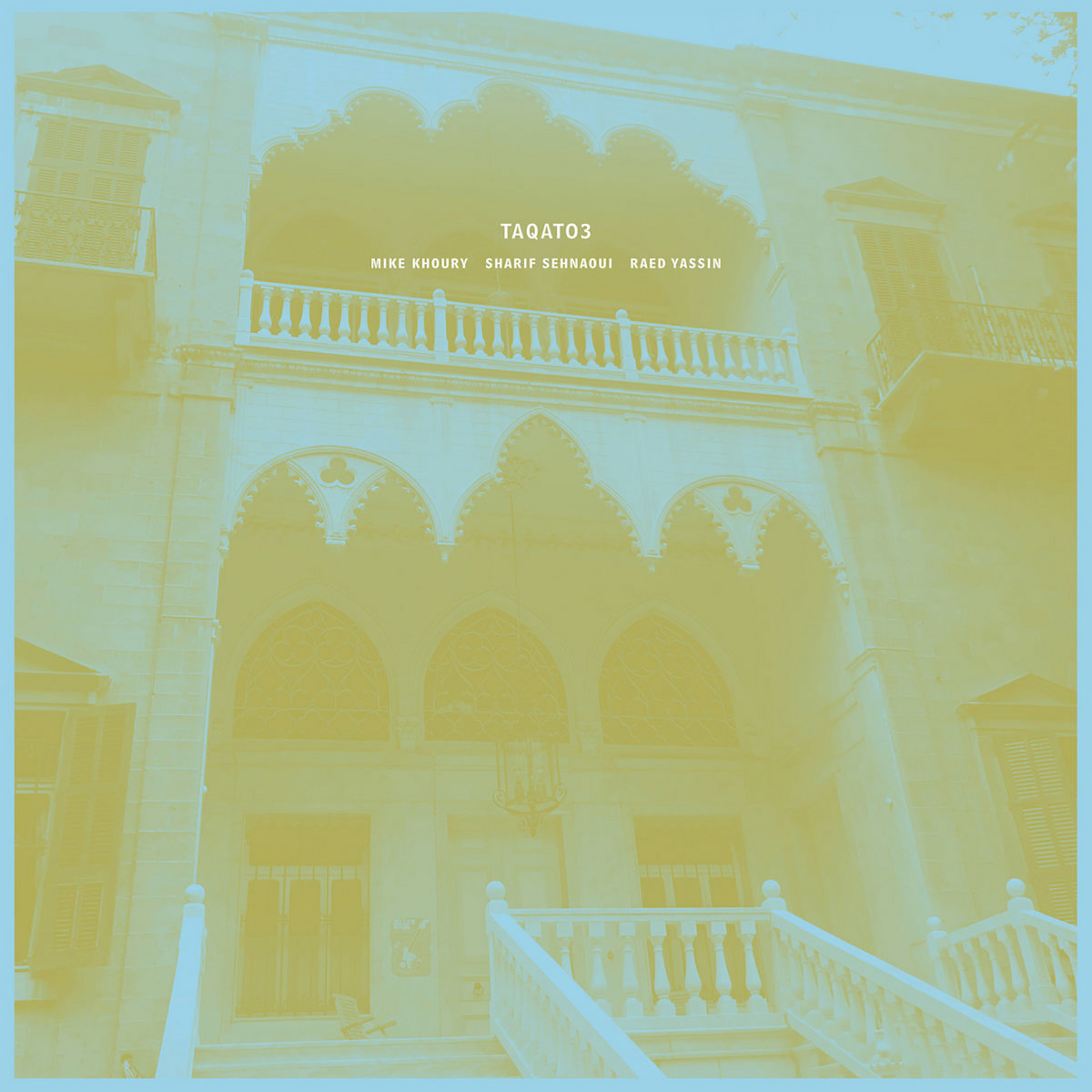
‘TAQATO3’ by Mike Khoury, Sharif Sehnaoui, and Raed Yassin captures an encounter that feels less like a meeting of individuals than the reactivation of a shared, preexisting language. Recorded live within the resonant interior of Bustros Palace in Beirut, the album carries with it the weight of accumulated history, not as a burden but as a subtle pressure shaping every gesture, every silence, every decision made in real time.
“3ibara” establishes the trio’s collective sensibility with remarkable immediacy. Khoury’s violin does not assume a traditional melodic role; instead, it hovers, probes, and occasionally pierces the surface with lines that feel both deliberate and exploratory. Sehnaoui moves between guitar and percussive textures, introducing fragmented figures that seem to question the violin’s assertions, while Yassin grounds the exchange with a bass presence that is at once sparse and decisive. The piece operates as a kind of threshold, opening a space where structure and intuition coexist without hierarchy.
In “Ard,” the trio leans into a more grounded vocabulary, though not in any conventional sense of stability. Yassin’s approach to the double bass, often incorporating objects and unconventional techniques, creates a shifting foundation that resists predictability. Sehnaoui’s guitar work becomes more textural, favoring resonance and decay over linear phrasing, while Khoury navigates this terrain with a heightened sensitivity to timbre. The music suggests an engagement with the material properties of sound itself, as though each note were being examined from multiple angles before being allowed to dissipate.
“Liqaa” brings a subtle shift in emphasis, foregrounding interaction as a form of dialogue rather than confrontation. Khoury’s violin lines begin to trace more extended arcs, though they remain deliberately incomplete, inviting response rather than resolution. Sehnaoui answers with gestures that blur the distinction between string and percussion, while Yassin’s bass provides a quiet but persistent continuity. The trio’s communication here feels almost conversational, yet it avoids any sense of narrative closure, maintaining an openness that keeps the listener engaged in the act of interpretation.
The brevity of “3amar” lends it a concentrated intensity. Ideas emerge and recede with little warning, creating a sense of fleeting coherence that is never fully stabilized. Khoury’s playing becomes more incisive, Sehnaoui introduces sharper contrasts in texture, and Yassin responds with understated but strategically placed interventions. The piece functions as a compressed study in collective responsiveness, demonstrating how quickly the trio can pivot without losing cohesion.
“Shaddeh,” the album’s longest track, serves as its conceptual and emotional center. Here, the trio allows time to become an active element in the music, stretching and compressing it through sustained focus and gradual transformation. Khoury explores the full range of the violin’s expressive possibilities, from near-silence to more assertive declarations, while Sehnaoui expands his palette through the use of bouzouki and percussive techniques that add layers of density and contrast. Yassin’s bass anchors the piece without ever confining it, offering pulses and textures that suggest continuity even as the surface remains in flux. The result is a deeply immersive experience that rewards attentive listening, revealing new relationships between sounds with each passing moment.
“Ofok” closes the album with a sense of quiet recalibration. Rather than seeking a definitive conclusion, the trio opts for a more reflective approach, allowing space and restraint to shape the final statements. Khoury’s violin becomes increasingly sparse, Sehnaoui’s contributions grow more understated, and Yassin’s bass recedes into a subtle presence that supports without dominating. The piece leaves the impression of an open horizon, a continuation beyond the recorded frame rather than a resolution within it.
What distinguishes ‘TAQATO3’ is not simply the technical proficiency of its performers but the depth of their collective listening. Khoury, Sehnaoui, and Yassin engage with one another in a manner that prioritizes responsiveness over assertion, creating music that feels both spontaneous and deeply considered. Their individual histories in experimental and improvised contexts inform the performance, yet the album resists any sense of stylistic codification. Instead, it presents a fluid, evolving language that draws from multiple traditions without being confined by any of them.
The setting of Bustros Palace, with its layered past and enduring presence, resonates throughout the recording. One can sense the acoustics of the space shaping the music, amplifying certain frequencies while absorbing others, contributing to a sound that feels inseparable from its environment. This interplay between place and performance adds another dimension to the album, reinforcing its central concern with the relationship between sound, space, and perception.
‘TAQATO3’ stands as a compelling document of what can emerge when musicians meet with a shared openness and a willingness to relinquish control. It does not seek to impress through virtuosity alone, nor does it rely on conceptual framing to justify its existence. Instead, it invites the listener into a space of attentive engagement, where meaning is not imposed but discovered through the act of listening itself.
To learn more, please visit Bandcamp | Raed Yassin | 2182 Recording Company.