
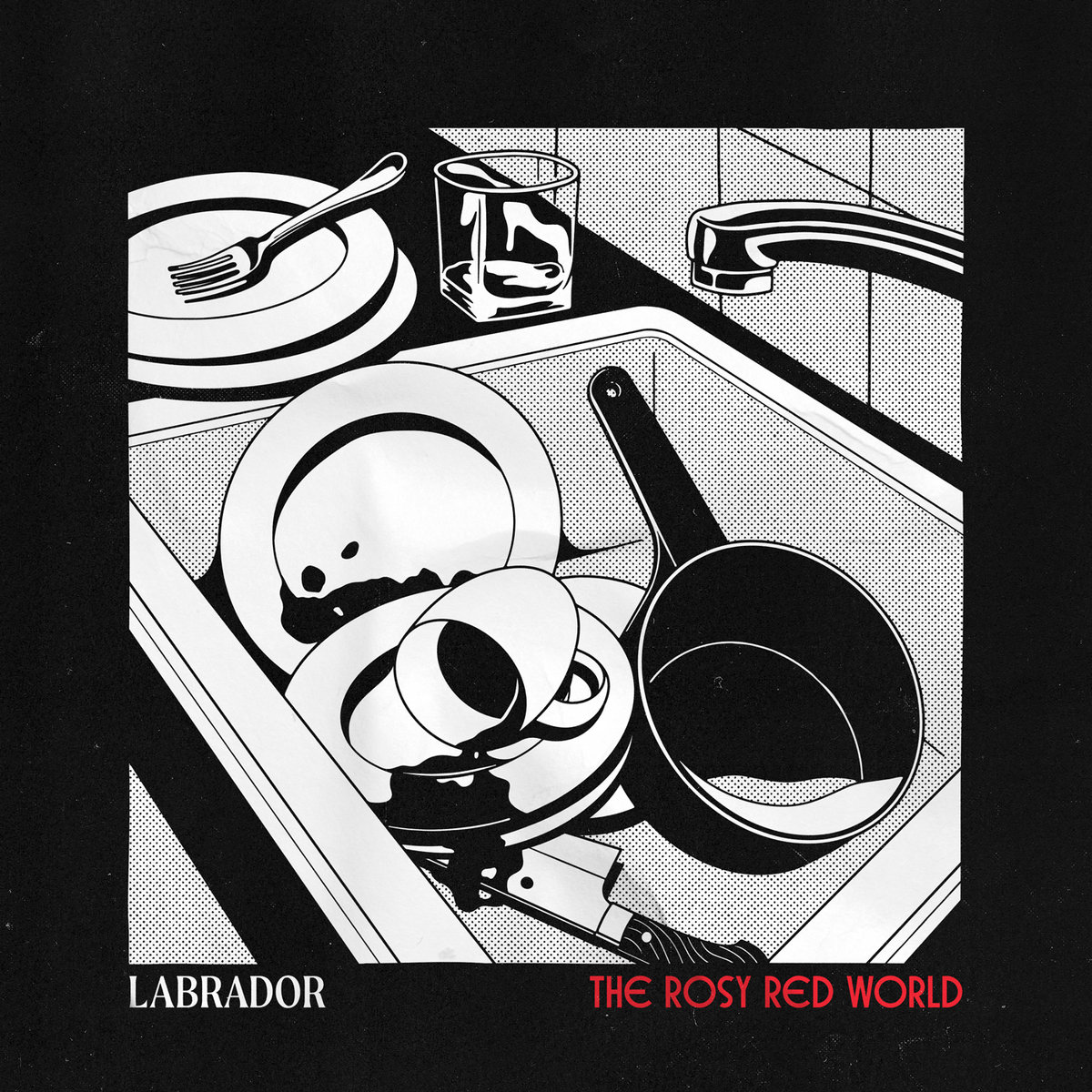
Labrador’s ‘The Rosy Red World’ arrives with the confidence of a record that has already wrestled with despair long before the listener presses play. What Pat King and his bandmates have assembled is not merely a collection of politically conscious rock songs, nor an exercise in revivalist Americana dressed in the dust of old protest records. It is a deeply considered work about ownership, responsibility, collapse, and solidarity, filtered through the language of bar-band rock and sharpened by historical memory. The album stares directly into social ruin without surrendering to paralysis, transforming exhaustion into momentum and outrage into communal release.
The opening title track, “The Rosy Red World,” establishes the album’s philosophical center with remarkable precision. King’s repeated cry of possession lands with deliberate instability, suspended between accusation and reclamation. The ambiguity is the point. His vocal delivery carries the exhaustion of somebody witnessing systems devour human life while still insisting that collective resistance remains possible. Musically, the band leans into a rolling, hard-driving pulse that evokes pub rock urgency and anti-war punk without lapsing into nostalgia. Kris Hayes’ guitar work burns through the arrangement in sharp, melodic streaks while Steve Kurtz anchors the performance with drumming that feels both disciplined and barely containable. The track does not posture as revolutionary fantasy; it sounds like people attempting to preserve moral clarity in the middle of civic decay.
That emotional balancing act continues with “Slow Down, King,” one of the album’s most affecting performances. Labrador understands that political records fail when they abandon intimacy, and this song restores the human scale after the opener’s broader social panorama. Slide guitar curls through the arrangement with a weary elegance, giving the song the atmosphere of an all-night drive through industrial outskirts and empty highways. King’s voice, often ragged around the edges in exactly the right way, communicates a kind of reluctant self-awareness here, as though the narrator recognizes his own susceptibility to the same cycles of consumption and ambition he critiques elsewhere.
Matt Schimelfenig’s additional keys deepen the track’s melancholy undertow without overwhelming its sparse beauty.
“Too Much Wanting” detonates the reflective mood with a burst of velocity that recalls the confrontational immediacy of late-70s punk filtered through roots rock traditions. Labrador excels at marrying melody with agitation, and this track may be the clearest example of that instinct. The guitars slash forward in bright, almost triumphant patterns while the rhythm section barrels underneath with ecstatic force. Yet beneath the energy lies a bitter meditation on appetite as ideology. The song frames greed not simply as personal failing but as a societal engine that normalizes exploitation and transforms cruelty into aspiration. Will Hochgertel’s bass playing deserves particular attention here; his lines do not merely support the arrangement but actively propel its sense of restless urgency.
“We Drew Straws” follows with an even sharper sense of fatalism. The title itself suggests arbitrary sacrifice, and the song captures the psychological machinery of systems that assign suffering unevenly while insisting upon inevitability. Labrador avoids simplistic sloganeering by grounding the politics in emotional texture rather than rhetoric alone. Hayes and King’s intertwined guitar parts create a nervous propulsion that mirrors the instability described in the lyrics, while Kurtz’s percussion injects a barely restrained volatility into every transition. The band sounds less interested in delivering answers than in documenting the psychic consequences of modern power structures.
“Metaphors For Love” may be the album’s most sophisticated composition because it understands romance and politics as interconnected forms of vulnerability. Rather than separating private feeling from collective struggle, Labrador presents emotional language itself as compromised terrain. The song questions whether tenderness can survive in cultures dominated by commodification and violence. Musically, it swings with a wiry exuberance that prevents the thematic weight from becoming oppressive. Schimelfenig’s subtle keyboard textures provide warmth around the edges while the guitars maintain a sense of forward pressure that keeps the track emotionally unsettled.
The quieter moments on ‘The Rosy Red World’ are equally essential to its architecture. “Waiting To Be Useful” carries profound sadness without collapsing into resignation. Country influences emerge most strongly here, particularly through the measured pacing and aching slide guitar passages, yet Labrador avoids imitation. The song is not interested in genre authenticity as performance; instead, it uses familiar musical forms to examine alienation and self-worth under economic systems that condition human value through productivity. King sings with understated vulnerability, allowing the song’s emotional devastation to surface gradually rather than theatrically.
“Kill Kill Kill” reintroduces aggression with startling effectiveness. The repetition of the title transforms it from provocation into diagnosis, exposing the normalized brutality embedded within political discourse and entertainment alike. The track channels garage-rock ferocity without sacrificing compositional discipline. Kurtz delivers some of his strongest drumming on the album, balancing chaos and precision with remarkable instinct. Labrador’s ability to sustain such intensity without sounding performative speaks to the band’s chemistry and conviction. “Your Home Is An Eyesore” functions as one of the album’s most biting critiques of bourgeois insulation and aestheticized privilege. Yet even here, Labrador refuses caricature. The song understands that alienation infects every social layer, though not equally. Musically, it carries a swaggering looseness that contrasts effectively with its lyrical bitterness. Hayes’ guitar lines snake through the mix with sharp wit, giving the song an almost sardonic energy.
“Wagers” serves as the emotional reckoning before the finale. The arrangement carries a bruised grandeur, built around the idea that every political and emotional commitment involves risk without guarantee. Labrador captures the exhaustion of continuing to hope while recognizing how often history punishes optimism. Hochgertel and Kurtz form a particularly formidable rhythm section here, creating momentum that feels heavy with consequence rather than triumph. Closing with “No Man Is An Island” is a bold choice because the song’s legacy carries enormous symbolic weight. Labrador approaches the Rondalis Tandy composition not as preservationists but as participants in an ongoing conversation about solidarity. Drawing inspiration from Horace Andy’s interpretation while reshaping the arrangement into something fiercer and more volatile, the band transforms the track into a culmination of the album’s moral argument. The guitars practically tear through the song’s framework before reconstructing it around communal endurance. What emerges is neither reverence nor revisionism but continuation.
Throughout ‘The Rosy Red World,’ Labrador demonstrates an unusually mature understanding of protest music’s limitations and possibilities. Too many contemporary political records either collapse into sanctimony or retreat into detached irony. Labrador chooses a more difficult path. These songs acknowledge brutality without romanticizing despair, and they pursue hope without pretending that optimism arrives naturally. The album’s weathered sonic palette reflects this duality perfectly. Recorded in Philadelphia and the Poconos, the music carries the atmosphere of regional history, labor, displacement, and survival embedded within its very texture.
Pat King proves himself not just a compelling songwriter but a perceptive architect of emotional contradictions. His production allows every musician room to shape the album’s identity. Hayes’ guitars provide both abrasion and melody, Hochgertel’s bass playing grounds the songs with muscular intelligence, and Kurtz’s drumming injects relentless physicality into even the album’s quieter passages. Schimelfenig’s contributions on keys and percussion enrich the record’s emotional dimension without diluting its immediacy. Greg Obis’ mastering preserves the album’s raw force while giving the performances clarity and weight. ‘The Rosy Red World’ refuses to separate political consciousness from ordinary human feeling. Labrador understands that systems of exploitation do not merely destroy economies or governments; they reshape friendships, intimacy, memory, and identity itself. These songs inhabit that reality fully. The result is a record that sounds urgent not because it shouts loudest, but because it recognizes how difficult genuine solidarity has become and insists upon it anyway.