
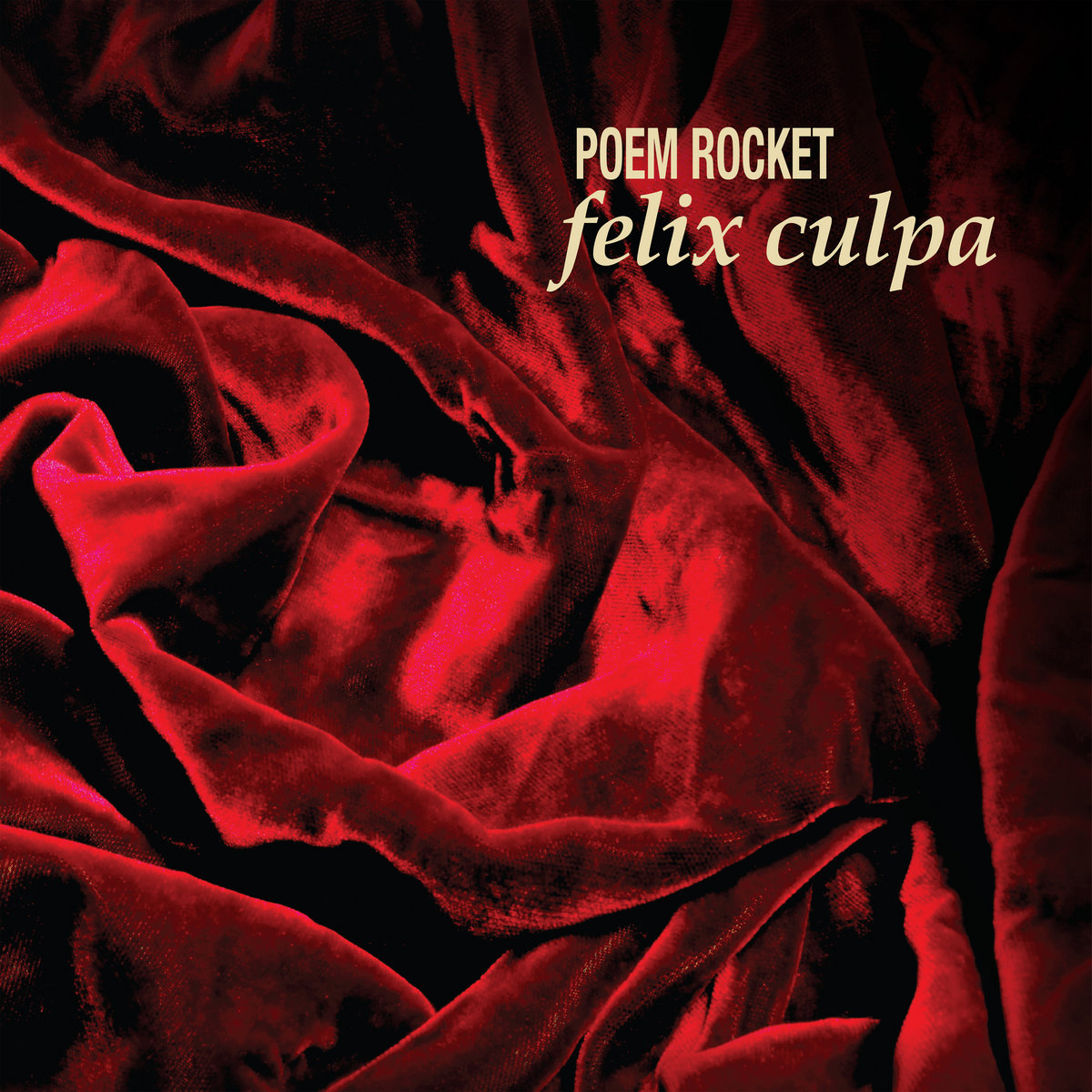
Three decades after its original appearance, Poem Rocket’s ’Felix Culpa: The 30th Anniversary Edition’ is not as an artifact preserved in amber but as a document still vibrating with nervous intelligence. Remastered by Kris Poulin, the collection captures a band operating outside the predictable architecture of American indie rock during the mid-1990s, building music that seemed suspended between dream logic and structural collapse. Poem Rocket approached melody with suspicion, noise with delicacy, and emotional disclosure with a strange combination of intimacy and distance. Listening now, the album sounds uncannily contemporary precisely because it never attempted to belong to its own moment.
The musicianship across the record carries an improvisational looseness without ever descending into shapelessness. Michael Peters’ electric and acoustic guitars function less as traditional harmonic anchors than as emotional weather systems, shifting suddenly from brittle dissonance to aching melodic clarity. Sandra Gardner’s bass playing and multi-instrumental contributions provide the album’s elusive center of gravity. Her piano and vibraphone parts add a ghostly luminosity to songs that might otherwise drift entirely into abstraction. Andrew Nelson’s drumming resists conventional rock propulsion; his rhythms stumble, sway, and fracture in ways that make each composition feel unstable yet strangely alive. Dennis Bass contributes keyboards and textural interventions that seem determined to sabotage linearity itself, introducing bursts of sonic debris that continually reshape the emotional contours of the album.
“Eject” serves as both opening statement and warning. The song enters abruptly, as though interrupting an ongoing transmission rather than beginning a carefully sequenced album. Peters’ guitar lines twitch and scrape against Nelson’s restless percussion while Gardner’s voice hovers just above the arrangement, detached but emotionally charged. The remaster sharpens the song’s internal contrasts, revealing details previously buried beneath the original mix’s murk. “Deus Absconditus” deepens the album’s theological and philosophical undercurrents. The title references the hidden God of existential uncertainty, and the music mirrors that instability beautifully. Gardner sings with an almost conversational restraint while the instrumentation circles around her in fragmented patterns. What might have become merely obscure instead acquires emotional force through precision. Every fractured rhythm and dislocated melodic phrase seems carefully calibrated to evoke spiritual disorientation.
“Contrail de l’ Avion” remains one of the album’s defining achievements. The song possesses a fragile elegance that never hardens into prettiness. Gardner’s vocals drift through the composition with narcotic calm while Peters layers guitars that shimmer like damaged film stock. Nelson’s drumming is especially remarkable here, refusing predictable crescendos in favor of subtle destabilization. The result evokes motion without destination, a kind of suspended emotional flight. Even after thirty years, the track resists easy categorization. It occupies a space somewhere between post-rock, dream pop, avant-garde folk, and abstract chamber music without fully surrendering to any of them. “Small White Animal” introduces a quieter menace. The arrangement moves with careful restraint, allowing tiny sonic details to acquire enormous emotional significance. Gardner’s bass lines pulse beneath the surface like suppressed anxiety while Dennis Bass injects electronic coloration that gives the track an eerie translucence. The song’s title suggests vulnerability, but the music conveys something more ambiguous: innocence already contaminated by experience.
“Flaw” condenses the band’s aesthetic philosophy into miniature form. Imperfection here becomes generative rather than destructive. Peters’ guitar work deliberately resists polish, and Nelson’s drumming sounds as though it is continuously renegotiating its own tempo. Rather than correcting instability, Poem Rocket foreground it as emotional truth. “Milky White Entropy” may be the album’s most unsettling composition. The title itself suggests decay disguised as purity, and the music follows that contradiction relentlessly. Vibraphone tones drift through distorted textures while Gardner’s vocals maintain a chilling calmness. The song creates psychological discomfort not through aggression but through slow erosion, as though coherence itself is dissolving in real time.
“Period (punctuation, or the amount of time required for a cyclic motion)” reveals the group’s fascination with repetition and recurrence. The extended title risks self-consciousness, yet the music transforms intellectual playfulness into something emotionally resonant. Nelson’s percussion patterns loop with hypnotic persistence while Peters and Bass destabilize the harmonic structure through subtle dissonances. The track meditates on cycles both cosmic and personal, suggesting emotional histories from which escape may be impossible. “Pretty Baby” offers the closest approximation to conventional beauty on the album, though even here Poem Rocket refuse sentimentality. Gardner sings with heartbreaking restraint, avoiding melodrama entirely. The arrangement surrounds her voice with acoustic fragility and distant electronic interference, as though tenderness itself is struggling to survive inside an increasingly fractured environment.
“The Animal Planter” pushes further into surrealism. The composition moves unpredictably, guided less by traditional songcraft than associative logic. Peters’ guitar lines seem to search constantly for stable ground while Nelson’s drumming introduces bursts of near-chaotic energy. Yet beneath the abstraction lies a strange emotional clarity. Poem Rocket understand that surrealism functions best when tethered to recognizable feeling. “Furry Evil Bird” remains gloriously difficult. The song balances absurdity and menace with remarkable confidence, channeling post-punk angularity through an avant-garde sensibility. Dennis Bass’ contributions become especially significant here, adding layers of electronic distortion that transform the track into something simultaneously playful and threatening. The piece sounds perpetually on the verge of collapse, which gives it much of its peculiar vitality.
“Flight Manual” acts as a meditation on navigation and failure. The arrangement feels sparse compared to earlier tracks, allowing each instrumental gesture to gain greater emotional weight. Gardner’s piano lines introduce fleeting moments of clarity before Peters’ guitars cloud the atmosphere once again. The song captures the album’s recurring fascination with systems breaking down: communication systems, emotional systems, spiritual systems. Closing track “Blue Chevy Impala” grounds the album in something almost mythically American. After so much abstraction and fragmentation, the image of the car arrives with startling emotional force. Yet Poem Rocket refuses easy nostalgia. The song treats memory as unstable terrain, constantly shifting beneath the listener’s feet. Gardner and Peters sound emotionally exhausted but unwilling to retreat into cynicism. The composition drifts toward silence rather than resolution, leaving behind the sensation of having witnessed not simply an album but a psychological landscape.
What singles out ’Felix Culpa: The 30th Anniversary Edition’ from many rediscovered underground records is how little it depends upon historical context for its power. The album does not survive merely because it anticipated future trends. It survives because Poem Rocket pursued emotional and sonic ambiguity with rare conviction. Peters, Gardner, Nelson, and Dennis Bass created music uninterested in commercial certainty or genre allegiance, and that refusal grants the record its enduring vitality. The remastering illuminates details previously obscured, but the deeper revelation comes from recognizing how fearless the original recordings already were. Poem Rocket understood that vulnerability and experimentation need not exist in opposition. ’Felix Culpa: The 30th Anniversary Edition’ stands as a portrait of artists willing to risk incoherence in pursuit of emotional honesty, and that willingness gives the album its strange, enduring radiance.
For more details, please visit Silver Girl Records | Poem Rocket