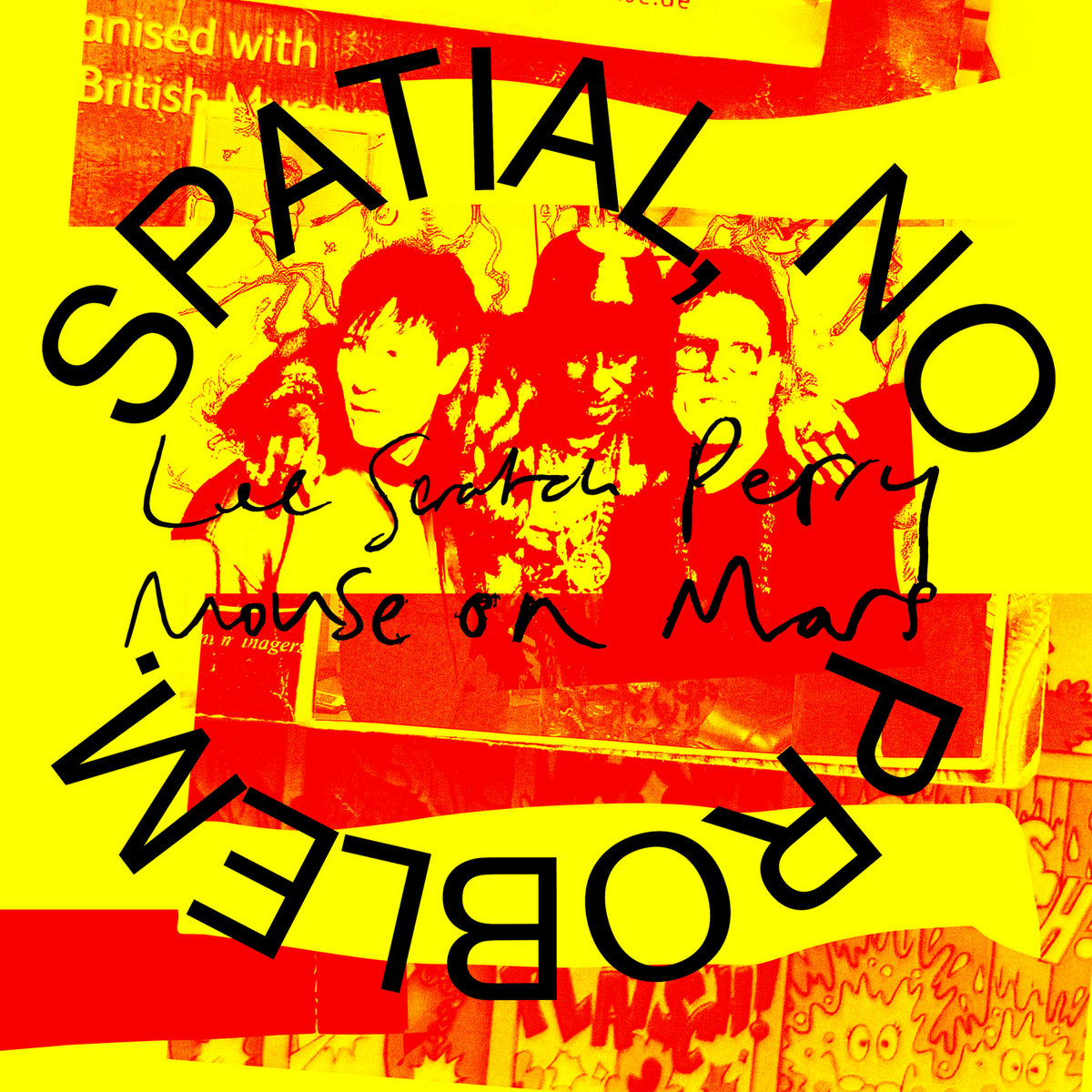
Few artists spent their careers dismantling musical boundaries with the gleeful determination of Lee “Scratch” Perry (1936 – 2021). Across decades, he transformed the recording studio into an instrument, a laboratory, a spiritual chamber, and a site of perpetual reinvention. That spirit remains vividly present on ‘Spatial, No Problem’, a remarkable collaboration with German electronic visionaries Mouse on Mars (Jan St. Werner and Andi Toma), that now carries an additional emotional resonance as Perry’s final official album project before his passing. Yet approaching the record merely as a farewell would diminish its significance. This is not an epitaph. It is a celebration of restless creativity, a work animated by curiosity, experimentation, and the refusal to accept stylistic limitations.
Recorded over just three days at Mouse on Mars’ Paraverse Studio in Berlin, the album possesses an energy that is both spontaneous and surprisingly cohesive. Rather than constructing a conventional collaboration in which Perry’s unmistakable voice is simply placed atop electronic backdrops, the project functions as a genuine exchange of ideas. Perry, St. Werner, and Toma create an environment where dub, krautrock, ambient music, jazz, electronic abstraction, and New Orleans brass traditions intermingle freely, generating a sound world that remains impossible to categorize with precision.
The opening track, “Rockcurry,” immediately establishes the album’s playful unpredictability. Rhythms collide and mutate, electronic textures dart across the stereo field, and Perry enters not as a commanding frontman but as a mischievous guide leading listeners through unfamiliar terrain. The track captures the record’s central premise: music as a constantly shifting organism rather than a fixed structure. “Hallo Shiva” expands this philosophy into something even more adventurous. Layers of percussion, synthetic tones, and fragmented melodic ideas circulate around Perry’s vocal presence, creating a dialogue between ritualistic energy and technological experimentation. The composition reflects a lifelong characteristic of Perry’s artistry; his ability to treat language not simply as communication but as sonic material. Words become rhythm, texture, invocation, and provocation simultaneously.
With “Economic Train,” the album begins exploring movement in a broader sense. The track evokes machinery, transit systems, and social networks without relying on literal representation. Mouse on Mars excel at creating electronic environments that suggest activity and transformation, and here they provide Perry with a dynamic framework within which his observations can roam freely. The result is music that sounds perpetually in motion, refusing stable coordinates. The wonderfully titled “Spatialee” functions as a statement of purpose. Space itself becomes the composition’s primary subject. Sounds appear, vanish, and re-emerge in altered forms, emphasizing depth and dimension rather than linear progression. Perry’s fascination with the metaphysical aspects of sound production finds an ideal partner in Mouse on Mars’ sophisticated approach to electronic architecture. Together, they transform the listening experience into something akin to navigating a living environment.
One of the album’s most fascinating pieces, “Fire Dali”, channels the surrealist spirit suggested by its title. Musical ideas arrive unexpectedly, often defying conventional logic while maintaining an internal coherence. Perry spent decades cultivating an artistic persona that blurred distinctions between prophet, trickster, philosopher, and performance artist. Here, those identities coexist effortlessly. The track radiates creative freedom, embracing absurdity as a means of discovering new forms of meaning. “Yayaya” introduces a lighter, more communal energy. Vocal fragments, rhythmic patterns, and electronic interventions interact with an almost celebratory spirit. Yet beneath its playful exterior lies a sophisticated understanding of repetition and variation. Mouse on Mars manipulate familiar elements just enough to prevent predictability, while Perry injects every phrase with his singular sense of character.
The album reaches one of its most accessible moments with “To The Rescue”. Its rhythmic foundation provides a degree of stability rare within the broader context of the record, allowing listeners a temporary foothold amid the constant experimentation. Even here, however, conventional expectations remain secondary to discovery. The track demonstrates how effectively Perry and Mouse on Mars balance spontaneity with structure, creating music that remains engaging without sacrificing complexity. Closing piece “State Of Emergency” serves as an appropriate conclusion to an album built upon perpetual transformation. Rather than delivering resolution, it amplifies the sense of possibility that defines the record. Sounds continue to shift and evolve, suggesting that creative exploration persists beyond any individual composition. For an artist whose career was defined by innovation, no ending could be more fitting.
What makes ‘Spatial, No Problem’ particularly striking is the chemistry between its principal architects. Perry’s voice carries decades of accumulated experience, cultural memory, and creative intuition. St. Werner and Toma respond not with reverence but with imagination, treating Perry as an active collaborator rather than a historical figure. This approach allows the music to remain vibrant and forward-looking. The revolving cast of musicians and contributors who moved through the various rooms of the Paraverse Studio further enriches the album’s character, reinforcing its sense of collective invention and spontaneous dialogue.
The record also highlights an often-overlooked aspect of Perry’s legacy. While he is rightly celebrated as a foundational figure in dub and reggae, his deeper contribution lies in his understanding that recorded sound itself is a limitless medium. Throughout his career, he approached music with the curiosity of an explorer encountering unfamiliar territory. That same curiosity animates every moment of ‘Spatial, No Problem’. Many posthumously significant releases acquire their importance through context rather than content. This album succeeds because the music itself remains extraordinary. It captures three artists operating without concern for genre expectations or commercial formulas, pursuing ideas wherever they might lead. The result is a work that sounds simultaneously playful, profound, bewildering, and joyous.
As a final chapter in Lee “Scratch” Perry’s recorded legacy, ‘Spatial, No Problem’ encapsulates the qualities that made him one of modern music’s most singular figures. It celebrates experimentation over certainty, imagination over convention, and possibility over limitation. More than a closing statement, it stands as a reminder that artistic innovation is not a destination but a perpetual state of becoming. Few musicians embodied that principle more completely than Perry, and few final recordings affirm it with such vitality.
For more information or to have a listen, please visit Domino Recording Co. | Bandcamp