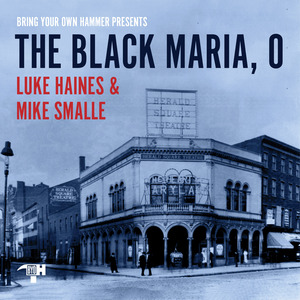
Luke Haines and Mike Smalle open “The Black Maria, O” across a gap of nearly 140 years. The words come from 1887, while synthesizers, programmed rhythm and electric guitar place them inside a colder, sharper musical world. That distance never disappears. It becomes the song’s tension.
The original “The Black Maria, O” was written by Irish American lyricist Edward Harrigan with composer David Braham for the musical comedy McNooney’s Visit. Its title draws on “Black Maria,” slang for the police wagons that carried prisoners through late nineteenth century New York, while the lyric reaches toward the criminal world surrounding the prison on Blackwell Island. Haines and Smalle leave that language intact, allowing its age and unfamiliarity to remain audible.
Smalle’s new music gives it a completely different body. A dark electronic pulse runs underneath the track while guitars and synth textures keep disturbing its surface. There is a severe elegance to the arrangement, but it never settles into pure atmosphere. The rhythm keeps moving forward while small abrasions gather around it, creating something cool, dramatic and increasingly uneasy.
That tension keeps “The Black Maria, O” from becoming an archival curiosity. Smalle treats Harrigan’s words as living material rather than something to restore faithfully. The language remains rooted in another century, but the music puts it under a different kind of pressure. The effect is strange in the best way, as though an old street song has suddenly found itself running through electrical wiring.
Haines’ vocal adds another layer of friction. His voice sits high and close in the mix, dry and sharply defined against the instrumentation. Instead of grounding the song in period gravity, his delivery makes the lyric feel more nervous and slightly removed from its surroundings. It is an unusual fit for such old language, and that mismatch becomes part of the track’s character.
The production is less convincing when everything is pushed too tightly together. The vocal occasionally occupies space the finer electronic textures could use, and some details become harder to distinguish as the arrangement thickens. But the construction underneath remains strong. Smalle’s Korg MiniKorg 700s, programming and electric guitars establish a precise frame, while Haines’ guitar work roughens its edges.
Then the frame begins to give way.
As the song approaches its final stretch, the metallic clatter grows louder. What first registers as texture starts to feel more physical, as though machinery is moving somewhere inside the track. A swell of voices and public commotion begins to gather around it, and the arrangement becomes denser, less composed and more volatile.
That escalation changes the scale of the song. “Black Maria” stops feeling like an antique phrase preserved inside an old lyric. Metal, noise and human agitation make the machinery behind the words easier to feel. The track never attempts to recreate an 1887 street literally, but the ending finds a contemporary sound for the pressure inside Harrigan’s language.
The animated video by visual artist and filmmaker Jules Hackett extends that collision between archive and reinvention. Rather than explaining every reference, it gives the song another contemporary surface and leaves the unfamiliarity of the source material intact.
“The Black Maria, O” belongs to Bring Your Own Hammer’s forthcoming From The Tombs, the second album in its Music & History Series. The 21 song double album turns toward crime, law and order in nineteenth century Ireland and among the Irish diaspora, bringing historical scholarship directly into the writing and recording process. Curated by Dr. Richard Mc Mahon, with historical support from Dr. Niall Whelehan, the project gives musicians access to documents, stories and songs that might otherwise remain confined to archives.
Haines and Smalle make that exchange audible. Harrigan’s lyric remains unmistakably old, while Smalle’s composition never disguises its contemporary instincts. Neither side is absorbed completely into the other. The excitement comes from hearing them coexist, then gradually begin to disturb one another.
By the closing moments, the polished electronic pulse has been crowded by metal, noise and commotion. What began as an intriguing meeting of nineteenth century lyric and dark electronic pop has become something less stable. The old language has not been translated or cleaned up. It has simply been given enough new force to start moving again.
That is where “The Black Maria, O” lands hardest. Haines and Smalle do not make the past feel alive by insisting on its importance. They let an old song enter a new musical vocabulary and allow the resulting friction to do the work. By the time the arrangement begins to come apart at the edges, 1887 no longer feels quite as distant.
“The Black Maria, O” is out now via Bring Your Own Hammer and Dimple Discs. The single previews From The Tombs, due in November 2026.
The Black Maria, O video
Get the single
Bandcamp
Spotify
Apple Music
Bring Your Own Hammer releases
Bring Your Own Hammer online:
Website
Bandcamp
Facebook
Instagram
YouTube
Spotify