
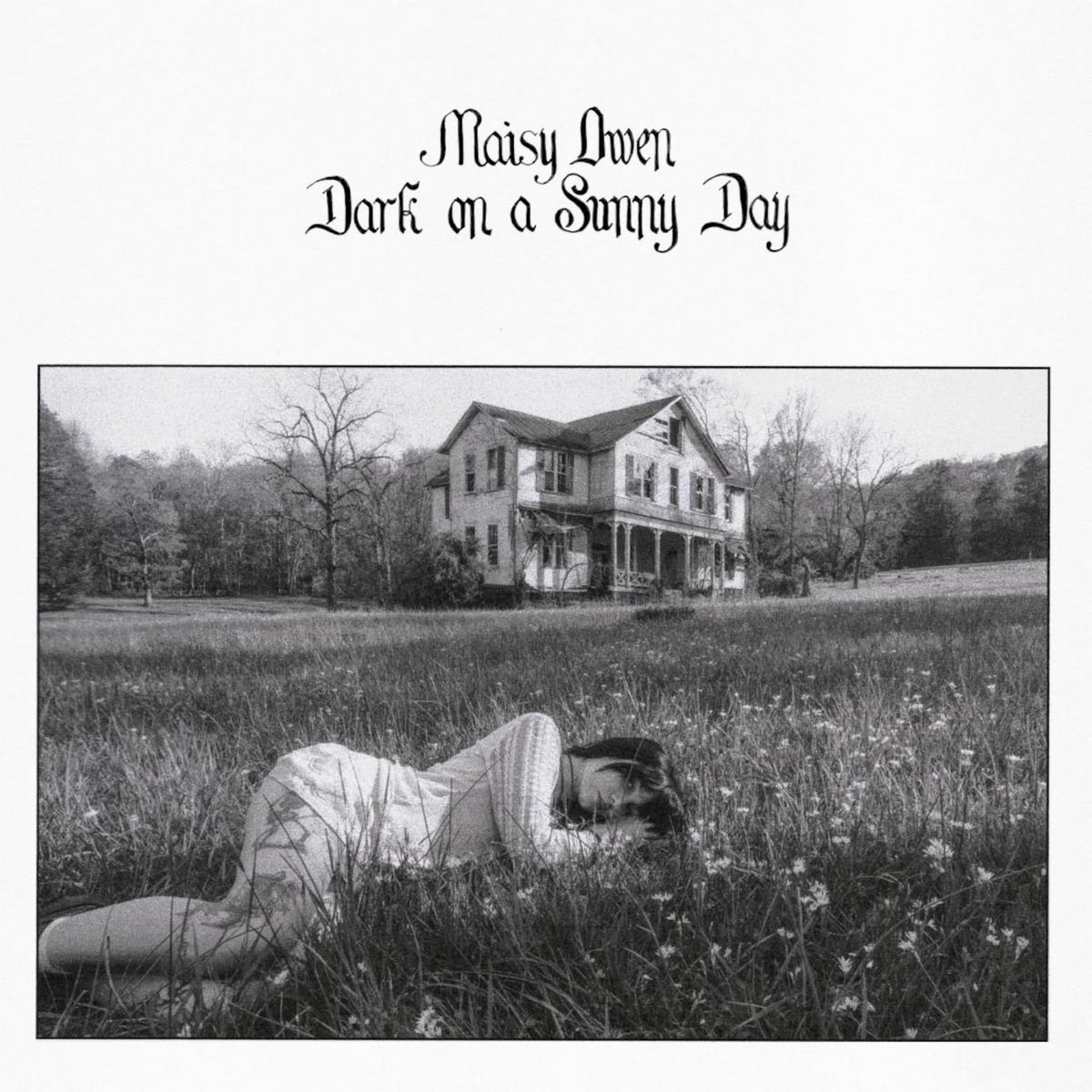
For a debut album, ‘Dark on a Sunny Day’ arrives with remarkable assurance. Maisy Owen writes and performs with the confidence of an artist who has spent years quietly refining her craft, absorbing influences without becoming beholden to them. The result is a record that embraces folk traditions while refusing to be confined by them, balancing intimacy and expansiveness through songs that are emotionally direct yet rich with ambiguity. Across eight concise tracks, Owen demonstrates an uncommon gift for transforming personal reflection into something universal, allowing melancholy, longing and self-examination to coexist with moments of surprising strength.
The album opens with “My Youth is All For You”, a song that immediately establishes Owen’s distinctive voice as both songwriter and performer. Her fingerpicked guitar provides a delicate framework, but it is the emotional precision of the lyric that commands attention. Rather than romanticising youth, Owen presents it as a form of sacrifice, a currency spent in pursuit of connection and meaning. Her vocal delivery avoids melodrama, finding power in restraint and creating a sense of vulnerability that resonates long after the song concludes. That same economy of expression characterises “Letters”, one of the album’s most affecting moments. Built around sparse instrumentation and a melody that lingers in the mind, the song explores absence and memory without resorting to sentimentality. Owen understands that the most profound emotional weight often resides in what remains unsaid. The arrangement, supported by Robin Eaton’s bass work, leaves ample space for the song’s emotional undercurrents to emerge naturally.
The title track, “Dark on a Sunny Day”, broadens the album’s sonic palette. Here, Owen and producer Robin Eaton introduce a fuller folk-rock dynamic that contrasts beautifully with the preceding material. Roger Moutenot’s lap steel lends the track a subtle cinematic quality, while John Radford’s drumming provides momentum without overwhelming the song’s reflective core. The contrast embedded within the title becomes the thematic centre of the piece, capturing the strange coexistence of brightness and sorrow that defines much of the album’s emotional landscape. “The Rest of Me” serves as a fascinating midpoint. Produced by Owen herself and featuring Dan Seymour on upright bass, the song feels especially personal, as though listeners have been granted access to an unfinished thought or private confession. The brevity of the track works in its favor, concentrating its emotional impact into a few memorable minutes. Owen’s viola, an instrument that has accompanied her since childhood, adds subtle color and texture, reinforcing her identity as a musician whose arrangements emerge organically from the songs themselves.
One of the album’s standout achievements arrives with “On My Way Down”. The song exemplifies Owen’s ability to find beauty within emotional decline. The melody carries a quiet inevitability, while the lyric confronts uncertainty with striking clarity. Rather than dramatize despair, Owen examines it with curiosity and honesty. The result is a song that feels deeply human, neither defeated nor triumphant, but fully aware of life’s complexities. “I Can Be Just Like You” introduces another dimension to Owen’s songwriting. Beneath its graceful exterior lies a sharp examination of influence, imitation and identity. Supported by Paul Defiglia’s upright bass and Eaton’s bass contributions, the arrangement possesses a gentle propulsion that complements the song’s thematic concerns. Owen explores the ways individuals absorb the qualities of others, questioning whether resemblance is a form of admiration, surrender or survival.
The album reaches one of its darkest emotional spaces with “God Fear”. Here, Owen wrestles with inherited beliefs and personal reckonings through imagery that is both evocative and unsettling. Defiglia’s upright bass adds depth and resonance, while Radford’s understated percussion grounds the song in a steady pulse. The performance captures the unease of confronting powerful ideas that continue to shape a person long after they have been intellectually challenged or abandoned. Closing track “It All Ends the Same” functions as both conclusion and reflection. Produced, engineered and mixed by James Russell, who also contributes piano, the song gathers many of the album’s recurring themes into a final meditation on impermanence. Yet despite its title, the piece does not descend into fatalism. Instead,
Owen finds a strange comfort in acceptance, recognizing that endings are inseparable from the experiences that precede them. Russell’s piano provides an elegant counterpoint to Owen’s vocal, creating a sense of closure that feels earned rather than imposed. A significant part of the album’s success lies in the collaborative musicianship surrounding Owen’s songwriting. Radford’s drums are consistently tasteful and responsive, never distracting from the songs’ emotional priorities. Moutenot’s lap steel adds atmosphere without excess. The contributions from Defiglia, Seymour, Eaton and Russell enrich the arrangements while preserving their essential clarity. Most impressive, however, is Owen herself, whose performances on guitar, viola, bass, piano and vocals reveal a musician deeply attuned to every aspect of her artistic vision.
‘Dark on a Sunny Day’ separates itself from many contemporary folk releases is its objection to present sadness as a defining identity. Owen is drawn toward darker emotional colors, but she approaches them with curiosity rather than resignation. Her songs seek understanding instead of catharsis, asking difficult questions without insisting upon definitive answers. The album’s greatest accomplishment is its emotional intelligence: it recognizes contradiction as a permanent feature of human experience and finds beauty within that uncertainty. With this debut, Maisy Owen establishes herself as a songwriter of uncommon depth and sensitivity. ‘Dark on a Sunny Day’ is a beautifully realized collection that honors folk traditions while asserting a voice entirely its own. It is an album marked by careful craftsmanship, emotional honesty and a rare ability to illuminate the complexities that exist beneath everyday experience. Far from simply introducing a promising new artist, it announces the arrival of a songwriter capable of turning private reflections into enduring art.
More information can be found at Tompkins Square | Bandcamp | YouTube | Instagram | Facebook