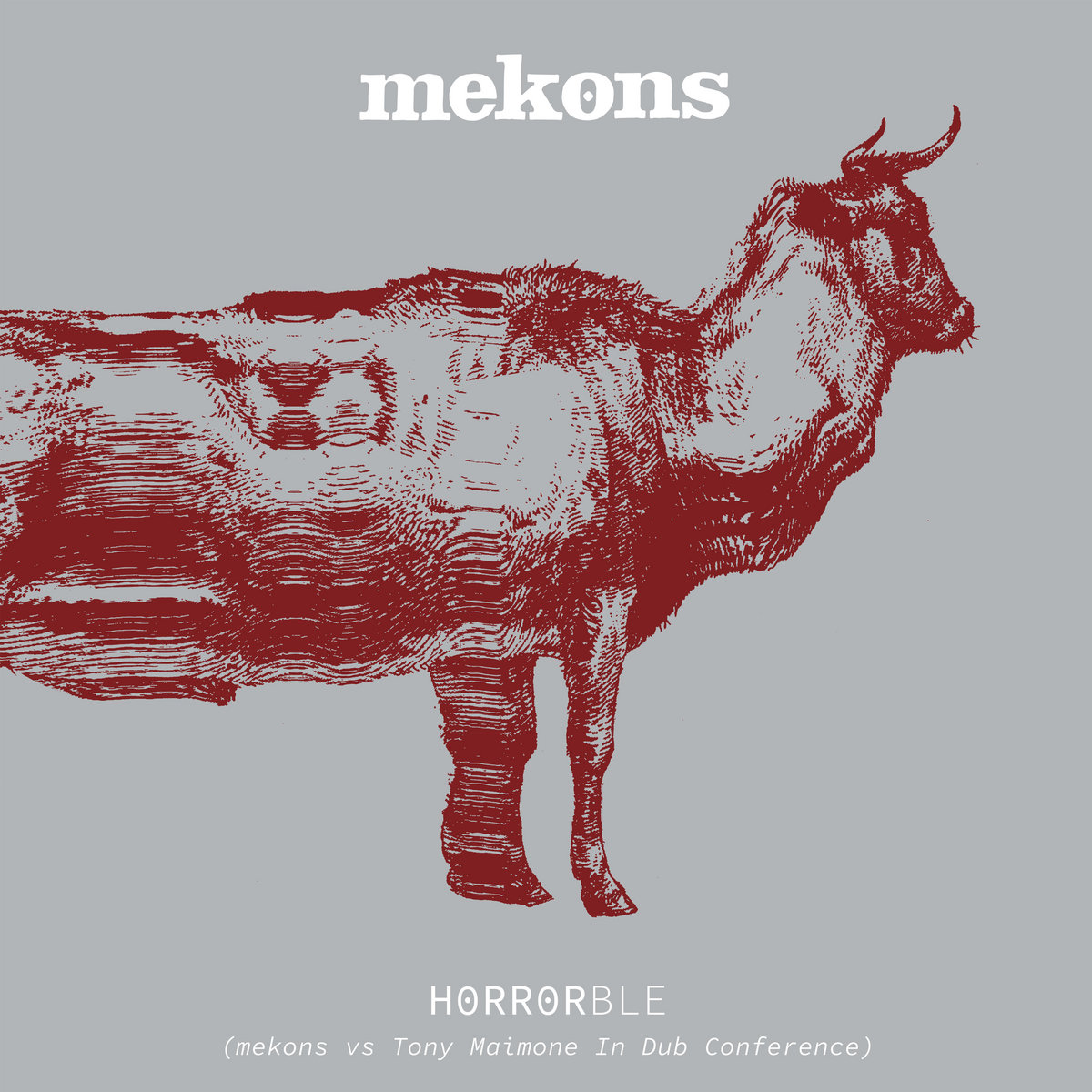
Few bands possess a catalog resilient enough to survive radical transformation without losing its identity. Fewer still possess the confidence to dismantle their own work so thoroughly. With ‘Horrorble (Mekons vs Tony Maimone In Dub Conference)’, Mekons and Tony Maimone undertake exactly that challenge, reconstructing the politically charged material of ‘Horror’ into a parallel work that examines the same anxieties from an entirely different perspective. Rather than functioning as a companion piece or collection of remixes, this album operates as a shadow narrative, extracting buried emotions and latent meanings from its source material through the language of dub.
The relationship between Mekons and Maimone extends back decades, and that history is audible throughout the record. Maimone, best known for his work with Pere Ubu, approaches these songs not as an outsider seeking to reinterpret them but as a longtime collaborator engaging in a conversation with familiar voices. The result is an album that respects the foundations of ‘Horror’ while refusing to preserve them intact. Melodies become fragments. Rhythms linger where verses once stood. Familiar structures dissolve into atmospheric spaces where uncertainty becomes the dominant emotional force.
Opening track “Before The Ice Age (Version)” establishes the album’s methodology immediately. Elements of the original composition drift through the mix like half-remembered transmissions, while bass and percussion assume a more commanding role. The title evokes a world standing at the edge of environmental collapse, and this version amplifies that implication by creating a sense of historical distance. The song sounds as though it is being transmitted from both the future and the past simultaneously, transforming ecological concern into something almost geological in scale. “Sad and Sad and Sad (Version)” pushes further into emotional abstraction. Stripped of conventional songcraft, the composition becomes a meditation on persistence rather than despair. Echoes stretch across the stereo field, creating a feeling of absence that proves more affecting than direct expression. What remains is not merely sadness itself, but the residue left behind after disappointment has settled into permanence.
Economic and political concerns continue to shape the album’s landscape. “War Economy (Version)” retains the urgency embedded in its title, but the mode of communication changes dramatically. Rather than confronting listeners through direct force, the track allows rhythms and bass patterns to carry the weight of its critique. Maimone understands one of dub’s most powerful principles: subtraction can communicate as effectively as addition. The spaces between sounds become as meaningful as the sounds themselves. “A Horse Has Escaped (Version)” introduces an element of instability that runs throughout the record. The image suggested by the title is one of disorder breaking free from containment, and the music mirrors that sensation through constantly shifting sonic relationships. Fragments emerge, disappear, and reappear in altered forms, creating an atmosphere of perpetual movement.
The album reaches one of its most fascinating moments with “The Western Design (Version).” On the original album, the song’s themes of power, history, and ideology carried a sharp political edge. Here, those concerns become spectral presences. The track examines the remnants left behind by political systems rather than the systems themselves, creating a sonic landscape populated by echoes of authority rather than declarations of it. “Glasgow (Version)” introduces a surprising emotional warmth amid the album’s broader unease. Even within its fractured structure, traces of melody rise to the surface, suggesting memory struggling against erosion. The city invoked by the title becomes less a geographical location than a repository of collective experience, shaped by labor, conflict, resilience, and change.
One of the album’s most poignant transformations occurs on “You’re Not Singing Anymore (Version).” The title carries an unmistakable sense of absence, and the dub treatment intensifies that quality. Voices emerge only partially before dissolving back into the surrounding atmosphere. The result is a meditation on disappearance itself, examining what remains after communication has broken down. “Private Defense Contractor (Version)” stands among the album’s most effective reinterpretations. Its subject matter, tied to the commodification of violence and the machinery of modern conflict, gains a chilling new dimension through the dub format. Rhythmic fragments ricochet through the arrangement while bass frequencies dominate the sonic field, creating an environment where power feels omnipresent yet strangely impersonal.
“Sanctuary (Version)” offers a temporary refuge, though not an uncomplicated one. The song questions the very notion of safety, suggesting that sanctuaries themselves may be fragile constructions vulnerable to external pressures. The arrangement balances serenity and unease, refusing to commit fully to either emotional state. By the time “Surrender (Version)” arrives, the album has developed a compelling dialectic between resistance and resignation. The track explores the ambiguity embedded within its title. Is surrender an act of defeat, acceptance, survival, or transformation? Mekons and Maimone wisely leave the question unresolved, allowing the music to occupy a space between those possibilities.
The guest appearance from Benji Webbe on “Mudcrawlers ft. Benji Webbe (Version)” introduces a striking new texture to the record. Webbe’s presence injects a sense of physical immediacy into an album often preoccupied with atmosphere and distance. His contribution complements rather than disrupts the project’s aesthetic, adding another layer to its ongoing exploration of mutation and reinvention. The track possesses a restless energy that distinguishes it from much of the surrounding material while remaining fully integrated into the album’s broader vision. “Fallen Leaves (Version)” serves as a reflection on impermanence. The imagery suggested by the title aligns perfectly with the album’s larger concerns. Throughout ‘Horrorble’, songs shed their original forms much as leaves separate from branches, entering new cycles of existence. This track captures that process beautifully, balancing melancholy with acceptance.
The bonus track “Dub Crawlers (Version)” functions as a fitting epilogue. Rather than providing closure, it deepens the album’s sense of open-ended exploration. The piece gathers fragments of ideas and atmospheres encountered throughout the record, presenting them in their most distilled form. It serves as a reminder that dub is not merely a genre or production technique but a philosophy of listening, one that values absence as much as presence.
What distinguishes ‘Horrorble (Mekons vs Tony Maimone In Dub Conference)’ is that it does not treat dub as a stylistic novelty. Maimone and Mekons understand that dub’s true power lies in its ability to expose hidden structures. By stripping away familiar surfaces, the album reveals dimensions of ‘Horror’ that might otherwise have remained obscured. Climate catastrophe, political decay, economic violence, and cultural fragmentation become less immediate but no less urgent when filtered through these echoing soundscapes.
The musicianship behind the project deserves particular recognition. Mekons have spent decades refining a collective approach that prioritizes ideas over virtuosity while never sacrificing musical intelligence. Their willingness to subject their own material to such extensive reconstruction reflects a rare artistic confidence. Maimone’s contributions prove equally essential, guiding the transformation with a deep understanding of both dub tradition and experimental rock’s exploratory spirit.
Far from existing as an auxiliary release, ‘Horrorble’ stands as a substantial artistic statement in its own right. It examines the same troubled world as its predecessor but from a different vantage point, replacing direct confrontation with reflection, atmosphere, and sonic archaeology. What emerges is not a diluted version of ‘Horror’ but its mirror image: darker in some respects, more contemplative in others, and every bit as compelling. The album demonstrates that reinvention remains one of the most powerful tools available to artists willing to question their own work, revealing unexpected possibilities within songs that seemed already complete.
For more information, please visit Fire Records | Bandcamp