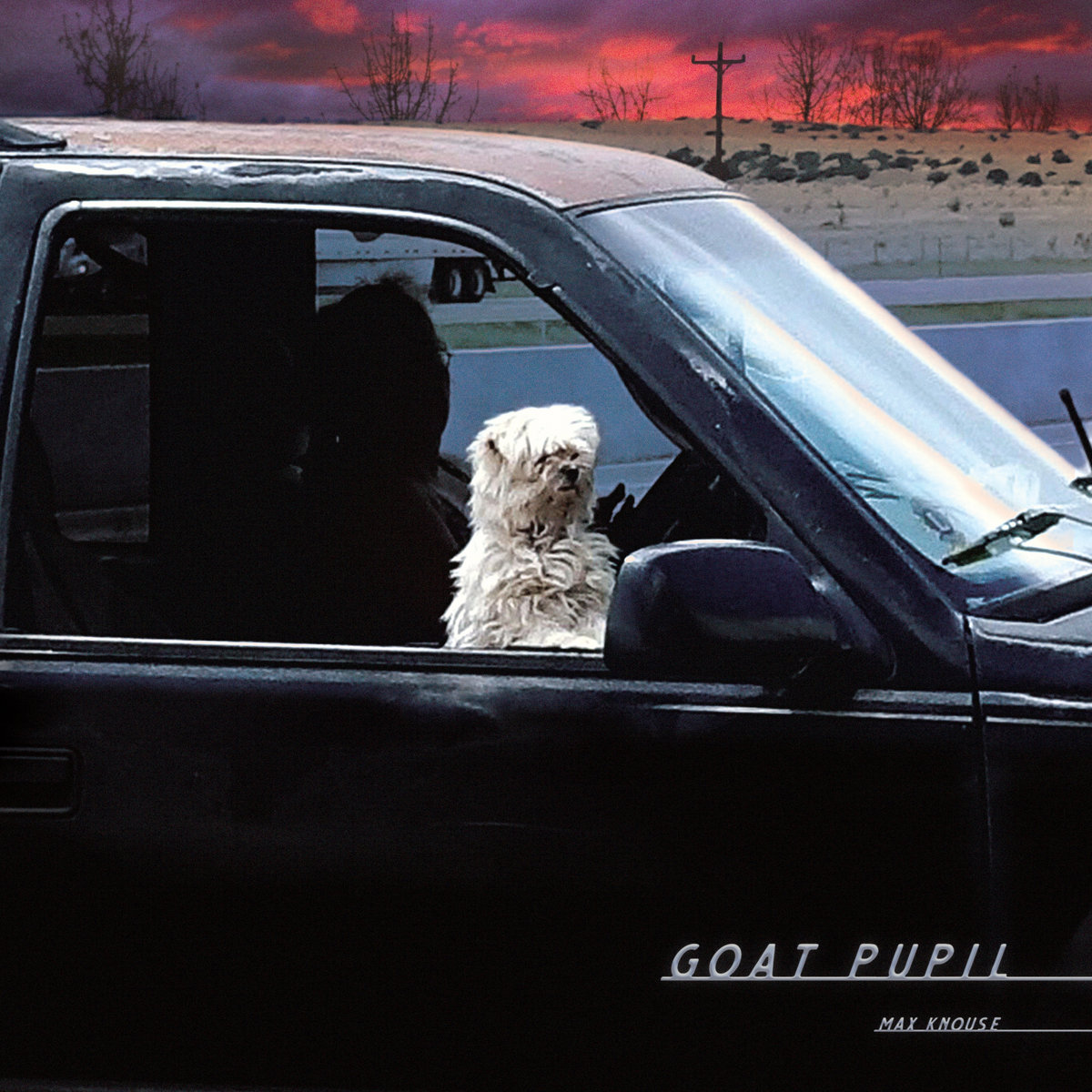
Few contemporary instrumental records manage to sound both meticulously composed and completely unguarded, yet Max Knouse’s ‘Goat Pupil’ inhabits that uncommon territory with remarkable assurance. Rooted in modern jazz but never confined by convention, the album presents ten concise meditations that value atmosphere as highly as melody, allowing every gesture to carry narrative weight without resorting to unnecessary virtuoso display. Knouse writes with the confidence of someone who understands that restraint can be every bit as expressive as technical brilliance, and the trio format becomes an ideal vehicle for a collection that prizes conversation over exhibition.
“Dubane,” immediately establishes this philosophy. Written by Michael Krassner rather than Knouse, it serves as a thoughtful overture, introducing the record’s spacious aesthetic while demonstrating how naturally the ensemble inhabits another composer’s language. Ben Lumsdaine’s drumming is attentive without becoming ornamental, constantly reshaping the rhythmic landscape through subtle accents and shimmering cymbal work. Bailey Zick’s double bass anchors the performance with remarkable elasticity, giving Knouse ample room to move between lyrical phrases and harmonic detours without sacrificing momentum.
“Like a Rocket Stage” expands the vocabulary established in the opener, balancing fluid improvisation with a melodic sensibility that lingers long after its closing notes. Knouse’s phrasing is especially compelling here, favoring lines that seem to search for unexpected destinations rather than predictable resolutions. Every pause appears intentional, every phrase carefully weighted. Instead of treating silence as absence, the trio transforms it into an active participant, allowing resonance and anticipation to become integral elements of the composition. The brief title piece functions as more than an interlude. In less than a minute it recalibrates the listener’s perspective, acting almost as if it was a change in lighting before the record moves into deeper emotional territory. Its economy demonstrates Knouse’s editorial discipline; ideas are never stretched beyond their natural lifespan simply to satisfy conventional expectations about duration.
“Angel’s Share” introduces another dimension to the album’s personality. Co-written with Ronan Delisle, it possesses an openness that borders on cinematic without drifting into sentimentality. The interaction between piano, bass and drums becomes especially vivid, each musician responding instinctively rather than mechanically. Lumsdaine’s percussion colors the harmonic movement with understated sophistication, while Zick’s bass lines quietly redirect the music’s emotional current through carefully judged shifts in emphasis. The ensemble achieves an unusual equilibrium in which no instrument occupies the foreground for long, creating an experience defined by perpetual exchange.
“It’s Time to Go Out Running” injects kinetic energy without abandoning the reflective character that defines the record. Knouse demonstrates an impressive command of pacing, alternating flowing passages with compact rhythmic motifs that keep the performance in constant motion. Rather than building toward a single dramatic summit, the composition accumulates meaning through incremental development, inviting close attention to details that reveal themselves naturally.
That balance between movement and contemplation continues in “Cavalrain,” whose harmonies possess an understated ambiguity that encourages multiple interpretations. The trio avoids obvious dramatic cues, trusting listeners to navigate the music on their own terms. Such confidence is refreshing; nothing here seeks immediate gratification or obvious emotional shorthand. Instead, the piece invites curiosity, rewarding attentiveness through intricate dialogue rather than conspicuous display. “Hawaii Duct” shifts the atmosphere once again, introducing a lighter melodic contour while preserving the album’s introspective character. Knouse’s touch remains remarkably nuanced throughout the performance, revealing a pianist more interested in tonal shading than density. His voicing leaves generous harmonic space, allowing Zick’s resonant bass to function not merely as accompaniment but as an equal melodic voice. Lumsdaine responds with remarkable sensitivity, shaping each phrase through texture instead of volume.
“Silverlight” stands among the album’s most graceful achievements. Its melodic clarity never drifts into simplicity, supported by harmonies that continuously suggest alternative directions without fully committing to them. This measured ambiguity lends the performance an enduring fascination. Every return to the principal theme reveals fresh relationships between melody and accompaniment, demonstrating the trio’s exceptional capacity for subtle variation. One of the album’s most memorable titles belongs to “Goldleaf In a Silver Alert,” and the music proves equally distinctive. Here Knouse balances abstraction with accessibility, crafting a composition whose shifting harmonic landscape remains surprisingly welcoming. The trio’s communication reaches an especially high level, with rhythmic ideas passing almost imperceptibly between instruments. The performance exemplifies collective improvisation at its most refined, where individual expression strengthens rather than competes with the ensemble’s shared identity.
Closing piece “Mountainlight” provides an understated conclusion that avoids grand gestures in favor of quiet reflection. Its brevity reinforces the album’s commitment to precision, ending the program with a sense of completion rather than finality. The music does not seek to answer every question it raises; instead, it leaves space for contemplation, allowing its final sonorities to resonate beyond the record itself.
Recorded over two days in October 2025 in an improvised studio space above Cibo Pizzeria in Phoenix, Arizona, ‘Goat Pupil’ carries an intimacy that perfectly suits its artistic ambitions. Producer, engineer and mixer Chris Schlarb captures the trio with exceptional clarity, preserving both the immediacy of live interaction and the delicate nuances of individual performances. Adam Gonsalves’ mastering enhances that naturalism without introducing unnecessary polish, allowing the album’s organic character to remain intact.
Knouse emerges from this release not simply as an accomplished pianist and composer, but as an artist deeply invested in the expressive possibilities of collective musicianship. Every decision throughout ‘Goat Pupil’ reflects careful listening, thoughtful composition and profound trust between performers. With Ben Lumsdaine and Bailey Zick contributing performances of remarkable intelligence and sensitivity, the album achieves a rare coherence that speaks through nuance rather than spectacle. It is a recording whose quiet confidence becomes its defining strength, offering an experience that continues to reveal fresh perspectives through the richness of its musical imagination.
Learn more links: