
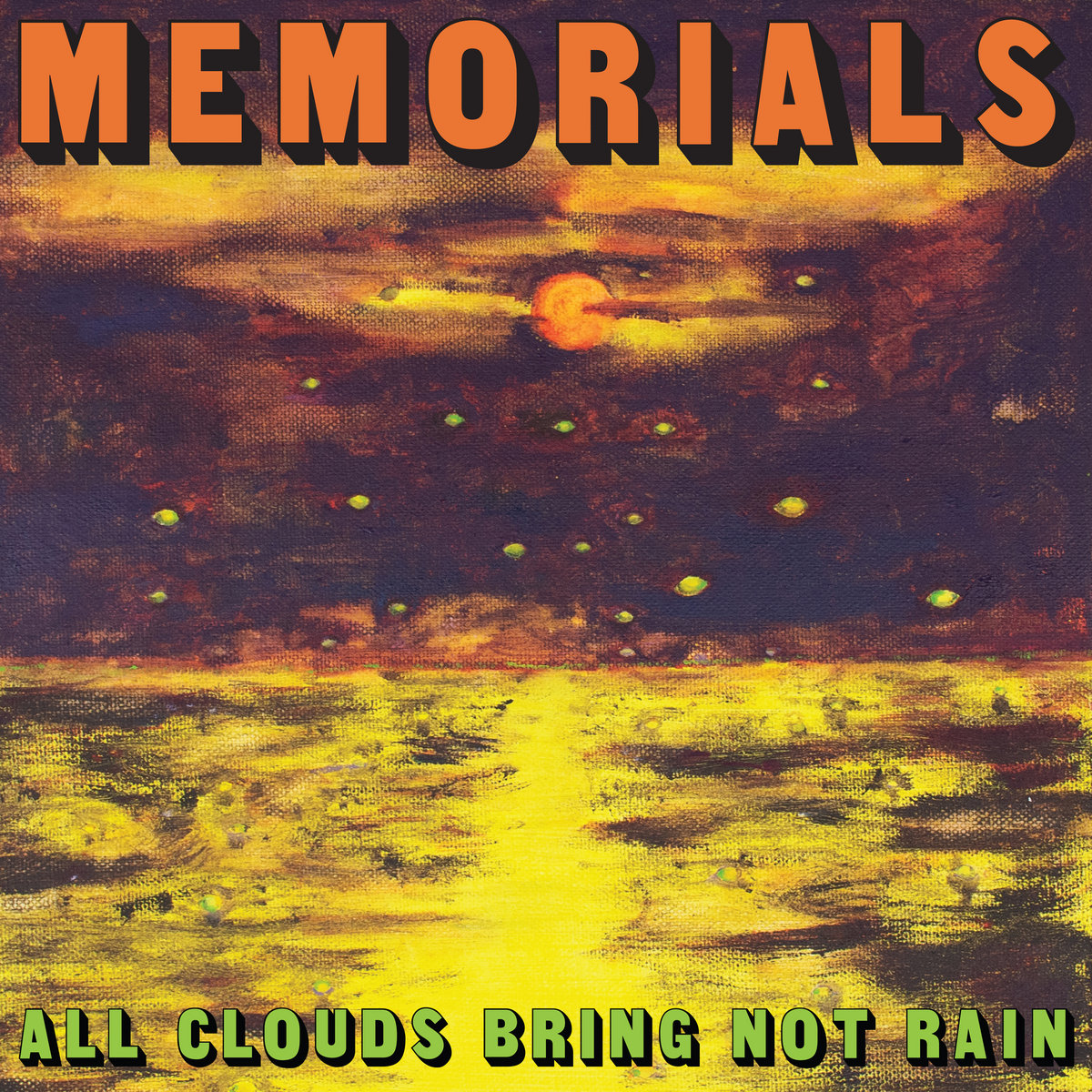
A peculiar duality sits at the heart of ‘All Clouds Bring Not Rain’, the second full-length from MEMORIALS, revealing itself gradually rather than declaratively. On the surface, it presents as a collection of finely wrought songs, melodic, even inviting, but beneath that exterior lies a restless curiosity about structure, texture, and the very idea of what a song can contain. Created entirely by Verity Susman and Matthew Simms in near-total isolation, the album carries the imprint of its environment: secluded, self-sufficient, and quietly expansive.
“Life Could Be a Cloud” opens the record with an almost disarming sense of clarity. Susman’s voice enters without adornment, its directness establishing an emotional anchor even as the arrangement begins to shift beneath it. Simms’ production sensibility is immediately apparent—not in overt flourishes, but in the way sounds are positioned, layered, and subtly destabilized. The track suggests possibility without insisting on it, a gentle thesis for what follows.
That sense of openness is quickly complicated by “Cut Glass Hammer,” where sharper contours emerge. The interplay between rhythm and texture becomes more pronounced, with Simms weaving together elements that feel both organic and mechanically precise. Susman’s vocal line, meanwhile, glides above the arrangement with a calm assurance, creating a productive friction between surface ease and underlying complexity.
“I Can’t See A Rainbow” offers one of the album’s most striking juxtapositions. Its melodic core is immediate, almost disarmingly so, yet the surrounding instrumentation resists settling into any predictable pattern. There is a subtle dislocation at work, as though the song were being viewed through shifting lenses. This quality deepens in “Dropped Down The Well,” where the sense of descent is rendered not through obvious dramatics but through a gradual thickening of atmosphere, each layer adding weight without obscuring the whole.
“In The Weeds” and “Reimagined River” form a kind of diptych at the album’s center, each exploring movement in different ways. The former feels dense and inward-looking, its details accumulating in a manner that rewards close attention. The latter, by contrast, carries a sense of flow, its structure more fluid, its transitions less defined. Together, they illustrate the duo’s ability to inhabit contrasting modes without losing coherence.
“Mediocre Demon” introduces a note of sly irreverence, its title hinting at a playful undercurrent that runs through the album. Musically, it balances that playfulness with a carefully constructed framework, where unexpected turns feel earned rather than arbitrary. “Bell Miner” continues this approach, its use of timbre particularly striking; the inclusion of instruments like vibraphone and Leslie-treated textures expands the album’s palette without drawing attention to the mechanics behind them.
“Lemon Trees” and “Watching The Moon” shift the emotional register once more, leaning into a more reflective space. Susman’s voice here is especially compelling, its unembellished quality allowing small inflections to carry significant weight. Simms’ arrangements remain inventive, but they recede just enough to let the songs’ emotional contours come forward.
As the album moves toward its conclusion, “Wildly Remote” and “Holy Invisible” feel less like endpoints than like further openings. The former suggests distance not as isolation but as perspective, while the latter brings the record to a close with a sense of quiet suspension. There is no definitive resolution, only a lingering awareness of the spaces the music has traced.
What distinguishes ‘All Clouds Bring Not Rain’ is not simply its breadth of influence (though echoes of folk, experimental music, and various strains of popular song are woven throughout), but the way those influences are absorbed into a language that feels entirely its own. Susman and Simms do not treat genre as a set of boundaries to be crossed or erased; instead, they approach it as a reservoir of possibilities, drawing from it selectively and reshaping it according to their own logic.
The decision to write, perform, record, and mix the album themselves proves crucial to its character. There is an internal coherence here that might have been diluted in a more conventional setting. Every sound feels considered, every choice part of a larger, evolving design. Yet for all its intricacy, the album never loses sight of the listener. Its melodies linger, its structures invite exploration, and its overall effect is one of sustained engagement rather than immediate resolution.
In the end, ‘All Clouds Bring Not Rain’ is an album that trusts in its own ambiguity. It does not offer easy answers or fixed meanings, but instead creates a space in which multiple possibilities can coexist. It is a work of quiet ambition, one that reveals more of itself with each encounter, and one that suggests that clarity and complexity need not be opposing forces, but can instead enrich one another in ways that feel both surprising and inevitable.
To learn more, please visit MEMORIALS | Fire Records | Bandcamp | Instagram | YouTube | Facebook.