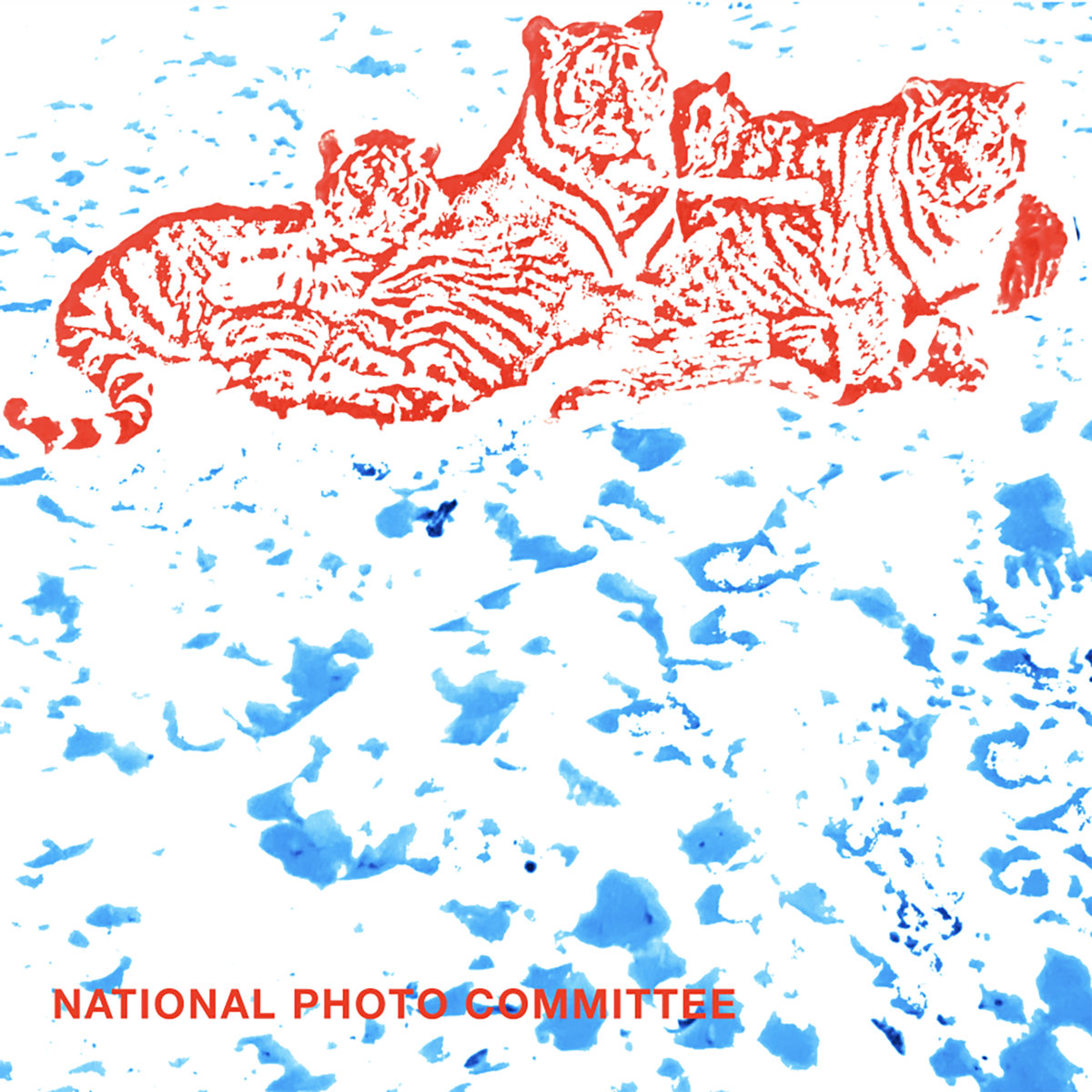
National Photo Committee’s ‘Red Hot Photo Committee’ is an album with an unusually vivid sense of resistance. Its songs seem to have been assembled from incompatible materials; country twang, indie-rock drift, basement punk, ragged folk, bar-band swagger and then deliberately left in their imperfect state. The Chicago quartet of singer and guitarist Maxwell Bottner, bassist Will Carr, pedal-steel guitarist Henry Moskal, and drummer Jason Shapiro understands that musical friction need not be corrected. Sometimes the scrape is the point. Their music gains force from the places where its components refuse to settle comfortably together.
Bottner is the album’s most conspicuous source of instability. His baritone has the dry, weathered quality of someone who has spent considerable time observing the world from the corner of a room, yet there is an almost childlike appetite for absurdity in his delivery. He can sound knowing and bewildered within the same phrase, as though he is never quite certain whether the joke belongs to him. That ambiguity gives his lyrics considerable charm. On “Foam The Field,” he establishes a world where homespun imagery and crooked observations coexist without needing to resolve into a tidy narrative. His singing carries the battered warmth of a voice that has been used hard, while his guitar work keeps the songs moving even when their emotional direction becomes uncertain.
“If I Wait” is perhaps the clearest example of National Photo Committee’s peculiar ability to disguise unease as buoyancy. Moskal’s pedal steel lends the song a graceful, almost pastoral lift, and Carr’s bass supplies a loose, spring-loaded pulse. Beneath that surface, however, the guitars and drums keep introducing small disturbances. The song seems to be smiling while contemplating the consequences of standing still. Bottner’s vocal inhabits that contradiction perfectly: weary enough to suggest resignation, animated enough to imply that resignation may be temporary.
“Before The Feeling’s Gone” pushes further into the band’s fascination with impermanence. Rather than presenting melancholy as a grand, cinematic condition, National Photo Committee makes it ordinary, awkward and slightly funny. The song’s emotional intelligence comes from its refusal to overstate itself. Bottner does not need to announce the significance of a fading feeling; he circles it, pokes at it, and lets the uncertainty become part of the song’s character. Moskal’s steel adds a plaintive color without turning the piece into conventional Americana, while Carr and Shapiro give the arrangement enough motion to prevent it from becoming merely reflective.
Then comes “It’s Hard,” a blue-collar lament with enough mischief to keep its sadness from becoming self-important. The song understands that hardship and humor are not opposites. Bottner’s bawdy asides sit naturally beside the more despondent material, because real despair rarely arrives in a perfectly composed package. The band gives the song a couple of muscular surges, turning private frustration into something closer to communal release. National Photo Committee has an instinct for this kind of transition: a song can be forlorn one moment and suddenly sound like it might knock over a barstool.
“The Bishop” takes that instinct toward outright surrealism. Its strange parable and extravagant declarations are delivered with such confidence that the listener is left wondering whether Bottner is constructing a joke, hiding a confession, or simply enjoying the freedom of saying something that cannot be explained. That uncertainty is central to his appeal. He does not separate sincerity from absurdity; he lets them occupy the same room. The band responds accordingly, giving the song a loose, rollicking foundation that leaves plenty of space for its verbal oddities.
At 11 and a half minutes, “Gizzard” is the album’s great stretch of patience and abrasion. National Photo Committee settles into a slow-burning groove that recalls the expansive, weather-beaten side of Neil Young and Crazy Horse without merely reproducing it. The song accumulates weight through repetition, distortion and gradual intensification rather than obvious structural fireworks. Bottner’s voice sounds increasingly worn by the music around him, while the instrumental parts seem to erode at their edges. It is an impressive piece of extended rock writing precisely because it does not hurry toward a climax. The band lets duration become expressive.
“Adelaide” offers a different kind of release. Its chugging rhythm and honky-tonk inflections give the track a barroom physicality, but the arrangement never becomes comfortable country rock. Moskal’s saxophone-like wail near the end—an eruption that seems to tear through the song’s established proportions—makes the point. National Photo Committee can borrow the language of roots music without accepting its conventions wholesale. The same is true of “Two Ton Grape,” whose title alone suggests the band’s appetite for the ridiculous. Yet beneath the oddball surfaces lies a carefully developed musical identity: loose but attentive, homespun but ambitious, humorous without being weightless.
That balance is the real achievement of ‘Red Hot Photo Committee.’ The band’s DIY character is obvious, but so is its growing command of arrangement. Bottner began National Photo Committee in 2019, and the group’s evolution from a more solitary, pastoral indie-rock project into this broader ensemble is audible throughout the record. The arrival of Moskal’s pedal steel expands the harmonic vocabulary without sanding away the group’s rough character. Carr’s bass provides a dependable center even when the songs become unruly, while Shapiro’s drumming knows when to hold the line and when to kick the whole structure sideways.
What emerges is a distinctly Chicago record that somehow sounds as though it wandered in from several other places, carrying the evidence of each stop with it. ‘Red Hot Photo Committee’ is too eccentric for polished Americana, too rootsy for straightforward indie rock, too loose for conventional country, and too funny to surrender entirely to solemnity. Its imperfections are not obstacles to its personality; they are the source of it. National Photo Committee understands that music can be compelling precisely when it shows the seams, and that a crooked song can sometimes tell the truth more convincingly than a flawless one. Their friction is not merely an aesthetic feature. It is the engine.
Learn more links:
Bandcamp
Bluesky
Tumblr
Instagram
Twitter