
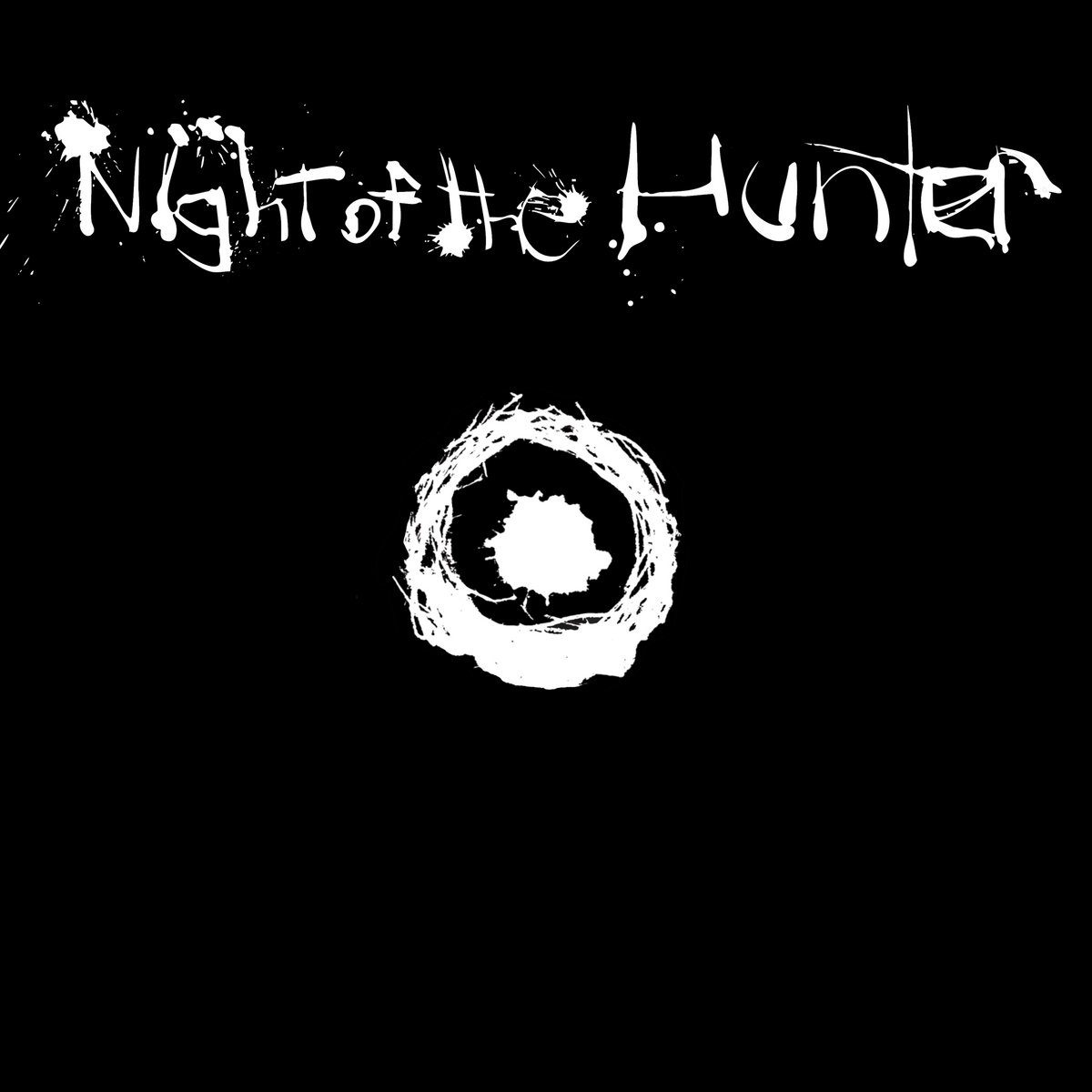
Night Of The Hunter arrive with a debut that treats dark electronic music not as a fixed aesthetic but as a mutable emotional language. The Los Angeles trio of Ezrah, Jeff Browning, and Thorson approach ’Night of the Hunter’ with the confidence of musicians who understand the lineage of industrial, gothic rock, darkwave, and ambient electronics, yet refuse to reduce those traditions into museum pieces. What emerges is a record fascinated by corrosion: emotional corrosion, sonic corrosion, the decay of certainty under relentless psychological weather. The album operates in shadows, certainly, but it is not content merely to decorate itself with gloom. It examines seduction, alienation, desire, and collapse with uncommon patience.
“Drain” establishes the album’s vocabulary immediately. Distorted guitars smear against deteriorating synthesizer lines while the percussion drives forward with a narcotic insistence. Browning’s instrumental layering gives the track a cinematic breadth, but what distinguishes it is restraint. Many contemporary dark electronic acts mistake density for atmosphere; Night Of The Hunter understand the importance of negative space. The pauses between pulses matter as much as the noise itself. Ezrah’s programming turns repetition into hypnosis rather than monotony, while Thorson’s textural contributions make the song feel permanently on the verge of disintegration.
“Reaction Is Itself Balance” sharpens the album’s industrial edge. The title alone suggests philosophical inquiry, and the music follows suit, balancing mechanized aggression with strangely meditative undercurrents. Metallic rhythms strike with near-military precision before dissolving into drifting ambient passages. The track recalls the period when industrial music still possessed an intellectual severity rather than merely functioning as nightclub provocation. What Night Of The Hunter capture especially well here is contradiction: the beat compels movement even as the surrounding atmosphere communicates emotional paralysis.
The album’s most seductive moment arrives with “Safe Inside the Storm,” featuring Aradia. Her vocal appearance changes the chemistry of the record instantly. Against the band’s oppressive electronic architecture, Aradia introduces something ceremonial and spectral, transforming the song into an intimate dialogue between vulnerability and domination. The composition avoids the predictable beauty-and-beast dynamic common to gothic collaborations; instead, her voice moves through the arrangement like another instrument corrupted by the storm surrounding it. The production never romanticizes darkness. It frames it as addiction.
“Collide” condenses the band’s ambitions into a leaner structure. The guitars slash harder here, carrying traces of industrial rock’s late-1990s theatricality without descending into parody. One of the album’s strengths lies in how sincerely it commits to its dramatic impulses. Night Of The Hunter do not wink at the listener. They understand that gothic music loses power the moment irony enters the room. The emotional extremity of “Collide” works because the trio pursue it with complete conviction.
That conviction deepens on “Cruel As You,” featuring Evilartform. The track channels emotional sadism through suffocating electronic repetition and punishing low-end frequencies. Evilartform’s contribution adds volatility, but the true achievement lies in the arrangement itself. The song continuously threatens eruption yet withholds catharsis, creating a psychological claustrophobia that mirrors the emotional cruelty implied by the title. Industrial music has often excelled at expressing rage; Night Of The Hunter prove equally adept at articulating emotional dependency.
“Sink The Bones,” with guest vocals from Emily Florence, stands among the album’s most fully realized compositions. Florence introduces an aching humanity absent from the preceding tracks, and the contrast is devastating. The song’s layered synthesizers drift like funeral hymns while distant guitar figures shimmer beneath the mix. The title evokes burial, but the music concerns memory more than death. Florence’s performance gives voice to the album’s submerged emotional core: exhaustion disguised as desire.
Then comes “Isolation,” perhaps the definitive statement of the album’s central philosophy. Night Of The Hunter understand isolation not as silence but as overstimulation; endless noise with no genuine connection. The beat pounds relentlessly while ambient textures drift like radio transmissions from abandoned interiors. The trio display remarkable discipline here, refusing unnecessary embellishment. Every sound serves the mood of emotional severance. “Destination” closes the primary album with a sense of unresolved movement. Rather than delivering a triumphant finale, the track suggests continuation into uncertainty. The composition stretches outward patiently, balancing ambient melancholy with propulsion. The band’s background as multi-instrumentalists becomes especially important here; the layering never sounds assembled by software alone. Human hands remain visible inside the machine.
The remix section avoids the disposable quality that often weakens expanded editions. “Isolation (Gold Ladder Remix)” transforms the original into something colder and more club-oriented without sacrificing its emotional bleakness. Gold Ladder amplifies the song’s rhythmic architecture while stripping away some of its organic haze, revealing the skeletal machinery beneath. “Reaction is Itself Balance (Stratosphere Soundsystem Remix)” pushes further into dancefloor territory, emphasizing velocity and momentum while preserving the philosophical unease embedded within the original track. “Drain (Bat Elvis Remix)” closes the record by reframing the album’s opening statement through a more aggressive electronic lens, as though the material has decayed even further during the course of the album.
What makes ’Night of the Hunter’ interesting is not simply its command of genre aesthetics but its understanding of emotional theatricality as a serious artistic tool. Ezrah, Jeff Browning, and Thorson recognize that gothic and industrial music function best when they externalize internal collapse. The album does not posture as darkness for darkness’ sake. It studies attraction to ruin with unnerving sincerity. Many records influenced by 1990s industrial and darkwave traditions become trapped in nostalgia, fetishizing old machinery while forgetting the emotional urgency that once animated the genre. Night Of The Hunter avoid that trap by treating those influences as living vocabulary rather than sacred relics. The result is an album immersed in decay yet alive with purpose, capable of sounding immense on a dancefloor while remaining psychologically intimate through headphones at three in the morning.
Learn more by visiting Curious Electricity | Bandcamp