
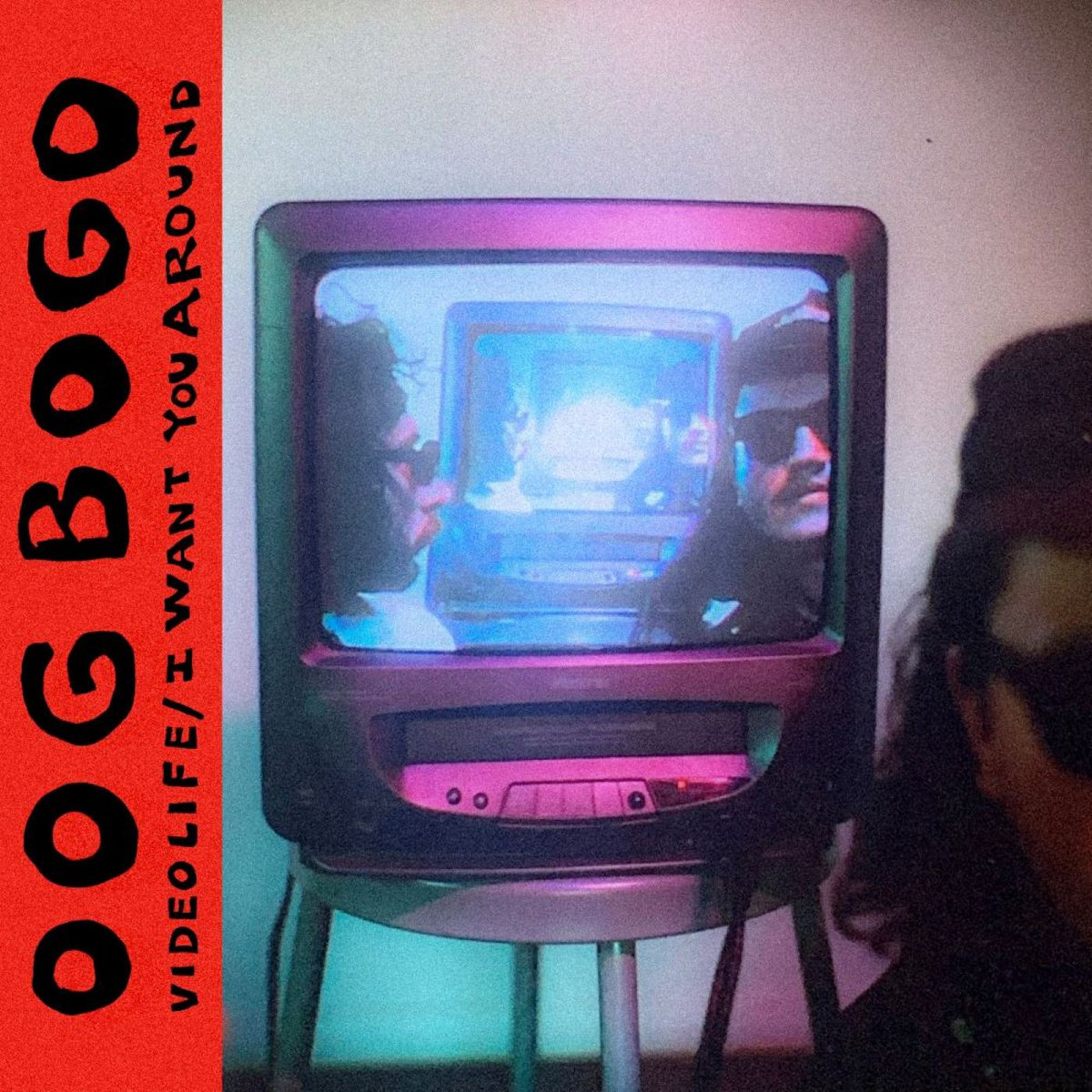
Few artistic choices are riskier than revisiting songs that already possess firmly established identities. Cover versions often drift toward either reverence or reinvention, becoming exercises in nostalgia or acts of deliberate disruption. Oog Bogo avoids both traps on the two-song release ‘Video Life / I Want You Around’, approaching a pair of late-1970s compositions with an understanding that the most effective reinterpretations do not attempt to overwrite history. Instead, they reveal why a song continues to matter.
What makes this release compelling is its refusal to treat either source material as a museum piece. Oog Bogo neither fetishizes the past nor attempts to modernize it through superficial stylistic updates. These performances operate from the premise that certain ideas remain unresolved. Questions surrounding mediated identity, longing, connection, and perception are no less relevant today than they were when these songs first appeared. The duo of tracks functions less as a retrospective exercise and more as a reminder of how persistent these concerns have become. “Video Life,” originally associated with Chris Spedding, proves especially fascinating in this context. The song’s central preoccupation with image and performance feels remarkably contemporary despite its origins in the late seventies. Decades before social media transformed self-presentation into a near-constant activity, the composition recognized the increasingly blurred line between lived experience and representation.
Oog Bogo understands the enduring power of that observation. Their rendition sharpens the song’s underlying unease without overstating it. Rather than presenting “Video Life” as prophecy fulfilled, they approach it as an ongoing condition. The performance captures the strange sensation of existing simultaneously as participant and observer, creating a version that resonates with contemporary anxieties while remaining faithful to the song’s conceptual core. The arrangement possesses an immediacy that prevents the track from feeling historical. Instead, it sounds startlingly current, as though it had been written specifically for a culture saturated by screens, documentation, and self-curation.
The flip side, “I Want You Around,” explores a very different emotional territory. Originally one of the most vulnerable compositions associated with The Ramones, the song has often stood apart from the band’s reputation for velocity and irreverence. Its emotional directness remains one of its greatest strengths. Oog Bogo approaches that directness with admirable restraint. Many artists confronting material this exposed are tempted to amplify its sentiment or cloak it in irony. Neither impulse appears here. The performance recognizes that genuine longing requires no embellishment. By resisting melodrama, the band allows the song’s emotional honesty to emerge with greater clarity.
What becomes apparent across both tracks is Oog Bogo’s sensitivity to the distinct forms of desire each song examines. In “Video Life,” desire is filtered through image, perception, and distance. In “I Want You Around,” desire is stripped down to its simplest expression: the wish for another person’s presence. One song navigates mediation; the other seeks immediacy. Together, they form an unexpectedly coherent pairing, revealing complementary perspectives on connection and absence.
While detailed musician credits are not provided, the performances throughout display a strong collective understanding of dynamics, atmosphere, and pacing. The arrangements remain focused without becoming minimal, preserving the character of the compositions while allowing Oog Bogo’s own personality to emerge naturally. That balance is difficult to achieve, particularly when working with songs that carry significant cultural associations.
By placing “Video Life” and “I Want You Around” back into circulation with intelligence and purpose, Oog Bogo demonstrates that reinterpretation can be an act of conversation rather than revision. These performances honor their origins while reminding listeners that the emotions and ideas embedded within them remain very much alive.
Learn more links:
Slouch Records
Bandcamp