
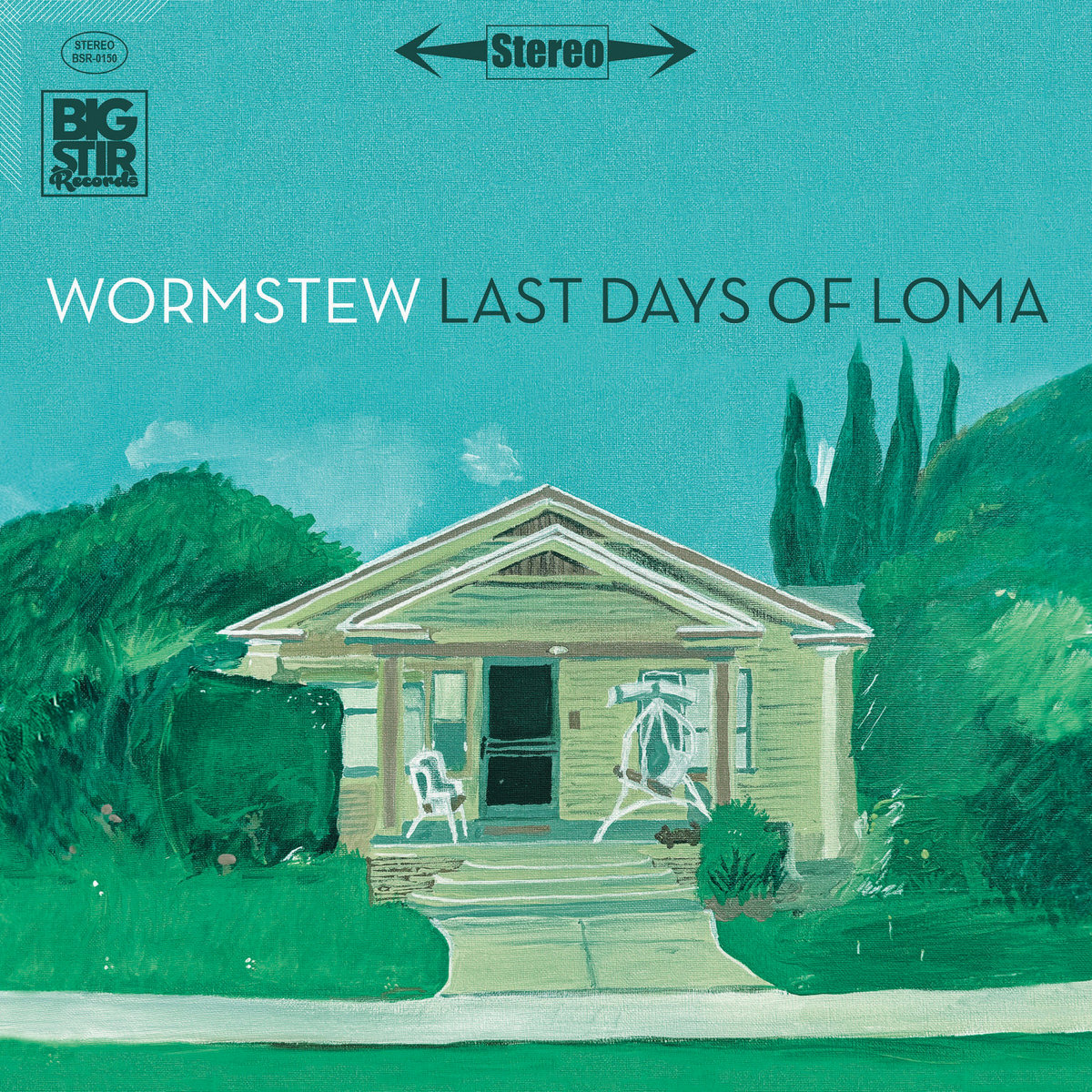
Some albums announce themselves with grand artistic statements, while others quietly invite listeners into a world that becomes increasingly captivating with every passing song. Wormstew’s ‘Last Days Of Loma’ belongs firmly in the latter category, though calling it understated risks overlooking just how imaginative and emotionally perceptive this debut truly is. Mike Schnee has spent years cultivating an idiosyncratic songwriting voice, but the arrival of Teresa Cowles and Michael Simmons transforms that vision into something richer, more cohesive and remarkably affecting. What could have remained an eccentric collection of clever ideas instead blossoms into one of the year’s most rewarding independent releases, balancing humor, melancholy and melodic sophistication with uncommon confidence.
The opening “Spinning” immediately introduces the album’s defining characteristic: its refusal to separate wit from sincerity. Built around buoyant rhythms, sparkling keyboards and effortless vocal harmonies, the song projects infectious optimism while hinting at the uncertainty beneath its surface. Schnee’s vocal performance possesses an inviting conversational quality, never overplaying emotion yet conveying it with unmistakable authenticity. Cowles’ melodic bass lines subtly shape the song’s momentum, while Simmons’ production keeps every instrumental layer crisp without sacrificing warmth.
That sense of playful unpredictability continues with “Sheriff Brody,” a delightfully offbeat character study that demonstrates how Wormstew transforms familiar cultural references into something distinctly personal. Rather than relying upon nostalgia for easy recognition, the song uses its cinematic inspiration as a springboard for observations that are quirky, affectionate and unexpectedly insightful. The arrangement mirrors that inventive spirit, moving with breezy confidence while allowing the trio’s vocal chemistry to remain front and center.
Humor takes another fascinating turn in “Bucket Of Blues,” where surreal lyrical detours coexist comfortably alongside polished folk-pop craftsmanship. The composition succeeds because its eccentricity never functions as distraction. Instead, the unexpected imagery enriches the emotional landscape, encouraging listeners to embrace ambiguity rather than search for literal meaning. Simmons’ understated percussion and tasteful keyboard textures provide the perfect framework for Schnee’s imaginative storytelling.
Among the album’s quieter highlights, “Letters On The Wall” reveals another dimension of Wormstew’s songwriting. Reflection replaces whimsy without abandoning the intimacy that defines the record as a whole. Every melodic phrase feels carefully considered, creating a contemplative atmosphere that invites listeners to project their own experiences onto its emotional canvas. The restraint shown throughout the arrangement demonstrates considerable artistic maturity. The gently cinematic “Movin’ Along” possesses an effortless charm rooted in classic pop craftsmanship while remaining unmistakably contemporary in perspective. Its optimistic melodic sweep evokes movement in every sense of the word, capturing both physical travel and emotional resilience. Cowles’ harmonies enrich every chorus, while Simmons’ multi-instrumental contributions subtly expand the song’s sonic landscape without drawing attention away from its graceful simplicity.
One of the album’s most memorable compositions arrives with “J.P. McCartney,” an inspired exercise in surreal storytelling that somehow transforms absurdity into heartfelt reflection. Lesser writers might have leaned entirely into parody, but Schnee understands that the strongest humor often reveals deeper emotional truths. Beneath its amusing premise lies a meditation on admiration, creativity and the peculiar relationships people develop with the artists who shape their lives. The delightfully infectious “Tippy Tippy Tea” celebrates everyday pleasures with irresistible enthusiasm. Its bright melodies, buoyant rhythms and playful lyricism radiate genuine affection rather than irony. What makes the song especially effective is its refusal to apologize for its optimism. Wormstew recognizes that joy can possess just as much artistic substance as melancholy when expressed with conviction.
Self-awareness takes center stage on “Assholes,” where sharp observations about human behavior are delivered with equal measures of humor and humility. Guest musician Probyn Gregory contributes expressive banjo that perfectly complements the song’s earthy character, adding another layer of personality without overwhelming the ensemble performance. Rather than pointing fingers, the composition acknowledges universal flaws with refreshing honesty, making its social commentary all the more persuasive. “Irony At Its Finest” continues that introspective thread through clever lyrical construction that avoids easy cynicism. Instead of mocking life’s contradictions from a comfortable distance, the song embraces them as unavoidable aspects of the human condition. Its melodic elegance prevents the philosophical themes from becoming heavy-handed, maintaining the album’s remarkable balance between intellectual curiosity and emotional accessibility.
Perhaps the album’s most quietly devastating achievement is “When Cats Are Sad.” Beneath its deceptively gentle melody lies an unusually thoughtful meditation on loss, companionship and the inevitable fragility of affection. The contrast between its inviting arrangement and emotional depth gives the song extraordinary resonance. Rather than manipulating sentiment, Wormstew trusts the listener to recognize profound feeling within ordinary moments. The luminous “When Our Worlds Collide” offers one of the album’s warmest expressions of connection. Built upon beautifully blended harmonies and understated instrumentation, it celebrates relationships without resorting to romantic cliché. Schnee writes with remarkable generosity, allowing vulnerability to emerge naturally through simple observations rather than elaborate declarations.
As the record approaches its conclusion, “Forgotten” becomes one of its emotional anchors. Gentle keyboards, restrained percussion and expressive vocals combine to create a poignant meditation on memory and impermanence. The trio’s harmonies reach remarkable levels of intimacy here, each voice enhancing the others until individual performances dissolve into a unified emotional statement. “Another Stupid Song” may possess the album’s most self-deprecating title, yet it contains some of its finest songwriting. Its exploration of insecurity never becomes self-pitying because the melody continually reaches toward hope. The arrangement glows with subtle sophistication, allowing acoustic guitars, keyboards and harmonies to build quiet emotional momentum that lingers long after the final chorus.
The closing title track provides a deeply satisfying conclusion by grounding the album’s whimsical imagination within tangible experience. It reflects upon change not as dramatic upheaval but as the accumulation of ordinary moments that gradually reshape a life. That perspective gives the farewell remarkable emotional credibility. Rather than searching for grand conclusions, Wormstew finds lasting significance in details many writers would overlook.
The performances throughout ‘Last Days Of Loma’ deserve equal recognition. Schnee anchors the record with expressive vocals and sensitive work on acoustic and electric guitars, keyboards and percussion, consistently placing the songs above personal display. Cowles contributes melodic bass playing, beautifully integrated harmonies and tasteful keyboard textures that strengthen every arrangement through subtle musical intelligence. Simmons proves indispensable not only as drummer but also as producer, guitarist, keyboard player and vocalist, guiding the material with exceptional sensitivity while preserving its organic spontaneity. His production captures every performance with clarity, allowing the album’s intricate arrangements to remain inviting rather than overly polished.
‘Last Days Of Loma’ resists categorizing human experience into simple emotional compartments. Comedy exists alongside sorrow, absurdity shares space with profound reflection and playful imagination frequently reveals deeper truths than straightforward confession ever could. Schnee writes from a perspective that embraces life’s inconsistencies instead of attempting to resolve them, giving the album a refreshing honesty that resonates far beyond its concise running time.
Wormstew has crafted a debut that celebrates individuality without becoming self-indulgent, drawing listeners into a world where unusual observations illuminate universal emotions. ‘Last Days Of Loma’ succeeds because it understands that intelligence and accessibility need never compete. Its songs are memorable, thoughtful and quietly adventurous, revealing a band whose greatest strength lies not in sounding like anyone else, but in expressing a worldview all their own.
Learn more links:
Big Stir Records
Bandcamp