
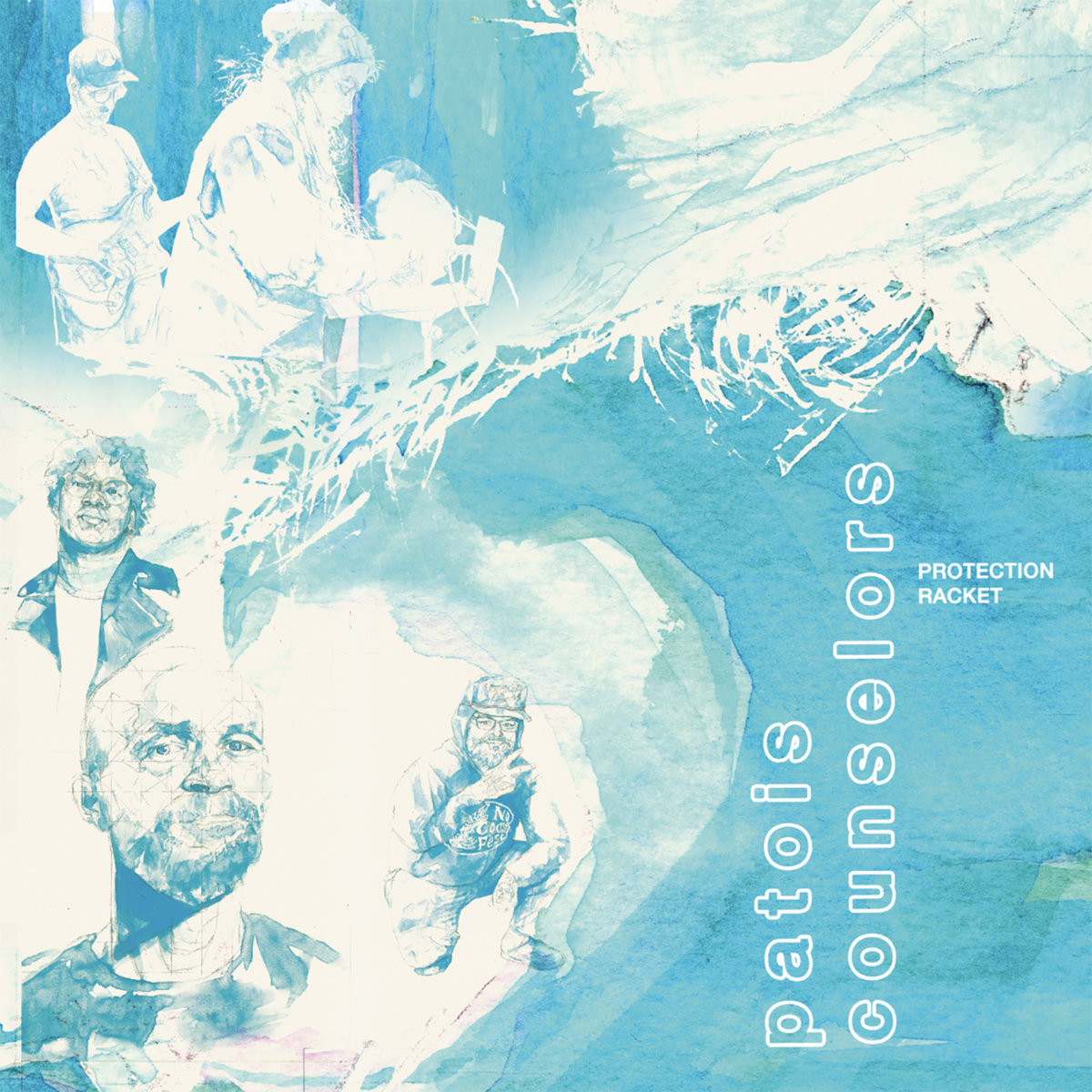
Patois Counselors have spent the better part of a decade developing a peculiar kind of American music: intellectually restless, rhythmically unruly, politically alert, and romantic enough to keep staring toward the horizon even while documenting everything wrong with the view. On ‘Protection Racket’, their fourth full-length, the Charlotte, North Carolina quintet sharpens that sensibility into perhaps its most complete statement. Bo White, Lenny Muckle, Robin Doermann, Krizia Torres, and Taylor Knox play with an impressive collective discipline, but never at the expense of instability, surprise, or humor. Their songs can sound tightly engineered one moment and ready to fly apart the next, as though the band understands that contemporary life itself rarely holds a consistent shape.
Patois Counselors draw from the great post-punk tradition without becoming trapped by its familiar silhouettes. Pere Ubu, The Fall, Wire, Devo, and Hüsker Dü are discernible points of reference, but the group filters those influences through a distinctly Southern sensibility. The music has air in it. Guitars clang and surge, synthesizers flicker, drums hit with muscular precision, and White’s voice moves through the arrangements with the wary authority of someone attempting to make sense of a culture that has made nonsense into a governing principle. Beneath the intellectual aggression lies a surprising affection for beauty, particularly the melancholy beauty of the hour when daylight disappears and the future becomes temporarily unknowable.
“Sheer Radical” establishes the album’s terms with magnificent impatience. White surveys the machinery of privilege and political stupidity with a lyricist’s eye for absurdity, turning language itself into a weapon against those who have somehow acquired enormous authority while displaying remarkably little wisdom. The song’s momentum keeps it from becoming a mere exercise in indignation. Patois Counselors understand that outrage without musical imagination quickly becomes predictable. Here, the guitars and rhythm section give White’s observations propulsion, making the song feel like an argument being conducted at highway speed.
“Cop City” pushes the record into darker territory. Its opening gesture suggests Devo reimagining the Stones’ “Paint It Black,” but the song soon develops its own identity as White examines militarized policing and the creeping normalization of authoritarian habits in ordinary American spaces. The band makes the subject unsettling without resorting to melodrama. Muckle’s guitar and Torres’s synth work create a setting that feels simultaneously mechanical and unstable, while Doermann and Knox provide the kind of rhythmic foundation that lets the song lurch forward with purpose.
The band’s fascination with the peculiar pathologies of digital life becomes even clearer on “Iceberg Status.” White has an exceptional ear for the vocabulary of online existence, particularly the phrases that become so ubiquitous they cease to sound strange even when they describe deeply strange behavior. His characters seem stranded inside their own screens, trapped between compulsive participation and profound alienation. At five minutes, the track gives the band room to stretch, but Patois Counselors never lose their sense of proportion. The arrangement keeps shifting beneath the lyric, creating the impression of a society constantly refreshing itself without ever changing.
“Non-Zero Love” provides a different kind of relief. The title itself contains the band’s characteristic combination of abstraction and tenderness: an almost mathematical formulation applied to something stubbornly human. Patois Counselors are at their most interesting when their intellectual instincts collide with their sentimental ones. White may distrust the language through which modern life explains itself, but he has not abandoned the possibility of affection. The song suggests that love, however compromised or insufficient, remains one of the few irrational forces worth preserving.
That impulse is complicated further by “Generational Riffs,” which arrives with guitar energy recalling Hüsker Dü while contemplating legacy, cultural inheritance, ambition, and failure. The song has an unusually generous perspective on disappointment. It recognizes that every generation inherits dreams it cannot quite fulfill and fashions new fantasies from the wreckage. Muckle’s guitar gives the track its urgency, while Knox’s drumming keeps it moving with a nervous vitality. The musicians sound fully aware of the lineage they inhabit, yet unwilling to treat inheritance as an excuse for imitation.
“Flat No” is perhaps the album’s most sonically volatile composition. Knox’s drums and Torres’s oscillating synths accumulate force until portions of the mix seem to buckle under their own weight. White’s vocal becomes another element in that struggle, fighting through a sonic environment that appears increasingly difficult to control. The effect is not chaos for its own sake. The music embodies the confusion White is describing, making form and subject inseparable. Patois Counselors have always understood that a song about disorder does not necessarily need to sound orderly.
“Paywall Club” turns its attention toward another modern absurdity: the privatization of information and the increasingly elaborate barriers separating people from knowledge, culture, and one another. The band approaches the subject with wit rather than solemnity, allowing the rhythm to carry some of the argument. Doermann’s bass is especially important here, supplying movement underneath the song’s verbal density. The musicians repeatedly demonstrate that their arrangements are not simply backdrops for White’s lyrics; they function as a second language, commenting on and occasionally contradicting the words.
Then comes “Outlaw Country,” a fittingly expansive closer that examines the emptiness beneath one of America’s most persistent myths. The title evokes freedom, rebellion, open roads, and independence, but the song gradually reveals how hollow those ideals can become when separated from any meaningful social reality. As daylight disappears, the band does not provide an easy answer about what comes next. Instead, it leaves the question hanging in the air, where uncertainty can feel less like defeat than an invitation to remain awake.
That quality captures the larger achievement of ‘Protection Racket’. Patois Counselors are neither nostalgic traditionalists nor futurist provocateurs. They are chroniclers of a present that has become too strange to describe with conventional categories, and they possess the musical imagination necessary to match that strangeness. White’s writing is incisive without becoming merely cynical, while Muckle, Doermann, Torres, and Knox give those words a constantly shifting architecture of guitars, bass, synthesizers, and drums.
The album’s greatest pleasure lies in that contradiction: Patois Counselors are deeply skeptical about the world, yet their music remains exuberantly alive. ‘Protection Racket’ recognizes stupidity everywhere, but refuses to become stupidly despairing. It finds humor inside collapse, romance beneath the sarcasm, and possibility at the edge of darkness. By the time “Outlaw Country” reaches its final horizon, the sun may indeed be gone, but the band has left the stereo glowing. Few American groups are better at turning cultural exhaustion into something this vivid, funny, intelligent, and strangely hopeful.
Learn more links:
ever/never records
Link Tree
Bluesky
Tumblr
Instagram
Twitter