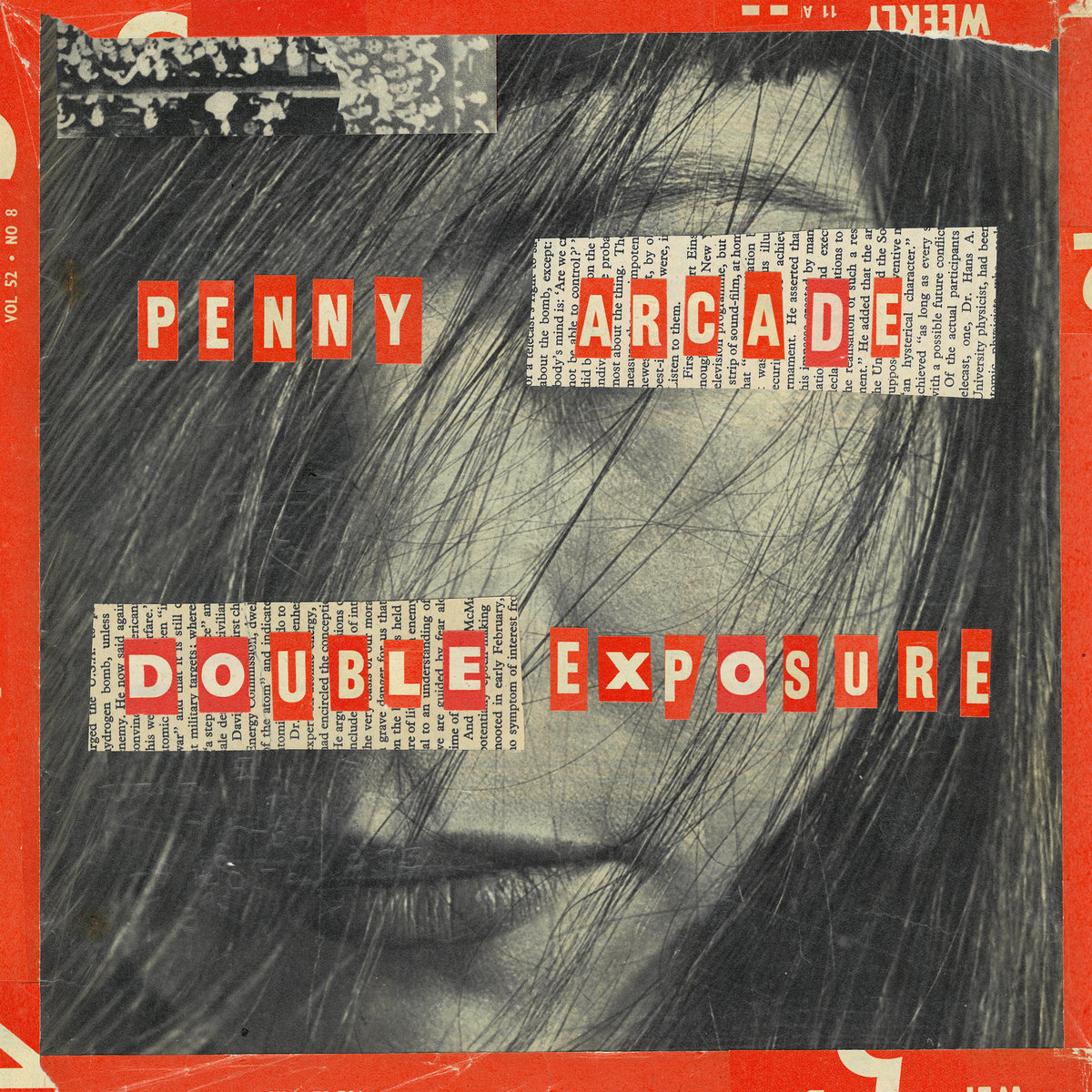
James Hoare has spent much of his career refining understatement into an aesthetic principle. Across his work with previous groups Veronica Falls, Ultimate Painting and The Proper Ornaments, melody often arrived wrapped in restraint, as though emotional directness required partial concealment to remain credible. Under the Penny Arcade moniker, however, Hoare appears increasingly fascinated by imperfection, accident and incompletion. ‘Double Exposure’ pushes that fascination further than anything he has previously released, constructing an album from fragments, impressions and rapidly captured intuitions that somehow cohere into one of the most psychologically revealing records of his career.
The opening “Regrets” immediately signals a shift in emphasis. The guitars remain present, but they no longer dominate the architecture of the songs. Instead, they flare and recede within a looser, stranger framework driven by primitive drum machines, wavering organs and tape saturation. The dual guitar solo that cuts through the track arrives not as a display of virtuosity but as a sudden rupture in the album’s otherwise introspective atmosphere. Hoare understands precisely how fleeting exhilaration can alter the emotional temperature of a song, particularly when surrounded by such muted melancholy.
What distinguishes ‘Double Exposure’ from many contemporary lo-fi psychedelic records is its refusal to fetishize obscurity. Hoare is not hiding behind texture or abstraction. Even at its most elusive, the album remains emotionally legible. “Memory Lane” drifts through recollection without lapsing into sentimentality, balancing nostalgia against a subtle awareness of how memory distorts as much as it preserves. The arrangement feels deliberately skeletal, as though the song itself might vanish if touched too firmly.
“Worst Trip” occupies the album’s darkest emotional territory. The song captures psychic disorientation with unsettling precision, yet avoids theatrical collapse. Hoare’s vocal delivery remains detached enough to prevent the material from becoming self-consciously confessional. The sparseness works in the song’s favor; every clipped drum machine pulse and distant instrumental fragment contributes to an atmosphere of emotional dislocation that conventional full-band arrangements would likely dilute.
The abrupt transition into “You’ve Got the Key” demonstrates one of the album’s central ideas: instability as creative method. Hoare constantly shifts emotional focus before any single mood hardens into predictability. The track glows with a peculiarly English strain of psychedelia, recalling late-1960s domestic surrealism without reducing itself to retro reconstruction. The melodies feel instinctive rather than curated, discovered in real time instead of meticulously assembled.
“Everything’s Easy” may be one of the album’s quietest achievements. Beneath its deceptively relaxed surface lies a study in emotional contradiction. The song carries traces of blue-eyed soul filtered through exhausted introspection, as though contentment itself has become difficult to trust. Hoare’s use of negative space throughout the record is especially striking here. He leaves songs partially unresolved, allowing atmosphere and implication to perform as much narrative work as the lyrics themselves.
The brief instrumental “Early Morning” functions almost like a half-remembered transmission drifting through another room. Its *George Harrison*-inspired raga inflections never settle into homage because Hoare treats influence as atmosphere rather than reference point. The tape-recorded immediacy becomes essential to the album’s identity at moments like this. One senses decisions being made instinctively, before self-consciousness can interfere.
“Rear View Mirror” stands among the album’s strongest pieces precisely because of how confidently it embraces repetition and mechanical rhythm. The drum machine becomes hypnotic rather than rigid, pushing the song toward something that resembles emotional suspension. Hoare’s layered instrumentation hovers around the beat rather than locking tightly into it, creating an oddly destabilized form of psychedelic pop. The track’s loose resemblance to the electronic minimalism of Silver Apples and the spectral introspection of Radiohead circa ‘In Rainbows’ emerges naturally rather than programmatically.
“Time” deepens the album’s preoccupation with impermanence. Hoare approaches temporality less as philosophical abstraction than as lived sensation: memories blurring together, relationships dissolving quietly, identities becoming unstable through repetition. The recording’s rough edges become emotionally expressive in themselves. Small imperfections — fluctuating levels, tape hiss, slightly unstable textures — reinforce the sense of songs caught in transitional states rather than presented as finished monuments.
The wonderfully modest “Instrumental No. 1” encapsulates much of what makes ‘Double Exposure’ compelling. Lesser artists often treat unfinished ideas as placeholders; Hoare treats them as revelations. The piece lingers just long enough to establish mood before disappearing, resisting the contemporary compulsion toward overstated significance. Much of the album functions this way, privileging emotional residue over structural completion.
“We Used to Be Good Friends” carries some of the record’s most quietly devastating writing. Hoare avoids dramatic confrontation, instead tracing the slow erosion of intimacy through atmosphere and implication. The smoke-filled psychedelia surrounding the song never obscures its emotional clarity. If anything, the blurred production intensifies the sadness, suggesting memories already beginning to decay while they are still being revisited.
The tiny interlude “Mercy” lasts barely half a minute yet contributes meaningfully to the album’s sequencing logic. Hoare understands brevity as structure rather than novelty. These miniature transitions prevent the record from becoming static, preserving its dreamlike instability. Closing track “Riverside Drive” dissolves with remarkable grace. The song neither resolves nor concludes the album’s emotional concerns. Instead, it drifts outward, carrying with it the record’s recurring themes of transience, relocation and fragmented identity. Knowing that much of the album was recorded while Hoare prepared to leave England for the south of France lends additional resonance to its atmosphere of impermanence, though the songs never rely on autobiographical framing for their power.
The musicianship throughout ‘Double Exposure’ reflects Hoare’s increasingly singular creative philosophy shaped by Hoare’s instinctive multi-instrumental approach. His guitar playing remains distinctive even when partially displaced from center stage, while the organs, rudimentary drum machines and tape manipulations create a sonic environment that feels simultaneously intimate and unstable. The decision to record quickly onto a 16-track tape machine proves crucial. These songs derive much of their force from immediacy, from the sensation that they were captured at the precise moment inspiration appeared rather than endlessly revised afterward.
What makes ‘Double Exposure’ so absorbing is its embrace of incompletion as aesthetic truth. Hoare does not attempt to sculpt chaos into polished coherence. He allows contradictory moods, unfinished gestures and spontaneous melodic ideas to coexist without forcing them into rigid structure. The album’s title proves remarkably apt: these songs operate like overlapping images, partially obscuring and illuminating one another at the same time.
Many artists pursue authenticity through calculated roughness. Hoare arrives somewhere more convincing because he seems genuinely uninterested in controlling every aspect of the listener’s experience. ‘Double Exposure’ accepts uncertainty as part of its emotional vocabulary. That willingness to leave songs partially open (unresolved, flickering, transient), gives the album a rare kind of intimacy, one rooted not in confession but in vulnerability to accident itself.
Learn more by visiting Penny Arcade | Tapete Records | Bandcamp | Facebook