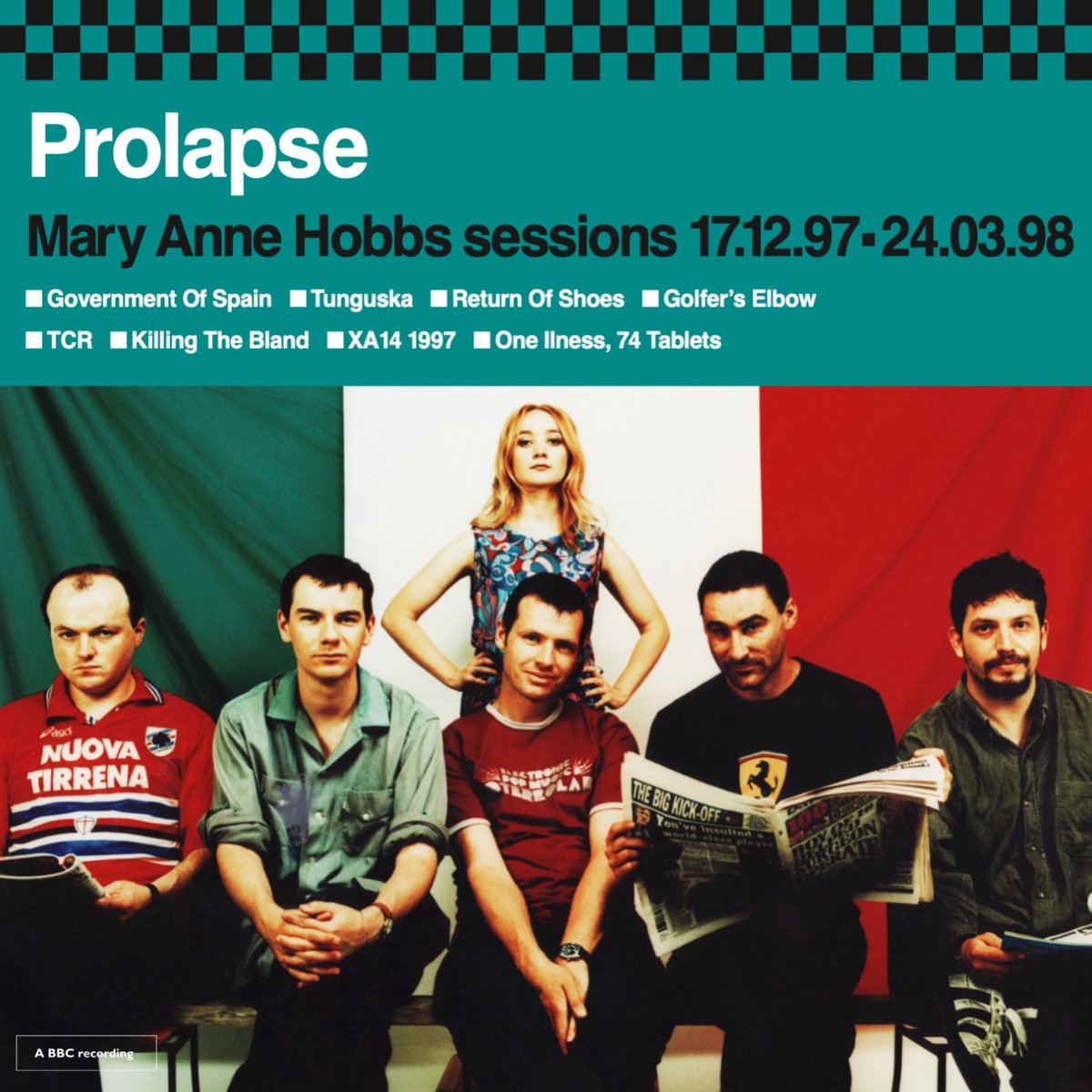
Prolapse were never interested in behaving themselves, and ‘Mary Anne Hobbs sessions 17.12.97-24.03.98, captures that clearly. These six tracks were played live on two BBC Radio 1 sessions in late 1997 and early 1998, right between ‘The Italian Flag’ (Radar Records, 1997), which is angular and full of ideas, and ‘Ghosts of Dead Aeroplanes’ (Cooking Vinyl Records, 1999), which is stranger and more spacious. You can hear a band that was disciplined without being neat, harsh without getting same-y, and funny while still serious about the music.
The lineup explains a lot of the force. Mick Derrick and Linda Steelyard are the competing vocal presences the music keeps reorganizing itself around. David Jeffreys and Pat Marsden play guitars, Mick Harrison plays bass, and Tim Pattison drives the drums. Donald Ross Skinner, who joined around this time after producing ‘The Italian Flag,’ adds more guitar and keyboard color. There are seven musicians on the recording, but Prolapse rarely sound like a conventional seven-piece. They sound more like a volatile system in which any part can suddenly take over.
“Government of Spain” shows that right away. It has the muscular repetition Prolapse are known for at their most hypnotic, but the guitars don’t just reinforce the groove. They scrape against its edges. The rhythm section of Pattison and Harrison hits hard and steady, while the three guitarists, Jeffreys, Marsden and Skinner, pile on a thick guitar layers over it. Derrick and Steelyard take different dramatic positions in the arrangement, and their voices bring human unpredictability to music that could otherwise feel almost mechanical. That tension between machine and personality was central to the band’s appeal. They borrowed krautrock’s devotion to repetition and kept the nervous volatility of post-punk. The goal was never trance through perfect uniformity. The rhythms keep seeming to settle until someone kicks the structure sideways.
“Tunguska” pushes the repetition further and widens the scale. The title suggests catastrophe and remote geography, but the band doesn’t try for cinematic imitation. The propulsion points forward while the layered guitars and vocals keep complicating where it’s headed. The live setting matters here. The sessions went out live, and that seems to sharpen the band’s focus without taming their eccentricities. “Return of Shoes” is especially interesting because it’s rare in their live history. Having it here makes the session more than a run through familiar material. The band isn’t just reproducing its best-known songs for the radio. It’s showing another corner of the repertoire, with the same nervous energy and the feel of a parallel Prolapse that existed alongside the better-documented records.
Then comes “Golfer’s Elbow,” one of two pieces improvised on the spot for these sessions. The title is pure Prolapse: ordinary, strange, a little silly, and somehow, it sticks. The music shows that improvising was never a gimmick for them. Their sound was loose enough that an improvised title and arrangement fit in with everything else without a seam. It tells you something about their writing, too. The songs sound carefully built, but there’s always room in them for mistakes, wrong turns and players pulling against each other. Live, it works because everyone knows when to assert themselves and when to let someone else knock things off balance. In that sense “Golfer’s Elbow” isn’t an outlier. It shows the improvising instinct already built into the regular material.
“T.C.R. / Killing the Bland” drops one of the band’s better-known pieces into this unstable setting. “T.C.R.” had been a signature since the mid-1990s, while “Killing the Bland” belongs to the broader, more confident world of ‘The Italian Flag.’ Pairing them shows how easily the band moved between eras and approaches. The music is dense without clogging, and the alternating vocals keep the repetition from turning predictable. Derrick and Steelyard are essential to that. They don’t work as lead and backing vocalists. They often seem to live in different realities, sometimes complementing each other and sometimes arguing with the arrangement itself. It’s theatrical without being theatrical rock, and the humor, impatience, absurdity and frustration all live in the delivery.
The huge “XA14 1997 / One Illness, 74 Tablets” is the most revealing closer. At nearly twelve minutes, it gives the band room to explore what the earlier tracks hinted at. The improvised “XA14 1997” is especially valuable because it shows Prolapse without the safety of a familiar song. Rather than coming apart, the group tightens up. The length gives the guitars room to build, the rhythm section time to work through more complicated patterns, and the vocalists more chances to throw things off. The circumstances matter too. The sessions were made at Maida Vale Studios and the Golders Green Hippodrome for Mary Anne Hobbs’s Breezeblock and transmitted live. A studio recording can be fixed, edited or scrapped. A radio performance offers none of that. Improvising under those conditions says something about the band’s confidence and how well they communicated.
That also explains the immediacy. The recordings catch a band between preparation and uncertainty. Everyone knows what Prolapse can do, but nobody seems sure what the next thirty seconds will bring. That ambiguity is a big part of the appeal. Against the rest of their catalog, these sessions are a useful document. The band already had a recognizable identity, but it hadn’t hardened into formula. The contrasting voices, multiple guitars, muscular rhythm section, keyboards, repetition, abrasion and sudden pivots all stay elastic. ‘The Italian Flag’ gave them a bigger platform and ‘Ghosts of Dead Aeroplanes’ would take the experimenting further, but these sessions show the connective tissue between the two.
It’s also a reminder of why Prolapse remain such a compelling cult band. The music doesn’t depend on flawless execution or an easily digestible personality. The band feeds on friction, both between the players and their ideas. They’re clearly skilled, but they never play like it’s a showcase. All that ability goes toward keeping things unstable, funny, repetitive, atmospheric and unpredictable. These six tracks offer more than archival value. They preserve a state of mind: Prolapse at full voltage, with nothing guaranteed and everything possible. The band sounds like it knows the machinery of its own music well enough to abuse it, take it apart and rebuild it while it’s still moving.
That’s why the sessions stay so invigorating. They document a group that had found its voice and had no plan to get comfortable in it. Even when the structures are familiar, the performances stay unsteady, and even when you know the songs, you can’t predict how they’ll end up. Prolapse understood that live music is at its best when control and risk share the stage, and these recordings make that the whole point. ‘Mary Anne Hobbs sessions 17.12.97-24.03.98’ is a vivid portrait of a remarkable band that wouldn’t let its own identity harden into a cage.
Learn more links: Bandcamp | Bluesky | Instagram | Facebook