
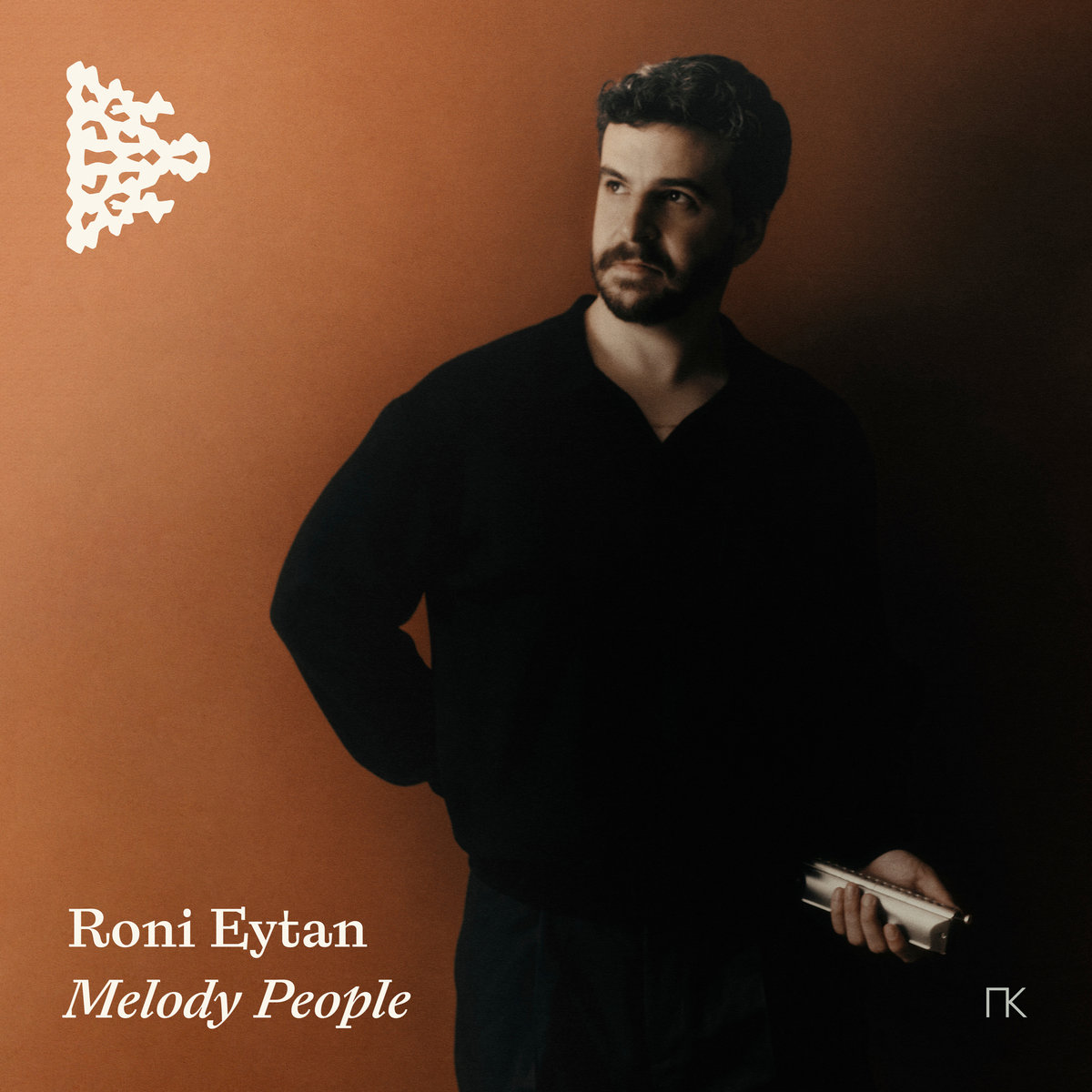
A harmonica is a strange instrument to build a jazz record around. Pocket-sized, tied to front porches and train yards, and nearly always a guest on someone else’s record: that’s the harmonica’s usual résumé. Roni Eytan, a Brooklyn-based player who has worked with Danilo Pérez, Kris Davis and Gilad Hekselman, finally takes the host’s chair on ‘Melody People,’ and the instrument sounds ready for it. His microtonal harmonica bends toward the in-between notes of Middle Eastern music, and he can stretch one note into a sigh, a question or a prayer. None of it feels like a trick. It sounds like he’s speaking his first language.
Shai Maestro produced and plays piano, and the whole band bends around one voice. Nitzan Bar’s guitars, Barak Mori’s bass and Daniel Dor’s drums and percussion sound like they’re listening first and playing second. Gérard de Haro recorded and mixed this at Studios La Buissonne, with Nicolas Baillard mastering. It has the warmth of a small club, where the band is close enough that you can hear the smallest of nuance. Wood, felt and breath are all audible.
“Winter Dance” opens the record in under two and a half minutes, and it does so with only Eytan and Dor. The track uses only harmonica and percussion, and it works as a wordless, urgent invitation to come together.. Then “Hopeful” lets the full band in. The piece began as an assignment from Herbie Hancock during Eytan’s time at his institute, and years of carrying it around have clearly paid off. Maestro’s piano starts alone, the band slides into a rolling 6/8 pulse, and Eytan’s harmonica arrives only at the very end, for a brief solo that feels almost shy. Keeping the lead voice out of the lead single is a bold call, yet it works.
The title piece, “Melody People,” stretches past eight minutes and gives the ensemble room to wander. The playing is conversational, with Maestro and Bar passing phrases back and forth while Mori and Dor keep the floor steady underneath. Few jazz records let a single idea last this long without padding, and this one earns its length. A short reprise, “Melody People (Holding | Letting Go),” returns near the end in under a minute and a half, a brief look back over the shoulder, and it hits harder for being so brief.
“Tears (A Mother’s Lament)” is where the instrument’s vocal quality becomes almost painful. Eytan phrases like a singer who knows the grief by heart, sustaining notes just long enough to ache. “A Modern Folk Tale” follows with more narrative sweep, as if a story were being told in a language the listener does not speak but understands anyway. Between them and the rest of the album sits “Before It Begins,” a single minute and change for solo cello by Mayu Shviro. It functions as a held breath, a curtain-raiser for what follows. “Like a River,” which brings Shviro back alongside the full band, flows exactly as promised, the cello adding a dark, grainy undercurrent to the harmonica’s brighter surface.
The quietest pieces hit the hardest. “Harmonica Song (For Dave),” just Eytan and Bar’s nylon string guitar, is a tender dedication that sounds like a conversation between old friends at the end of a long night. “Elegy for Saba” is a duet with Maestro, written for Eytan’s grandfather, a storyteller and music lover who passed melodies down through the family. The piece runs more than eight minutes and has the quality of a eulogy sung rather than spoken. Eytan plays it with restraint, and Maestro’s chords respond with a gentle, comforting weight. Listeners don’t need the backstory to feel it. Knowing it only deepens the loss.
Near the finish, “Hayalda Hachi Yafa Bagan” brings a Hebrew song into the fold, bright and sweet, and the band plays it with obvious affection. Then comes “Ne Me Quitte Pas,” the Jacques Brel (1929 – 1978), standard so many singers have attempted and so few have survived. Eytan wisely doesn’t try to sing it. The harmonica does the begging so he doesn’t have to. The melody says it all, closing the record with an ache that outlasts the final chord, without lyric. Some may want a little more fire. However, the album favors reflection over blaze, and a few of its longer tracks ask for patience. That is a fair quibble, and also beside the point. This is music built on memory, inheritance and gratitude, and it moves at the speed of those things. ‘Melody People’ is a quiet, assured debut from a player who has finally put his own voice at the front, and the voice is worth hearing.
Learn more links: