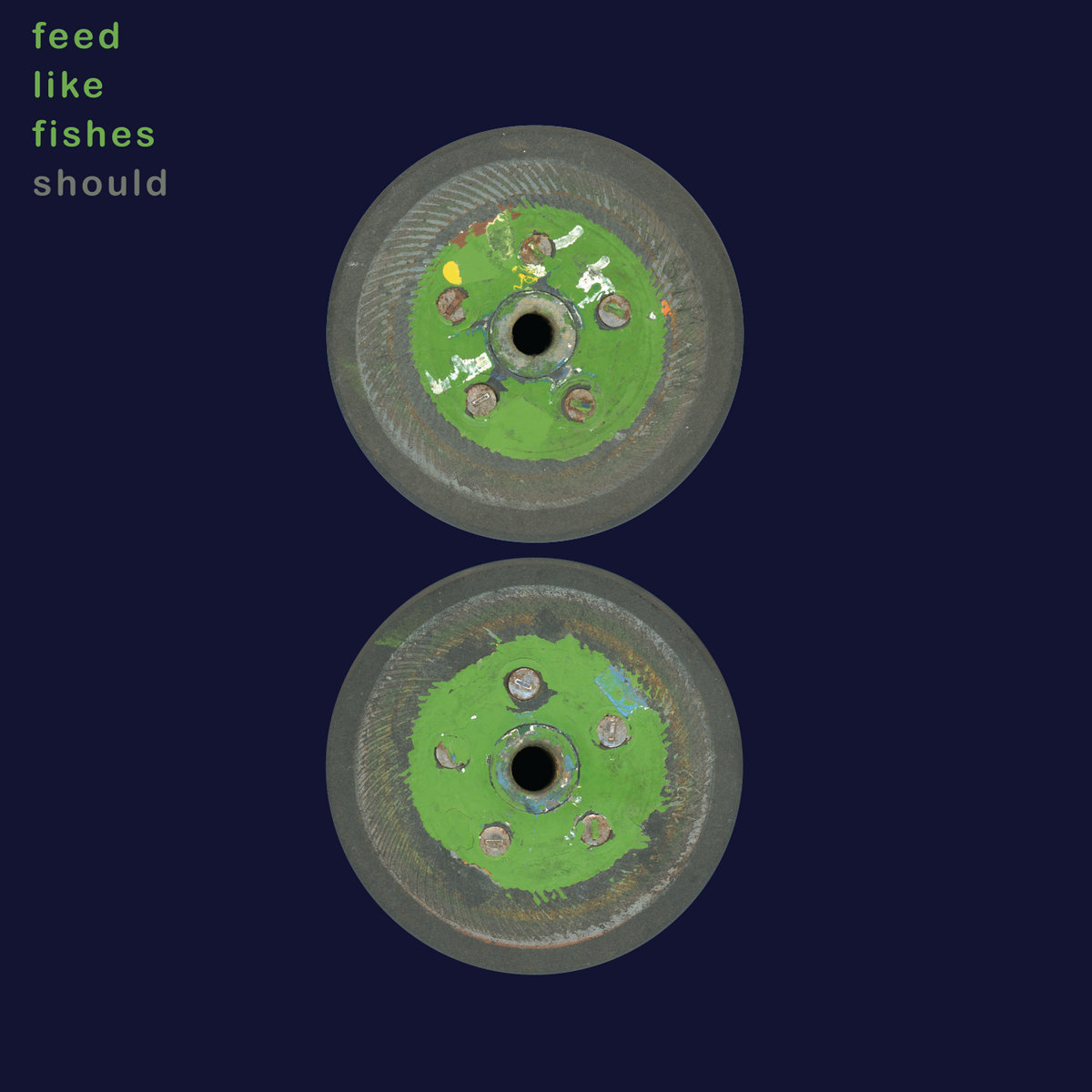
Few American underground bands have cultivated a mythology as quietly persistent as Should. Recorded between State College, PA and to a smaller degree, Austin, TX, ‘Feed Like Fishes’ was largely constructed by Marc Ostermeier, who performed the bulk of the instrumentation, shaping its sonic architecture from the ground up, with Tanya Maus lending her distinct vocals to complete the picture. Together, they forged a body of work that feels slightly out of time and too melodically rich to dissolve into pure noise, yet too sonically adventurous to settle comfortably within conventional indie rock. With ‘Feed Like Fishes (Deluxe)’, Numero Group offers not merely a reissue, but a restoration: a careful re-contextualization of an album that always felt like it was waiting for the right era to hear it clearly.
Originally circulating in limited form upon its release in 1998, ‘Feed Like Fishes’ arrived at a moment when the afterglow of British shoegaze was fading and American alternative rock was consolidating into more rigid commercial shapes. Should occupied a different frequency. Their music drew from the immersive haze associated with the genre’s UK architects, yet it never surrendered its structural intelligence. Even at their most sonically saturated, the guitars suggest deliberation rather than abandon. Marc’s bass anchors the music with a melodic sensibility that resists being reduced to texture; it moves with quiet authority, subtly redirecting the emotional current of each song.
The Deluxe edition underscores just how fully formed this vision was. Remastered with care, the album reveals a striking clarity beneath its layers of distortion. What once registered as gauzy blur now discloses intricate harmonic movement and carefully calibrated dynamics. The guitars shimmer, but they also converse; feedback is not an eruption but an extension of the melodic line. The band’s approach to volume feels architectural, building vaulted spaces of sound that envelop rather than overwhelm.
The opening instrumental “Fish Fourteen” sets the tone with guitars that seem less strummed than suspended. The distortion is soft-edged, like light diffused through gauze, and the rhythm section resists any obvious forward drive. The effect is not inertia but a kind of gliding stasis. “Sarah Missing” deepens that sensation. Ostermeier’s voice hovers just above a whisper, less a performance than an interior monologue. The guitars, layered but never dense, drift in parallel lines that refuse to intersect in any obvious hook. In a different band’s hands, such reticence might read as affectation. Here, it feels instinctive, as though the songs are discovering themselves in real time.
“Aside” and a cover of The Wedding Present’s “Spangle” continue this aesthetic of gentle deferral. On “Spangle,” a subtle swell in the upper register suggests the possibility of lift, but the band pulls back just as momentum threatens to crest. It is a study in almosts. “It Still Would” and “Lullen” follow, pairing minimal chord changes with melodies that appear only gradually, like figures emerging from fog, (“Lullen” featuring brother Eric Ostermeier on guitar). The unhurried pacing demands patience, but it rewards close listening; each small shift in tone or texture feels consequential.
The album’s center is marked by “Memdrive,” a track that captures Should’s fascination with repetition as meditation, featuring bass by Eric Ostermeier that subtly thicken its hypnotic pull. The bass locks into a circular figure while Marc Ostermeier’s guitar lines arc overhead, never resolving into a traditional chorus with its added textures lending the piece a deeper harmonic undercurrent. “Its Pull Is Slight” lives up to its title, exerting a gravitational force so delicate it’s nearly imperceptible, its power rooted in restraint rather than insistence. Instrumental sketches such as “Inst2” and the paired “In Nine” and “Things Are The Same (in Nine)” further spotlight the band’s structural curiosity, with Eric again contributing guitar work on “Inst2” and bass on “In Nine” that assist in enriching their tonal palette. These pieces function like connective tissue, emphasizing texture and atmosphere over narrative momentum. “Both Eyes Open” and “Faded” (the latter also shaped by Eric’s guitar & bass contributions), gesture toward something closer to conventional songcraft, yet even here Should avoid easy release. The layered guitars glow with a muted intensity, and the vocals remain partially veiled. “This House I’m Living In” and “Myself” introduce a faintly confessional tone, though the emotional temperature never spikes. Instead, the band sustains a steady, nocturnal radiance.
The bonus material expands the album’s emotional perimeter without disrupting its cohesion. “Singe” and “Feed Like Fishes” underscore the group’s commitment to atmosphere over gesture. The latter, in particular, feels like a mission statement: movement without destination, sound as environment rather than event. “Ocean Warm” drifts in on a tide of reverb, its warmth paradoxically tinged with distance. “Soothed (Rerecorded)” revisits earlier material with slightly more definition, yet preserves the original’s blurred edges, as if clarity itself were suspect. “Merger” (18th Dye cover) and “These Days” close the collection with a subdued finality. There is no grand summation, no dramatic fade to black. Instead, the album seems to recede gradually, like a shoreline disappearing in the rearview mirror.
What distinguishes ‘Feed Like Fishes’ from many of its contemporaries is its compositional patience. Should were never content to let atmosphere substitute for songwriting. Their melodies emerge gradually, sometimes half-concealed within waves of effects, rewarding attentive listening. There is a cerebral quality to the arrangements: an interest in repetition and variation that recalls minimalist composition as much as rock tradition. Yet the record never feels academic. Its emotional temperature runs high, even when expressed through restraint. The Deluxe edition only deepens the portrait. Demos and alternate takes illuminate the band’s process without diminishing the mystique. If anything, they highlight the discipline behind the apparent wash of sound. Stripped-down versions of familiar tracks reveal skeletal frameworks of melody and rhythm that prove how little of Should’s impact depended on studio ornamentation. The core was always there: entwined guitar figures with Maus’s vocals hovering between confession and abstraction.
There is also a cultural recalibration at work here. In an era newly attuned to the lineage of American shoegaze and dream-pop, ‘Feed Like Fishes’ sounds less like a footnote and more like a foundational text. The reissue allows listeners to trace a line from Should’s immersive density to the current resurgence of interest in textural, emotionally expansive guitar music. Yet the album resists being framed as prophecy. It is too idiosyncratic, too inward-looking, to function as mere precedent. Numero Group’s curatorial touch is crucial. The label has built its reputation on excavating overlooked catalogs and presenting them with both scholarly care and aesthetic sensitivity. Here, the packaging and sequencing emphasize ‘Feed Like Fishes’ as a coherent artistic statement rather than a relic. The Deluxe edition feels definitive, not archival in the dusty sense, but alive.
Listening now, the album’s emotional resonance feels uncannily contemporary. Its oscillation between fragility and force mirrors the psychological atmosphere of our own moment. The music suggests immersion without escapism; it invites the listener to dwell within sound rather than flee into it. In this sense, ‘Feed Like Fishes (Deluxe)’ is not just a historical corrective but a reminder of the possibilities embedded in careful listening. Should’s legacy has always rested in the margins; circulated among devotees, whispered about in liner notes and message boards. With this reissue, that margin expands. Eric and Marc Ostermeier and Tanya Maus emerge not as cult curiosities but as architects of a deeply considered sonic language. ‘Feed Like Fishes’ stands as evidence that some records do not age into relevance; they simply wait for the world to catch up.
Visit Bandcamp and Numero Group to find out more.