
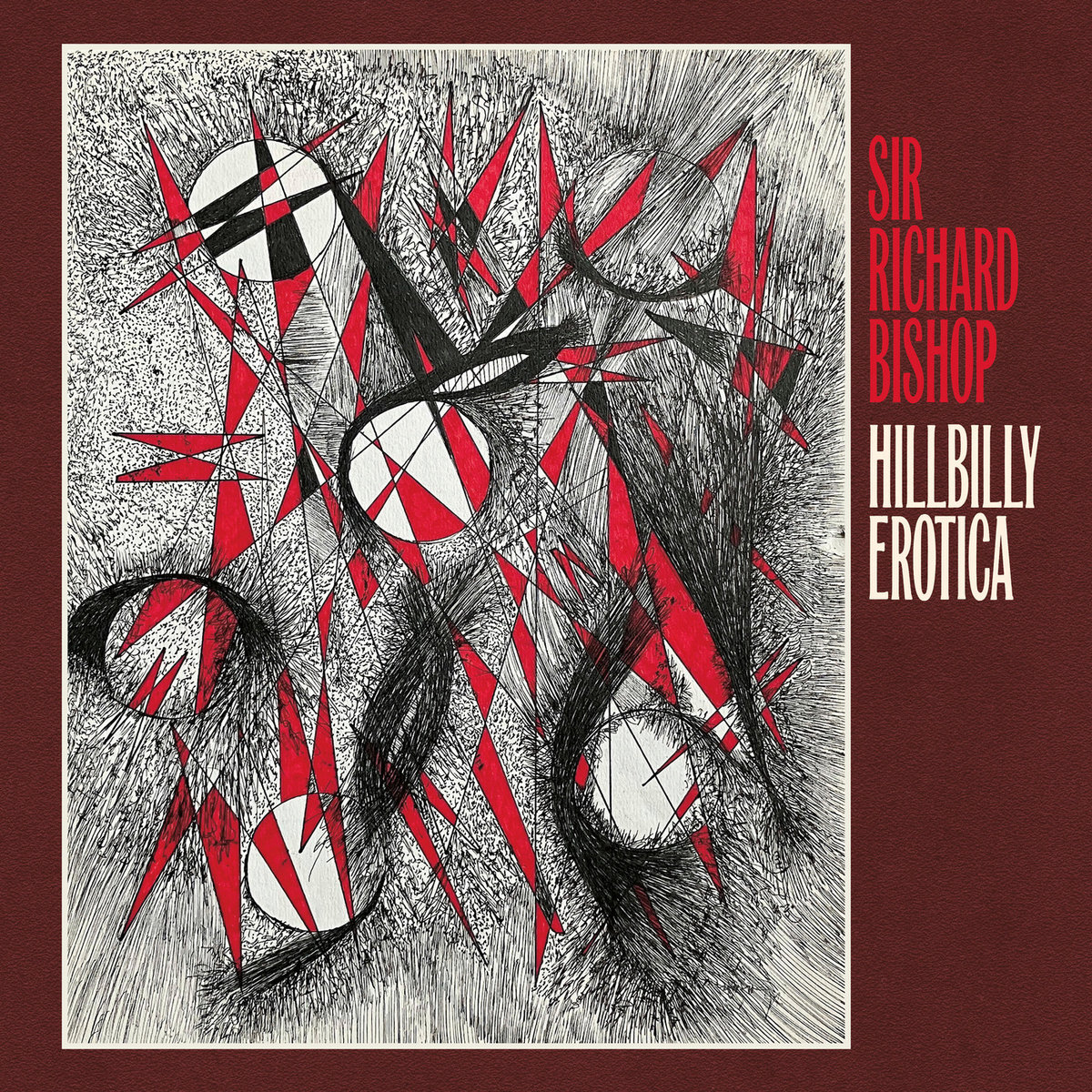
Sir Richard Bishop has never treated the acoustic guitar as a polite vehicle for tasteful folk. On ‘Hillbilly Erotica’ he uses it to dig, to fantasize, to chase inheritance, and to get happily lost. Across eight pieces he explores the remote Tennessee country tied to his father’s family, but this isn’t a roots-music exercise or a straight autobiography. It’s an imagined visit to ancestral ground, run through memory, improvisation, American folk traditions, ragas and blues by a guitarist who has never cared much about staying inside the lines.
The recording setup is strikingly simple. Bishop plays one acoustic guitar on all eight tracks, with no overdubs, and he improvises every piece except the closer, “Postcoital Serenade.” That limit gives the album its immediacy. There’s no band to share the load, no studio trickery to hide a hesitation, no second guitar to back up a phrase. Every decision is Bishop’s, made in the moment, so he sounds like someone finding his way through country he doesn’t know rather than walking a planned route.
“Lick Skillet” sets the odd mood right away. The title is a real rural Tennessee place name, and Bishop turns it into something close to myth. His fingers move fast and unpredictably, pulling scraps of folk melody into patterns that sound familiar and strange at once. It suggests an old American vernacular without trying to reconstruct it. He isn’t imitating a country guitarist from another century. He’s imagining what that music might sound like after a lifetime of listening, travel and improvising.
That distinction matters more on “Finger, Tennessee,” where place and sound get tied together. The bawdy-sounding title is mostly an accident of geography: Finger is one of several real communities near the remote Enville homestead connected to Bishop’s father. The joke and the history sit together happily. Bishop seems taken with how names survive across generations, carrying obscure histories while meaning almost nothing to outsiders. His guitar answers that mystery by sliding between delicacy and speed.
“Sweet Lips Spiritual” goes further into dream territory. The phrase hints at something both devotional and sensual, and his playing leans into that mix, respectful without turning solemn and earthy without turning crude. It feels like a ceremony, though one he made up rather than inherited. That’s one of Bishop’s gifts: he can make an improvised passage sound like it belongs to a tradition without pretending the tradition is fixed or fully knowable.
“Back Forty Lashes” is rougher, with steel strings driven through dense clusters of notes and sudden turns. His technique is formidable, but showing off isn’t the point. What you hear is thought happening through the hands: ideas arrive, collide, change and vanish. The guitar becomes a speculative instrument that can express uncertainty itself. The piece connects to the American Primitive lineage of John Fahey, but Bishop’s language is too personal and too tied to specific places to fit neatly inside it.
“Bride of Rhythm Methodist” adds another contradiction. The title has the surreal comedy Bishop likes, while the music has an almost spiritual seriousness. He moves from delicate picking to torrents of sound without losing the thread of a story. Even with no lyrics, the pieces feel populated. You can picture figures, landscapes, family stories, old buildings, dirt roads, church interiors and night gatherings drifting through, and Bishop wisely never pins any of them down. You get impressions, not explanations.
“Finger Revisited” makes the album’s fixation on place explicit by going back. It isn’t a repeat of the earlier piece. Bishop treats the location as a recurring point in the imagination, and the second visit finds new possibilities in familiar ground. That may say the most about how the record was conceived: geography as a prompt. A place can be inherited without being owned, remembered without being lived in, and turned into something that exists partly in the mind.
With “Hookers Bend,” Bishop again turns a real Tennessee place name into a launch point. The title invites an obvious joke, but the music doesn’t stay at the level of novelty. The playing relaxes and begins to flow, and the passages sound found rather than written. The guitar can thump like a drum one moment and sing the next, and he moves between the two without warning. One player can sound like a whole landscape when the imagination behind the playing is big enough.
“Postcoital Serenade” closes the record with a rare nod to composition. After seven improvised pieces, Bishop offers something more deliberately shaped, though the title keeps the sly humor going. It’s reflective without being sleepy. Dawn is coming, but the dark hasn’t quite let go. That sense of transition gives the album its last note: you’ve wandered through an imagined backcountry of family history, folklore, erotic suggestion, absurdity and musical memory, and you come out without a neat conclusion.
On ‘Hillbilly Erotica,’ Bishop never treats American folk music as a sealed archive. It’s raw material to question, distort and push toward places its original players couldn’t have imagined. His link to Fahey’s American Primitive idea is less about joining a school than about having a useful place to start from. He takes the acoustic guitar out into the wilderness and asks what’s still possible when inherited forms meet improvisation and restless curiosity.
The humor matters too. Under all the technical brilliance and ancestral speculation is a musician who knows that seriousness without mischief can be its own kind of confinement. “Lick Skillet,” “Hookers Bend” and “Postcoital Serenade” leave room for laughter even as the music deals with death, lineage, landscape and cultural memory. That mix gives the album its character. It’s gorgeous without being precious, exploratory without turning academic, and unruly without losing direction.
Bishop has made an acoustic-guitar record that sits somewhere between folklore and hallucination. The eight pieces don’t rebuild a vanished America. They invent one, out of the leftovers of family history and the stubborn mystery of place. He treats the steel-string guitar like a divining rod and goes wherever it pulls him. What comes out sounds old and new at the same time: odd, funny, lovely, occasionally fierce, and all about what gets passed down to us and the stories we make up when it doesn’t explain much.
Learn more links: Drag City Records | Bandcamp | Instagram | Facebook | Twitter