
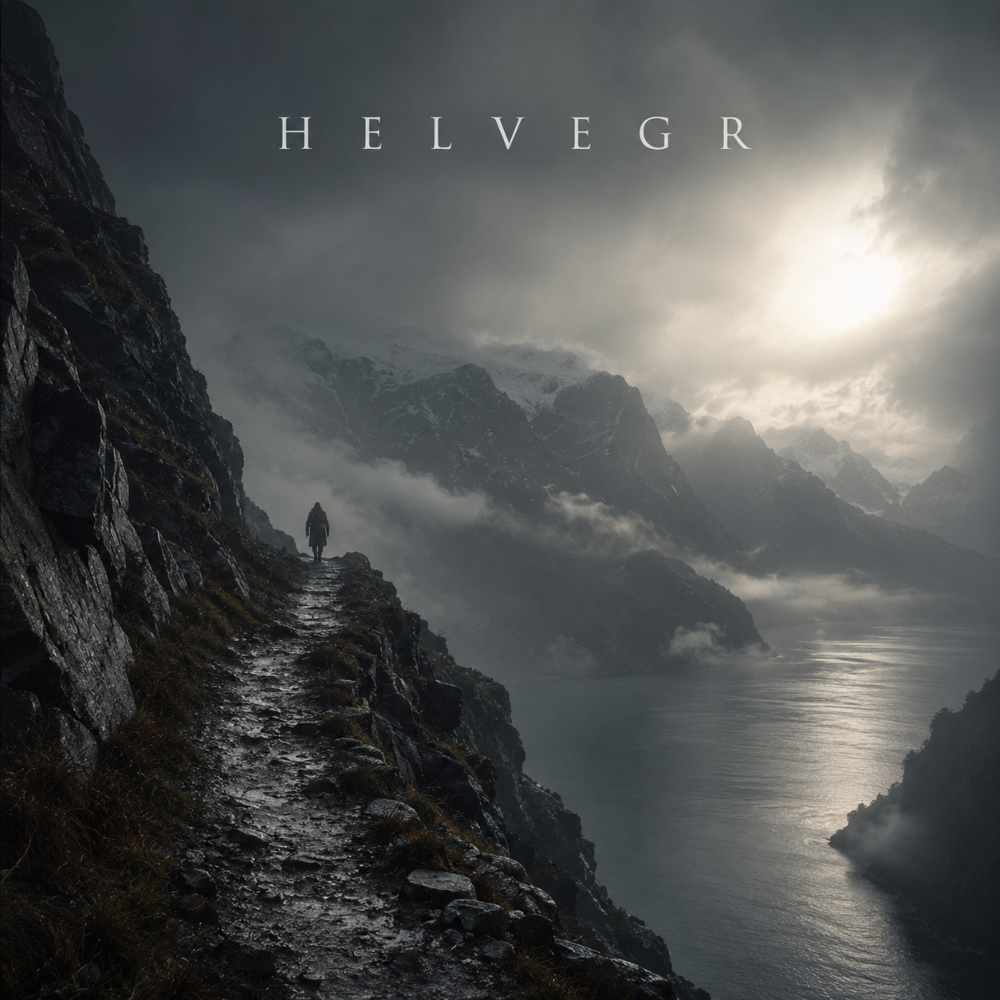
‘Helvegr’ seems to come from a very different place than most contemporary music, especially as, in many ways, it doesn’t sound that contemporary at all. Okay, modern production and instrumentation might place it in the here and now, at least on a surface level, but the voices, the heart, the intent feel like the echo from a more primal, more pagan place.
It’s a song that seems not to start, but rather to float into the listener’s consciousness, drift gently past, and fade out, as if we are party to one small piece of an endless song cycle, one that is perhaps an oral history of a place, a people, a sound born of the land itself (and beyond) rather than made by mere mortals.
That ‘Helvegr’ is the name for the road that leads to the Hel(l) of Nordic mythology is perhaps key to understand this song, that it sounds like a somber funereal wake, one built of beguiling, chanted, and ethereal voices, the coming together of the two halves of the divine whole, minimalist sonics, brooding bass pulses, something forged as much atmosphere and anticipation as music in the traditional sense.
Ambient and gothic, folk-finessed and ephemeral, ‘Helvergr’ is a reminder that sometimes the path before you doesn’t lead to the place that you dread after all but is actually the key to your salvation, your release, your escape.
This isn’t music made for the usual reasons; this is music that connects us to our past, our mythologies, our history – it is a reminder that such tales are not just the stuff of legend; they are for learning, coded teachings that have echoed down through time. In the modern age, we dismiss such stories as fairy tales, but I would suggest that as the modern world burns, perhaps we need such knowledge, such insights into the human psyche more than ever.
Facebook
YouTube
Instagram
TikTok