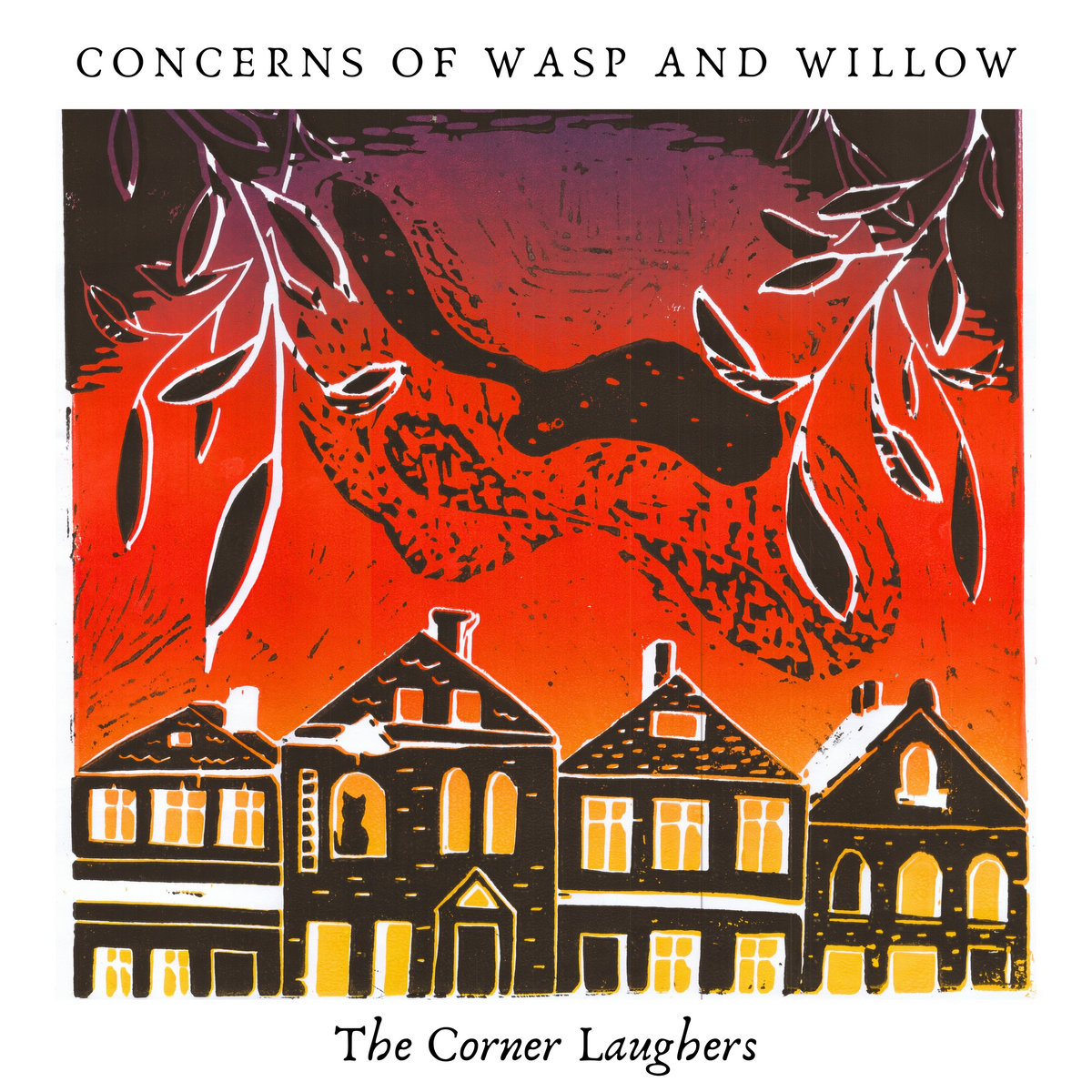
After a five-year pause, ‘Concerns Of Wasp And Willow’ returns The Corner Laughers to a terrain they have long mapped with uncommon precision: a space where melodic brightness and lyrical unease coexist without cancelling each other out. Rather than smoothing that duality into something more conventional, Karla Kane, Khoi Huynh, KC Bowman, and Charlie Crabtree lean into it, treating contradiction as compositional fuel. The result is an album that feels less like a reconciliation of opposites than a sustained conversation between them, carried forward through arrangement, instrumentation, and narrative detail.
“Terra Mia” opens the record with an immediate sense of narrative scope. Kane’s ukulele provides a deceptively light framework, quickly expanded by Huynh’s bass and Bowman’s multi-instrumental layering, while Crabtree’s drumming introduces a steady forward motion. The song’s environmental imagery is embedded within a structure that gradually thickens, suggesting accumulation rather than escalation. Octavia Kane’s contribution on “Crumb Clean,” though appearing later in the sequence, echoes this generational thread of musical continuity, reinforcing the sense that these songs exist within a broader ecological and familial system. “Dusking” marks the beginning of what Kane refers to as the “Dusking Trilogy,” and its placement early in the album establishes a tonal pivot. Here, the band leans into a more restrained palette, allowing harmonic detail to surface through careful spacing. Bowman’s guitar work and Huynh’s keyboard lines create a soft-edged architecture that supports Kane’s vocal phrasing without overwhelming it. The track’s emotional register is reflective rather than declarative, setting up a continuum that extends through later entries.
“Rainbow Cardigan,” already familiar through its earlier release, serves as a focal point for the album’s conceptual ambitions. Its juxtaposition of minor-key ukulele and expansive harmonic shifts is handled with particular care by Kane and Huynh, while Angela Rhoades’ electric guitar adds a subtle counterweight to the arrangement. Crabtree’s drumming anchors the piece, ensuring that its tonal shifts remain cohesive rather than fragmented. The song’s lyrical oscillation between temporal states is mirrored in its musical structure, which resists settling into a single emotional stance. “The Harvestman” occupies a darker register, both texturally and narratively. Bradley Skaught’s drumming introduces a slightly different rhythmic sensibility, lending the track a distinct physicality within the album’s broader continuity. Huynh and Bowman’s instrumentation here is more shadowed, with keyboards and guitar lines folding into each other in ways that obscure clear boundaries. Kane’s vocal delivery remains central, guiding the listener through a landscape that feels observational rather than interpretive.
“Dark Matter” and “Red Yarrow, Yellow Yarrow” continue the album’s engagement with ecological and cosmological imagery, though in markedly different registers. The former, with its buoyant rhythm and pointed lyrical framing, contrasts with the latter’s warmer, more grounded tonal palette. In both cases, Huynh, Bowman, and Crabtree function as a tightly integrated unit, shaping rhythmic and harmonic frameworks that allow Kane’s writing to move fluidly between abstraction and specificity. “Universe Point,” written by Bowman, introduces a more overtly conceptual dimension, addressing epistemological divides without sacrificing melodic accessibility. His vocal and guitar contributions here are particularly significant, positioning the track as both internal reflection and outward observation. The rhythm section maintains a steady presence, ensuring that the song’s thematic ambition remains anchored in musical clarity.
“Victoria Sponge,” co-written with Helen Luker, expands the album’s collaborative reach. Luker’s vocal presence introduces a distinct timbral contrast, while Bowman’s multi-instrumental arrangement draws together piano, bass, and guitar into a cohesive framework. The inclusion of Angela Rhoades further enriches the texture, creating a layered ensemble that reflects the song’s historical and narrative breadth. Even as it spans temporal and geographic references, the track maintains a sense of structural coherence grounded in the band’s shared sensibility. Closing track “Larkspur Landing” brings additional contributors into focus, with Jeri Sykes’ woodwinds adding a final layer of tonal complexity. The interplay between Kane, Huynh, Bowman, and Crabtree remains central, but the expanded instrumentation lends the piece a sense of open-ended reflection. Rather than resolving the album’s thematic threads, it holds them in suspension, allowing ecological and temporal motifs to coexist without closure.
Across ‘Concerns Of Wasp And Willow’, The Corner Laughers demonstrate a refined understanding of how collaboration can function as structural principle rather than decorative enhancement by creating a system in which melody, narrative, and arrangement are continuously negotiated. The album’s strength lies not in resolving its dualities, but in sustaining them with remarkable clarity and compositional discipline.
Find out more by visiting Big Stir Records | Bandcamp | Karla Kane | Twitter | Facebook.