
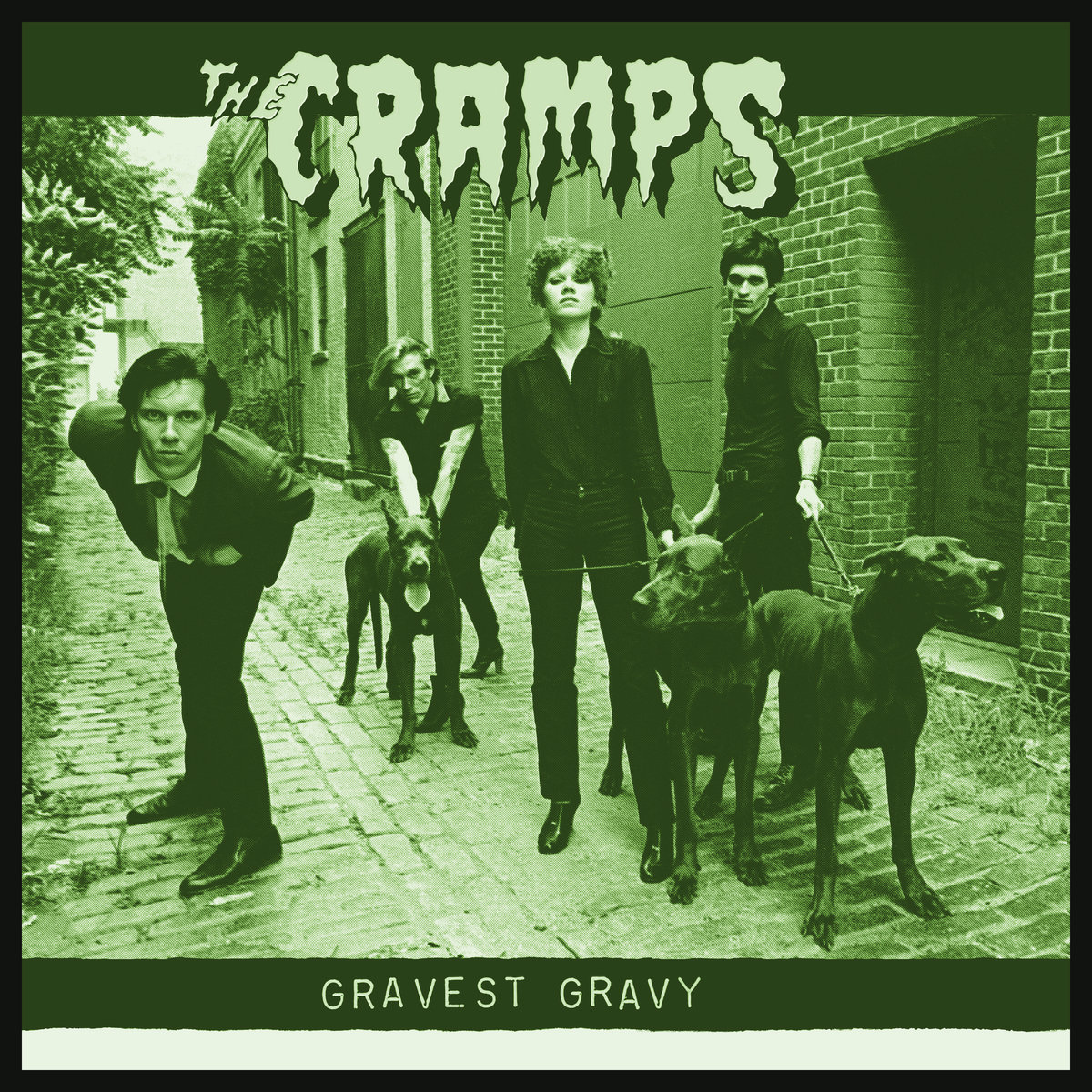
Archival releases often function as historical footnotes, preserving alternate takes and forgotten recordings for devoted collectors while offering little insight beyond curiosity. ‘Gravest Gravy’ achieves something considerably richer. Drawn from the October 1977 Ardent Studios sessions that also produced Gravest Hits, these performances illuminate a band still refining its identity while already sounding unlike anyone else. Rather than presenting unfinished sketches, the collection captures The Cramps at the precise moment their mythology was becoming reality, revealing how Lux Interior, Poison Ivy, Bryan Gregory, and Nick Knox forged a language from rockabilly, primitive rock and roll, surf, garage punk, B-movie horror, science fiction, and pop-cultural debris.
The opening version of “TV Set” immediately demonstrates why The Cramps became such an enduring cultural force. Lux Interior performs less as a conventional singer than as a charismatic ringmaster guiding listeners through an unhinged carnival of obsession and television-fed fantasies. His vocal style balances swagger, absurdity, menace, and humor in equal measure. Beside him, Poison Ivy’s guitar playing remains deceptively economical, avoiding unnecessary embellishment while generating an unmistakable atmosphere through hypnotic riffs and razor-sharp rhythmic precision. Bryan Gregory’s guitar broadens the sonic landscape with raw, untamed energy, while Nick Knox’s drumming drives everything forward with relentless simplicity that refuses polish in favor of instinct.
One of the album’s greatest revelations arrives with “Weekend On Mars.” Long regarded as a favorite primarily through live performances, this studio version highlights how naturally the group’s fascination with science fiction merged with the stripped-back vocabulary of early rock and roll. Rather than treating extraterrestrial imagery as novelty, The Cramps transform it into another chapter in America’s endless fascination with outsiders, misfits, and forgotten dreams. The song captures the exhilaration of discovering possibilities beyond ordinary reality without sacrificing the primitive pulse that defines the band’s aesthetic.
The reinterpretation of “Twist & Shout” demonstrates the band’s remarkable ability to reclaim familiar material without irony. Instead of polishing a universally recognized standard, The Cramps expose its primal core, reminding listeners that early rock and roll possessed a wildness often softened by decades of repetition. Poison Ivy and Gregory reduce the arrangement to its essential components, while Knox’s drumming supplies irresistible momentum. Lux, meanwhile, approaches the lyric with gleeful abandon, transforming celebration into something deliciously unhinged.
“Jungle Hop” continues that fascination with rock and roll’s earliest impulses, embracing rhythmic immediacy over technical refinement. The performance reflects the band’s understanding that excitement cannot be manufactured through complexity. Every musical decision favors direct impact, creating a sound that remains startlingly immediate despite its obvious affection for music several decades older than itself.
The Paul Revere and the Raiders cover “Hungry” reveals another important aspect of The Cramps’ artistic vision. Their encyclopedic appreciation for neglected corners of popular music was never an exercise in nostalgia. Instead, forgotten songs became raw material for reinvention. Here, appetite becomes psychological as much as physical, reflecting the band’s broader fascination with desire, excess, and restless dissatisfaction. Lux inhabits the lyric with theatrical conviction while the band strips away any lingering traces of mid-sixties polish.
“The Native Are Restless” offers fascinating insight into the group’s creative evolution. Featuring lyrics that differ from the later version familiar from ‘Psychedelic Jungle’ (_ _, ), the recording illustrates that The Cramps treated songs as living organisms rather than fixed compositions. Even at this formative stage, their material remained fluid, capable of transformation without losing its distinctive identity. The interplay between Poison Ivy and Gregory generates an exhilarating sense of controlled chaos, each guitarist contributing complementary textures rather than competing for attention.
“Domino” once again demonstrates the band’s uncanny ability to inhabit songs from another era while making them unmistakably their own. What could easily have become simple revivalism instead emerges as an act of creative archaeology. The Cramps excavate emotional possibilities hidden beneath familiar melodies, uncovering qualities that conventional interpretations rarely acknowledge. The early recording of “Can’t Find My Mind” feels especially significant in retrospect. Long before the group became synonymous with psychobilly, they were already constructing a psychological landscape populated by obsession, alienation, and gleeful instability. The song’s hypnotic repetition mirrors its lyrical concerns, creating an atmosphere that remains deeply compelling without relying upon elaborate arrangements.
Similarly, “Rockin’ Bones” celebrates rock and roll as something instinctive rather than respectable. The performance radiates physical energy while acknowledging the music’s own strange mythology, where skeletons dance, monsters fall in love, and forgotten drive-in fantasies continue to thrive long after mainstream culture has moved on. Gregory’s guitar work contributes a rough-edged vitality that perfectly complements Poison Ivy’s disciplined minimalism.
The *Roy Orbison*-associated “Problem Child” further demonstrates the remarkable breadth of the band’s influences. Although Orbison and The Cramps might initially appear to inhabit different musical worlds, both understood how vulnerability and theatricality could coexist. Lux emphasizes the song’s rebellious spirit without sacrificing its emotional undercurrent, revealing surprising continuity between classic rock and roll and punk’s emerging sensibility.
Closing with “Rocket In My Pocket,” originally associated with Jimmy Lloyd, proves an inspired decision. The performance encapsulates everything that makes these recordings so valuable. Rather than sounding like musicians carefully preserving history, The Cramps behave as though they have stumbled upon forgotten artifacts and instinctively recognized their continuing vitality. The song radiates infectious exuberance, serving as both celebration and declaration of artistic purpose.
The technical restoration deserves considerable praise. Brian Kehew’s tape transfers preserve the immediacy of the original reels while allowing their remarkable detail to emerge with fresh clarity. Henry Rollins’ thoughtful selection of material shapes the collection into something far more coherent than a simple archive. Ian MacKaye and Don Zientara’s engineering at Inner Ear Studios respects the integrity of the source recordings, while Pete Lyman’s mastering enhances their power without compromising their raw character.
More than four decades after these performances were captured, ‘Gravest Gravy’ confirms that The Cramps never merely borrowed from the past. Lux Interior, Poison Ivy, Bryan Gregory, and Nick Knox treated the entire history of American popular culture as a living organism, resurrecting forgotten songs, discarded imagery, exploitation cinema, pulp fiction, hot-rod mythology, and late-night television with equal enthusiasm. These recordings reveal a band already possessing complete artistic conviction while still discovering new possibilities within its singular vision. Far from serving as an appendix to their catalogue, ‘Gravest Gravy’ stands as compelling evidence that even the earliest stages of The Cramps’ evolution possessed the imagination, fearlessness, and joyful perversity that would secure their place among rock music’s most original innovators.
Releases August 21, 2026
Learn more links:
The Cramps / Vengeance Records
Bandcamp
YouTube
Instagram
Facebook