
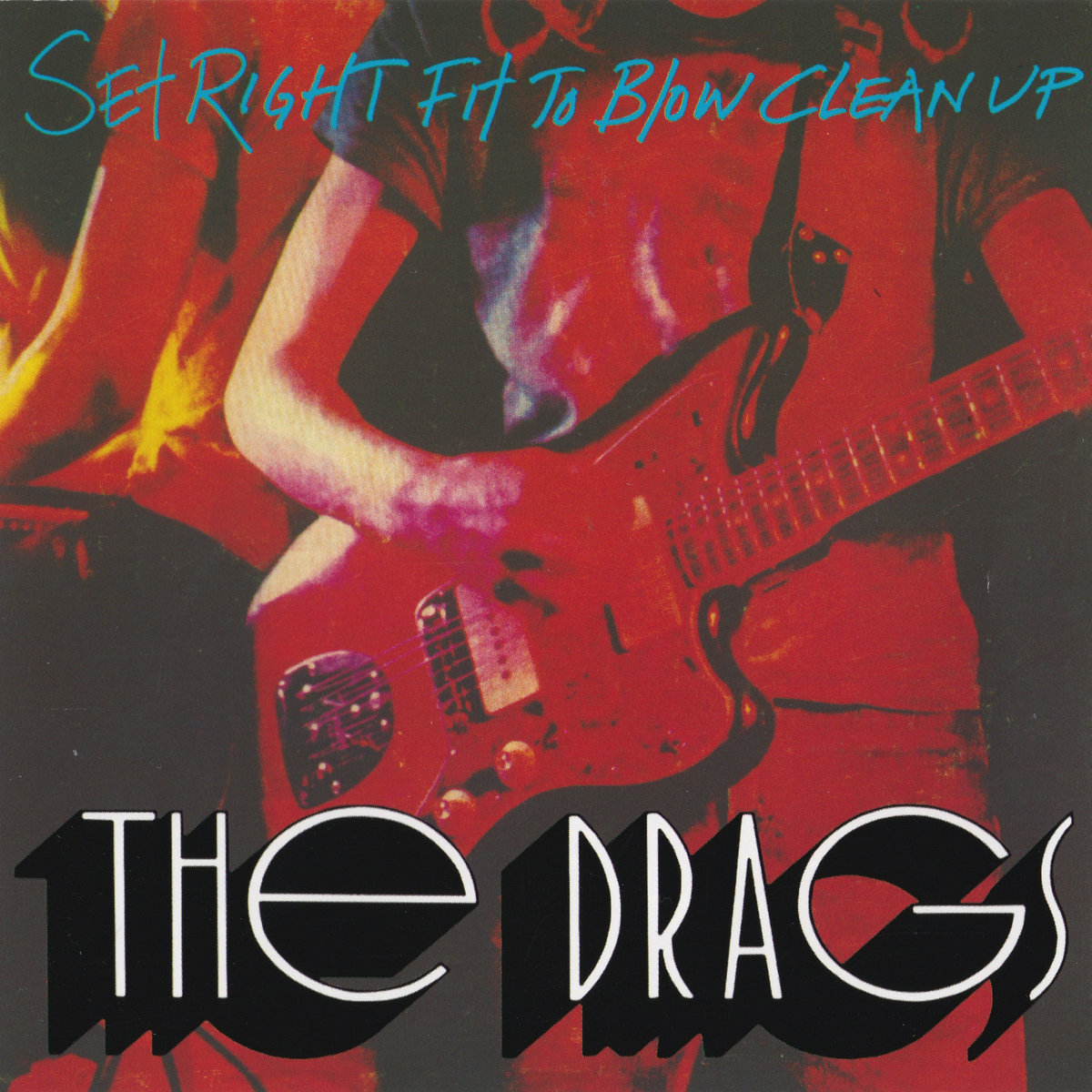
The Drags were apparently supposed to know better. By 1999, the Albuquerque garage-punk band had already established a reputation for compact, corrosive songs that seemed engineered to offend anyone who valued polish, restraint, or good taste. Then came ‘Set Right Fit To Blow Clean Up’, an album that took the band’s primitive attack and pushed it toward something bigger, stranger, and considerably more unruly. At the time, that expansion could be mistaken for a betrayal of garage orthodoxy. Heard now, it sounds like liberation. The Drags did not abandon punk when they added weight, wah-wah, oscillation, country twang, and extended instrumental passages. They discovered how much punishment the form could absorb without losing its identity.
The opening “This Is The Sound of Hard Rock” announces the change with an almost comically declarative title, but the music earns its boast. Singer and guitarist CJ Pretzel remains the essential center of gravity, delivering vocals with the blunt authority of someone who has no interest in negotiating with the listener. Lorca Shalom’s bass gives the songs their muscular propulsion, while Ron Skrasek, brought in after Keith Herrera’s departure, plays drums with a force that expands the group’s attack without sanding down its recklessness. Scott Derr, formerly of Monoshock, adds a second guitar and an assortment of sonic interference, turning the band’s basic architecture into something more unpredictable.
“Dirty Little Bird” demonstrates how effectively the expanded lineup can work within a concise frame. The song moves quickly, but its sound has enough density to suggest that The Drags are no longer interested in simply racing from one riff to another. Their playing has become heavier without becoming ponderous. That distinction is crucial. Punk’s relationship with hard rock has always been complicated, particularly among musicians determined to protect the genre from anything that might resemble virtuosity or classic-rock indulgence. The Drags simply stop worrying about the distinction. “The Kick Fighter” compresses that philosophy into barely two minutes. Its brevity is not evidence of minimal ambition; it is a demonstration of control. The band can still hit with the speed and economy associated with its earlier material, but now there is a larger sonic palette behind the impact. “Night Rider” takes the idea further, allowing the music more room to cruise. The guitars seem to occupy a wider field, and Skrasek’s drumming gives the track a rolling momentum that makes the song feel built for late-night driving and questionable decisions.
“A Modern Man” is a miniature blast of attitude, its short duration making its point before the listener has time to become comfortable. Then “Jet Lag” completely changes the temperature. The song’s drunken country twang is one of the album’s most inspired departures, sounding simultaneously sincere and gloriously disreputable. It is not a novelty detour. The country influence exposes something already present in The Drags’ music: an affection for American roots forms stripped of refinement and returned to their roughest, most bodily instincts. The result is warped, funny, and unexpectedly beautiful.
“Amplifier Blues” makes the album’s title feel almost unnecessary because the guitars themselves provide the manifesto. Derr’s contributions are particularly important here. As guitarist, noisemaker, and in-house engineer, he seems to understand that distortion can be treated as composition rather than mere decoration. The noises accumulate without overwhelming the songs, giving the record a sense of instability that conventional studio cleanliness could never provide. “No Matter What Shape (Your Head Is In)” pushes the band further into that expanded vocabulary. The song remains recognizably Drags music, but the edges have been deliberately blurred. This is punk music with its sleeves rolled up and its hands dirty from tinkering with equipment. The willingness to experiment never feels like an attempt to demonstrate sophistication. Quite the opposite: The Drags sound as though they are having too much fun wrecking the boundaries to care whether anyone approves.
“FM SHADES” is perhaps the clearest expression of the album’s newfound confidence. The title suggests radio culture, airwaves, and the seductive gloss of rock mythology, while the music responds with something much dirtier and more exhilarating. The song stretches the group’s attack without diluting it, creating the sensation of a garage band discovering an enormous amplifier and immediately deciding that the only responsible thing to do is turn every knob. “Black Light” pares things back again, its brief runtime making it another flash of concentrated force. The sequencing is one of the album’s subtle strengths: The Drags repeatedly alternate between compact explosions and songs that allow their expanded sound room to roam. That pacing prevents the heavier production from becoming monotonous and gives the record a sense of motion even when individual tracks are relatively loose.
Then comes “Communication Breakdown,” an inspired choice of cover that places The Drags in direct conversation with one of rock’s most recognizable templates for excess. They do not need to reinvent the song. Their approach makes the material fit naturally into the album’s worldview, where rock’s grand gestures are welcomed rather than mocked. The closing “Drags Gotta Have It” brings everything back home with a title that sounds like both demand and declaration. After everything that has preceded it, the song feels like the band reclaiming its own name as a musical principle. Recorded in a barn, with Derr involved in engineering, ‘Set Right Fit To Blow Clean Up’ has an environment built into its character. The setting is not incidental. The album sounds like music made in a physical space where amplification, instruments, people, and accidents were allowed to interact. That looseness is balanced by the considerable discipline of Pretzel, Shalom, Skrasek, and Derr. The musicians know when to hold back, when to accelerate, and when to let a sound become ridiculous enough to turn exhilarating.
The most striking thing about ‘Set Right Fit To Blow Clean Up’ is how completely it rejects the idea that punk must remain aesthetically frozen in order to remain punk. The Drags expand rather than dilute their identity. They allow hard rock, psychedelic noise, country, garage rock, and warped studio experimentation into the room, then make all of it answer to their particular sense of velocity and humor. What once might have looked like a dangerous flirtation with rock excess now reads as the band’s most convincing statement. ‘Set Right Fit To Blow Clean Up’ is not a polished correction of The Drags’ earlier work. It is their unruly culmination: louder, stranger, more spacious, and more confident in its own instincts. The teenage garage purist may have objected. The wiser listener knows better. The Drags did not get too rock. They finally gave themselves enough room to become fully, gloriously Drags.
Learn more links: