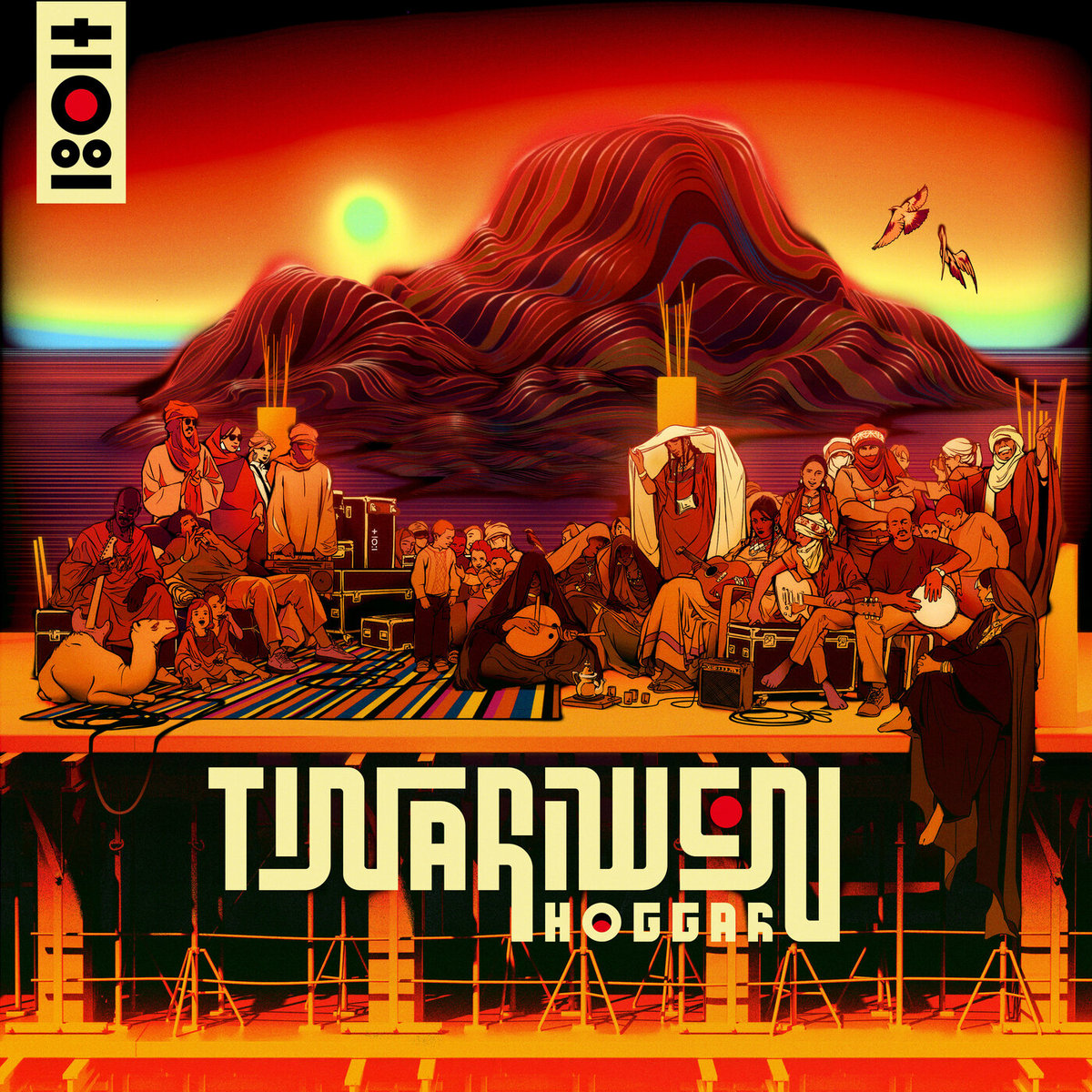
Authority and humility coexist throughout ‘Hoggar’, an album that distills Tinariwen’s long-cultivated musical language since their earliest days in the Sahara, into something both grounded and quietly expansive. Yet to describe it as a retreat would miss the album’s quiet ambition. By inviting younger Tuareg musicians into their orbit and incorporating voices such as José González and Solafa Elyas, the collective reshapes its identity as both custodian and collaborator, an ensemble grounded in tradition but open to subtle evolution.
“Amidinim Ehaf Solan” establishes the album’s tone with a cyclical guitar figure that seems to circle rather than advance, a reminder that Tinariwen’s sense of time often resists linear progression. The interplay between guitars, (long a defining feature of the group’s sound), remains central, with Ibrahim Ag Alhabib’s phrasing complemented by the contributions of Abdallah Ag Alhousseyni and Alhassane Ag Touhami. The rhythm section, anchored by steady hand percussion, favors propulsion without urgency, allowing the melodic lines to carry emotional weight.
“Imidiwan Takyadam (feat. José González)” introduces a gentle shift in texture. González’s presence does not disrupt the ensemble’s cohesion; instead, his voice integrates seamlessly, echoing the song’s theme of companionship and shared purpose. The track highlights Tinariwen’s ability to absorb external influences without diluting their core identity, the acoustic framework serving as a bridge between distinct musical sensibilities.
“Erghad Afewo” returns to a more familiar rhythmic cadence, its layered guitars creating a sense of communal dialogue. This idea of conversation between instruments and generations becomes a guiding principle throughout ‘Hoggar.’ It reaches a more expansive form in “Tad Adounya,” the album’s longest piece, where repetition is used not as a constraint but as a means of deepening expression. The song’s extended duration allows motifs to settle and resonate, evoking the open expanse of the desert landscape that informs the band’s aesthetic.
“Asstaghfero Allah” introduces a reflective tone, its melodic contours shaped by a sense of introspection. Here, the vocal delivery carries a weight that feels both personal and collective, as if articulating a shared history. “Sagherat Assani (feat. Solafa Elyas)” offers a contrasting texture, Elyas’s contribution adding a luminous quality that enhances the track’s melodic clarity. The collaboration feels organic, reinforcing the album’s emphasis on continuity rather than contrast. “N’ak tenere Iyat” and “Amidinin Wadar Nohar” continue to explore the balance between repetition and variation, each track built on patterns that gradually shift in emphasis. The contributions of younger musicians become more apparent in these moments, their playing subtly inflecting the established Tinariwen sound with renewed energy. Bass lines and percussion maintain a steady foundation, ensuring that even the most intricate guitar passages remain grounded.
“Khay Erilan” introduces a more contemplative pace, its arrangement allowing space for individual voices to emerge within the collective framework. This sense of measured pacing carries into “Dounia Tau Ray,” where the interplay between rhythm and melody feels particularly refined, each element contributing to a cohesive whole without drawing undue attention to itself. “Aba Malik” closes the album with a sense of continuity rather than finality. Its structure mirrors the cyclical quality introduced at the beginning, suggesting that the music extends beyond the confines of the recording. This circularity reflects Tinariwen’s broader artistic philosophy, one rooted in community, memory, and the transmission of knowledge across generations.
Throughout ‘Hoggar,’ Ag Alhabib, Ag Alhousseyni, and Ag Touhami anchor the music with a sense of authority that never feels rigid. Their guitars, voices, and compositional instincts provide a framework within which newer contributors can find their place. The result is an album that feels both grounded and open, shaped by a collective understanding of what Tinariwen represents. What ultimately defines ‘Hoggar’ is its sense of purpose. Rather than seeking to expand outward, the album looks inward, reaffirming the values that have sustained the group while making space for future voices. It is a work that acknowledges its own lineage while quietly extending it, ensuring that the music remains not only relevant, but alive.
For more information, please visit Tinariwen | Bandcamp | Instagram | Facebook.