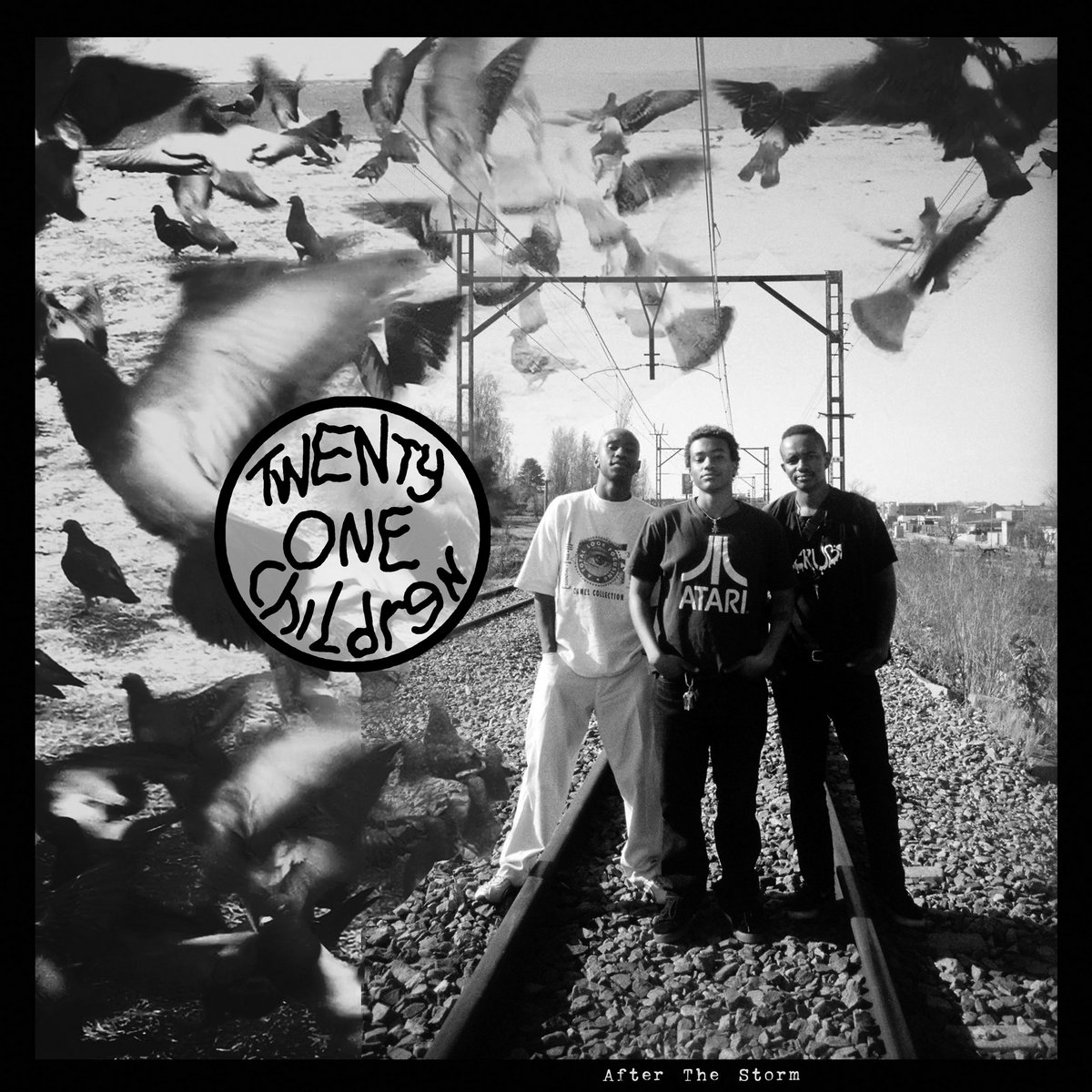
Punk has always thrived on dissatisfaction, but the most compelling practitioners understand that anger alone is rarely enough. The greatest records in the genre transform frustration into identity, resistance into culture, and noise into a language capable of expressing realities often ignored by the mainstream. Twenty One Children achieve precisely that on ‘After The Storm,’ a blistering eight-track statement that arrives with the force of a street-level uprising and the intelligence of a band fully aware of its place within a larger social landscape.
Emerging from Soweto, South Africa the trio of Thula, Abdula, and drummer Biko continue to carve out a sound that refuses easy categorization. The influence of classic skate punk and proto-hardcore is undeniable, yet ‘After The Storm’ never settles into imitation. Instead, the record channels local experience, community spirit, and cultural specificity into a volatile hybrid that belongs entirely to Twenty One Children. What makes the release so captivating is not merely its aggression but the conviction behind it. Every distorted riff, every shouted vocal, every thunderous drum pattern carries the weight of lived experience.
The brief opener, “Thulas Reborn Skit,” functions as more than an introduction. It establishes the album’s central preoccupation with transformation and survival. The title suggests renewal, but the atmosphere is far from peaceful. The skit feels like a transmission from a landscape already scarred by conflict, preparing the listener for what follows. That preparation proves necessary when “Life Thing” detonates from the speakers. Driven by Biko’s relentless drumming and propelled by a sense of barely controlled urgency, the track captures the exhausting unpredictability of modern existence. The song’s directness is one of its greatest strengths. Rather than intellectualizing struggle, Twenty One Children embody it through sound, creating a piece that feels immediate and unavoidable.
“Abdula Rebirth Skit” mirrors the opening interlude while deepening the album’s thematic framework. The notion of rebirth appears again, yet it is presented not as a spiritual awakening but as a necessity. In the world of ‘After The Storm,’ reinvention is not a luxury; it is a survival mechanism. That perspective feeds directly into “Fine Wine”, one of the album’s most engaging moments. Beneath its deceptively playful title lies a sharp understanding of resilience. The song balances humor and hostility with remarkable effectiveness, revealing a band capable of wielding irony without diluting its impact. The performance radiates confidence, with Thula and Abdula delivering vocals that sound both confrontational and celebratory.
The explosive brevity of “99” demonstrates Twenty One Children’s instinct for economy. Lasting less than two minutes, the track arrives, strikes, and disappears before its energy can diminish. Its compact structure recalls punk’s most effective short-form assaults, where intensity becomes a compositional principle rather than simply a stylistic choice. If any song encapsulates the album’s worldview, it may be “SCAB”. Ferocious and uncompromising, the track channels frustration into a focused attack on division, complacency, and exploitation. The interplay between vocals, percussion, and distortion creates a sense of collective momentum, as though the song itself is refusing to remain contained. Biko’s performance is particularly impressive here, anchoring the chaos while simultaneously amplifying it.
“Rain Dance” introduces a fascinating shift in mood without sacrificing the album’s momentum. The title evokes ritual, renewal, and the possibility of change, themes that resonate strongly within the broader context of the record. Yet Twenty One Children avoid sentimentality. The song’s power comes from its refusal to separate hope from struggle. Any promise of renewal must be fought for, and the music reflects that reality at every turn. The closing “Kasi Ghost Stories” is among the album’s most intriguing pieces. Drawing upon the mythology and memory embedded within township life, the track broadens the record’s scope beyond personal frustration and into communal experience. It serves as a reminder that the ghosts haunting this album are not supernatural entities but histories, inequalities, and unresolved social realities that continue to shape the present.
‘After The Storm’ distinguishes itself from many contemporary punk releases with its sense of purpose. The album never sounds content to merely express dissatisfaction. Instead, it channels that dissatisfaction into action, reflecting the ethos that has made Twenty One Children more than just a band. Their involvement in building skate parks, organizing benefit events, and cultivating alternative spaces within their community informs every second of this release. The music emerges from engagement rather than observation. The production complements that spirit perfectly. Distortion saturates the record without obscuring its personality. The rough edges are integral to the experience, preserving the immediacy that defines the band’s appeal. Rather than smoothing out imperfections, the recording embraces them, allowing the performances to retain their urgency and authenticity.
At just over eighteen minutes, ‘After The Storm’ leaves a remarkably strong impression. Many artists require an hour to communicate their intentions; Twenty One Children achieve it in a fraction of that time. The album captures the restless energy of a generation unwilling to accept inherited limitations, transforming local realities into music with universal resonance. What remains after the final notes fade is not simply the memory of volume or speed, but the impression of a band forging its own path with absolute conviction. ‘After The Storm’ is a declaration of identity, a celebration of resistance, and a vivid portrait of a group determined to reshape the world around them. Twenty One Children do not present themselves as observers of change. They sound like its architects.
Learn more here: Slovenly Recordings | Bandcamp